
Cardfornia vs Cryptopay Business: Which Fits Your Team?

Cardfornia vs Cryptopay Business: Which Fits Your Team?
Cardfornia and Cryptopay Business both let a company spend cryptocurrency, but they start from opposite ends of the problem. Cardfornia is a corporate virtual card platform built to spend stablecoins on operating costs. Cryptopay Business is a crypto payment gateway built to collect crypto from customers, with corporate cards as one module inside a wider merchant stack.
That difference decides most of the comparison. If your main pain is paying for ads, AI tools, SaaS and travel from a stablecoin treasury, the card platform is the closer fit. If your main pain is accepting crypto from buyers and settling to your bank account, the gateway is the closer fit. This article breaks down where each one is strong, where it is limited, and how to choose.
What each product actually is
First viewport screenshot of Free Bitcoin Wallet for Europe | Cryptopay.
Cardfornia in one paragraph
Cardfornia is a Singapore-based fintech platform providing crypto virtual cards for corporate businesses and startups. A company funds a single account with stablecoins such as USDT and USDC, then issues multi-currency virtual cards to team members at scale. Spending is controlled in real time, and the platform is aimed at crypto-native companies and globally scaling businesses that want to bridge digital assets into everyday operating spend.
Typical use cases are paying for AI tool subscriptions such as ChatGPT, Claude and Midjourney, digital advertising on Meta Ads, Google Ads and TikTok Ads, SaaS and cloud services such as AWS, Azure and Figma, plus global travel and procurement. Cardfornia highlights high-limit cards for ad spend to reduce account ban risk, automatic multi-currency settlement for SaaS, and real-time currency exchange for cross-border transactions. Client funds are held 100% in segregated accounts with third-party licensed custodians and are never lent or invested. Security practices are guided by ISO/IEC 27001 standards, and payment, custody and card issuing run through licensed partners with regulatory approvals in jurisdictions including Hong Kong, the UK, the US and Canada.
Cryptopay Business in one paragraph
Cryptopay Business is a crypto payment gateway for merchants and enterprises. It lets a business accept, manage and send cryptocurrency payments while staying fully fiat-denominated, supporting more than 15 cryptocurrencies and 35 fiat currencies with automatic conversion and next-day bank settlement to remove volatility risk. Payment channels include payment links, a flexible API, an online crypto checkout and static addresses for recurring customer payments. It also offers mass payouts, corporate crypto cards with high spending limits, and a forthcoming white-label payment gateway.
Cryptopay positions itself as licensed and EU-compliant, with VASP registrations in Estonia and Luxembourg, an MSB license in Canada, and adherence to AML/KYC and Travel Rule standards, plus preparations for MiCA. It reports no platform hacks and zero internal loss of funds, and emphasises customer retention tools, detailed reporting and automatic withdrawals to bank accounts. The service is exclusively for business clients, as retail services are being discontinued.
Head-to-head comparison

First viewport screenshot of Cryptopay – Krypto-Zahlungen leicht gemacht für Unternehmen und darüber hinaus.
| Dimension | Cardfornia | Cryptopay Business |
|---|---|---|
| Primary job | Corporate virtual cards funded by stablecoins | Crypto payment gateway for merchants |
| Core user | Crypto-native companies and startups spending treasury | Businesses collecting crypto from customers |
| Funding model | Single account funded with USDT or USDC | Customer payments converted automatically |
| Card scope | Multi-currency virtual cards issued to teams at scale | Corporate crypto cards with high spending limits |
| Settlement | Real-time currency exchange for cross-border spend | Next-day bank settlement in fiat |
| Currency coverage | Multi-currency card settlement for SaaS and travel | 15+ cryptocurrencies, 35 fiat currencies |
| Controls | Real-time control over operating expenses | Dashboard tracking, alerts, reporting |
| Custody stance | Funds in segregated accounts with third-party licensed custodians | Platform-managed balances with automatic bank withdrawals |
| Regulatory framing | Licensed partners in Hong Kong, UK, US and Canada; ISO/IEC 27001-guided security | VASP in Estonia and Luxembourg, MSB in Canada, AML/KYC and Travel Rule, MiCA preparations |
| Best-fit spend | AI subscriptions, ad platforms, SaaS, cloud, travel | Customer checkout, invoicing, mass payouts |
Where Cardfornia is stronger for spend-side teams
Stablecoin funding is the default, not an add-on
Cardfornia is designed around a stablecoin balance. You fund one account with USDT or USDC and issue cards from it. There is no requirement to first convert customer revenue into fiat before the money becomes usable for operating costs. For a treasury that already holds stablecoins, that removes a conversion step and the fee and timing friction that comes with it. If you want background on why dollar-pegged tokens behave the way they do, see USDC crypto explained.
Card issuance is built for teams, not for a single cardholder
Cryptopay offers corporate crypto cards with high spending limits, which is useful, but the card is one feature in a gateway product. Cardfornia's model is issuing multi-currency virtual cards to teams at scale, with real-time control over operating expenses. That matters when marketing, engineering and operations each need their own card and their own limits.
Ad spend and subscription spend are treated as first-class problems
Paying Meta Ads, Google Ads or TikTok Ads from a crypto-funded card is a specific operational headache: platforms are sensitive to payment behaviour, and a declined or mismatched card can put an ad account at risk. Cardfornia explicitly positions high-limit cards for ad spend to reduce account ban risk, and automatic multi-currency settlement for SaaS. Cryptopay's public positioning is about accepting payments and settling to bank, not about protecting ad accounts.
Cross-border spend is handled at the transaction level
Cardfornia offers real-time currency exchange for cross-border transactions, which suits companies paying vendors in several currencies from one stablecoin balance. Cryptopay's currency strength sits on the collection side, where it converts incoming crypto into one of 35 fiat currencies and settles next day.
Custody and transparency are stated up front
Cardfornia states that client funds are held 100% in segregated accounts with third-party licensed custodians and are never lent or invested, with security practices guided by ISO/IEC 27001 and regulated activity performed through licensed partners. That is a clear, checkable claim for finance teams that need to explain where company money sits.
Where Cryptopay Business is stronger
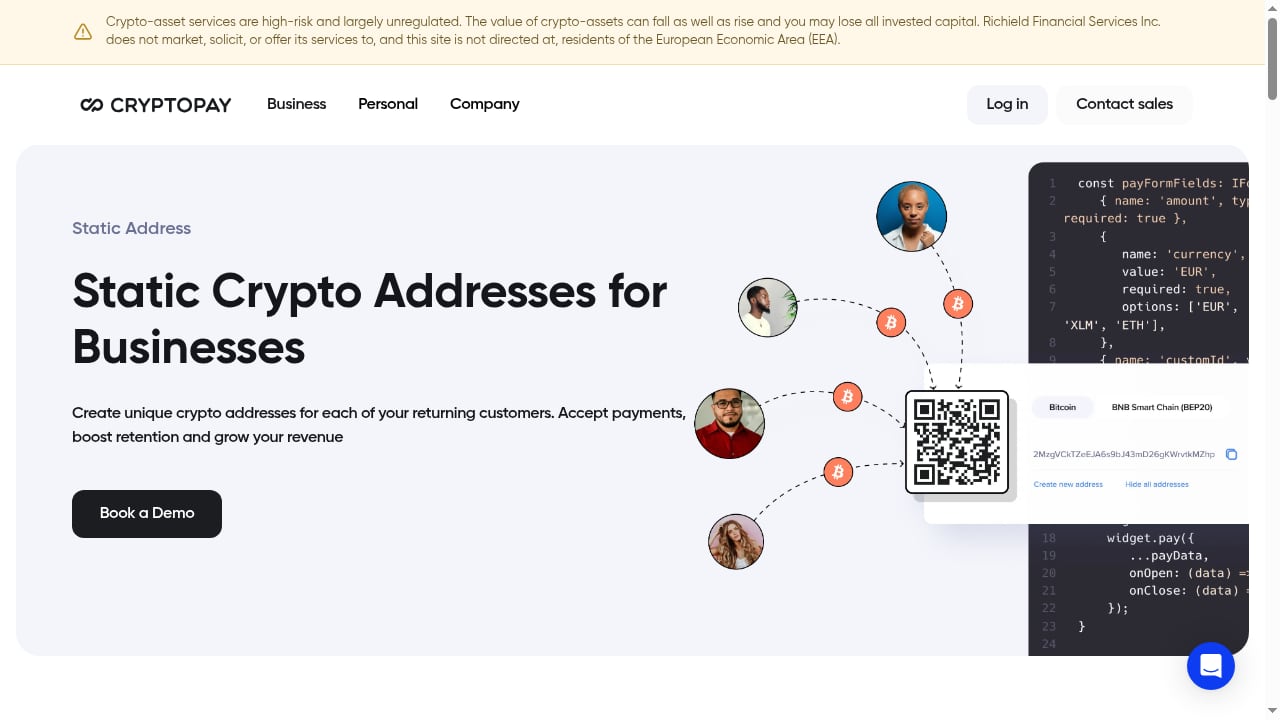
First viewport screenshot of Channels – Receive Crypto from Your Recurring Customers Easily with Cryptopay.
It solves revenue collection, which Cardfornia does not
Cryptopay's core product is a payment gateway. Payment links, a flexible API, an online crypto checkout and static addresses cover the main ways a merchant gets paid in crypto. Cardfornia does not position itself as a merchant acquirer, so if your requirement is taking crypto from customers at checkout, Cryptopay is addressing a need Cardfornia is not built for. The API example below shows how directly an invoice can be created:
params = Cryptopay::InvoiceParams.new(
  price_amount: '100.0',
  price_currency: 'EUR',
  pay_currency: 'BTC'
)

result = client.invoices.create(params)
Fiat denomination removes volatility from the merchant side
Automatic conversion plus next-day bank settlement means a merchant can price in fiat and never hold crypto exposure. That is a genuinely different risk posture from holding a stablecoin balance and spending from it.
Mass payouts are a distinct capability
Paying contributors, contractors or affiliates in crypto from a fiat wallet is a payout workflow. Cardfornia's stated focus is card issuance and expense control, not outbound mass payouts.
Track record and licensing footprint are well documented
Cryptopay cites 12+ years in market, zero platform hacks, zero internal loss of funds, 8M+ yearly processed transactions and $3B+ annual transaction volume, with VASP registrations in Estonia and Luxembourg, an MSB license in Canada, AML/KYC and Travel Rule adherence, and MiCA preparations. For a merchant choosing a processor, that history is relevant evidence.
The card comparison is narrower than it looks
Both products mention corporate cards, so it is tempting to treat them as direct substitutes. The distinction is what the card is for:
- Cardfornia: the card is the product. Stablecoin in, controlled multi-currency virtual cards out, aimed at operating expenses such as AI tools, ads, SaaS and travel.
- Cryptopay Business: the card is a companion to the gateway. It sits alongside accepting payments, mass payouts and bank settlement, and is described with high spending limits rather than team-scale issuance.
If you only need one card for occasional business spend and you already process payments through Cryptopay, using its card keeps everything in one dashboard. If you need many cards, per-team limits and a stablecoin-funded spend rail, Cardfornia is built around that job.
Practical scenarios
A Web3 startup paying for growth. The team holds USDC, runs paid campaigns on Meta and Google, and pays for ChatGPT, Claude, Figma and AWS. Cardfornia fits: one stablecoin-funded account, cards per channel, high limits for ad platforms, multi-currency settlement for SaaS.
A SaaS company selling to crypto users. Buyers want to pay in BTC, ETH or USDC, but the finance team wants euros in the bank. Cryptopay Business fits: checkout and API, automatic conversion, next-day settlement.
A company that does both. A crypto-native business selling a product and buying tools may need a gateway for inbound payments and a card platform for outbound spend. Running both is a legitimate setup, and it is worth comparing the wider field before committing — see Cardfornia vs Cryptopay Business vs Wirex and Cardfornia vs Reap vs Cryptopay Business.
A business that wants self-custody. Neither platform is a self-custody wallet. If holding your own keys is the priority, that is a different category, covered in Cardfornia vs Banqa.
How to decide

First viewport screenshot of Cryptopay Business | Accept and Send Crypto Payments as a Merchant.
- Name the primary job. Collecting money from customers points to Cryptopay Business. Spending stablecoins on operations points to Cardfornia.
- Count the cards you need. One or two cards can live inside a gateway. Dozens of cards with per-team limits need a card platform.
- Check the funding source. If your treasury is USDT or USDC, stablecoin-native funding avoids a conversion step.
- Check the settlement currency. Merchants usually want fiat in the bank. Spend-side teams usually want multi-currency card settlement.
- Verify custody and licensing claims. Both publish regulatory framing; confirm the entity, the custodian and the licence that applies to your jurisdiction before onboarding.
- Test the edge cases. Ad platform payments, subscription renewals and cross-border vendor payments are where card programmes break. Run a small live test before scaling.
Related reading
- Cardfornia Features Explained: Crypto Corporate Cards in 2026 - A practical look at Cardfornia features: stablecoin funding, multi-currency virtual cards, team spend controls, AI and ad-spend use cases, and security.
Sources and further reading
- Cardfornia | Corporate Crypto Payment Cards - Secure, stable and efficient crypto virtual cards built for corporate businesses and startups. Pay for digital ads, AI tools, SaaS subscriptions and travel with stablecoins.
- Cryptopay Business | Accept and Send Crypto Payments as a Merchant - Enjoy the benefits of Bitcoin and crypto payments while staying 100% fiat. Reach new customers, increase your revenue and save on fees
- CardFornia Blog - USDC crypto explained: how the dollar-pegged stablecoin works, its reserves, real business use cases, risks, and how companies spend USDC in 2026.
FAQ
Is Cardfornia a payment gateway?
No. Cardfornia is a corporate virtual card platform. It is built for spending stablecoins on business expenses, not for accepting crypto payments from customers.
Can Cryptopay Business issue cards to a whole team?
Cryptopay Business offers corporate crypto cards with high spending limits. Its public positioning centres on the gateway, payouts and settlement, so team-scale card issuance with per-member controls is not the headline capability.
Which one is better for paying Meta Ads or Google Ads?
Cardfornia explicitly targets ad spend with high-limit cards intended to reduce account ban risk. Cryptopay's stated focus is accepting and settling payments, so ad platform reliability is not a documented strength of its card offering.
Do I need to convert crypto to fiat before spending?
With Cardfornia, you fund with USDT or USDC and spend from that balance, with real-time currency exchange for cross-border transactions. With Cryptopay Business, incoming crypto is converted automatically and settled to your bank account next day.
Where are client funds held?
Cardfornia states that client funds are held 100% in segregated accounts with third-party licensed custodians and are never lent or invested. Cryptopay Business describes platform-managed balances with automatic withdrawals to bank accounts and reports zero internal loss of funds.
Can a business use both platforms?
Yes. A company that sells to crypto customers and also pays crypto-denominated operating costs can use a gateway for inbound payments and a card platform for outbound spend.
Conclusion
Cardfornia and Cryptopay Business are not really competing for the same budget line. Cryptopay Business is a mature crypto payment gateway with a long track record, broad currency coverage and a card feature attached. Cardfornia is a corporate virtual card platform where stablecoin funding, team-scale card issuance, ad-spend reliability and multi-currency settlement are the product itself.
Choose Cryptopay Business when the problem is getting paid in crypto and landing fiat in the bank. Choose Cardfornia when the problem is spending a stablecoin treasury across ads, AI tools, SaaS, cloud and travel with real-time control and segregated custody. If you need both directions, run both — and evaluate the card side on issuance scale, limits and custody transparency rather than on gateway features you will not use.