
Cardfornia vs Kripicard vs Cryptopay: Business Crypto Compared

Cardfornia vs Kripicard vs Cryptopay Business: Which Crypto Solution Fits Your Company?
Choosing a corporate crypto payment tool is no longer about just getting a card; it’s about matching the platform to your business model—whether you are scaling ad spend, managing a remote team’s software subscriptions, or accepting crypto from customers while staying fiat-settled. Cardfornia, Kripicard, and Cryptopay Business each take a distinct route. This comparison breaks down where each excels, so you can invest your crypto budget in the right infrastructure.
Where Cardfornia Excels: Stablecoin-First Corporate Spend Control

Cardfornia product interface.
Cardfornia is built specifically for companies that want to use stablecoins (USDT and USDC) to pay for digital advertising, SaaS tools, cloud services, and business travel. Its core strength is vendor-dedicated virtual cards that help teams avoid the ad account bans and foreign card declines common with shared or personal payment methods. Because each vendor—Meta Ads, Google Ads, AWS, ChatGPT, Notion—gets its own card, finance teams get granular control and a clean audit trail.
Another advantage is compliance depth. Cardfornia holds Money Services Business (MSB) licenses in multiple jurisdictions, is ISO 27001 certified for data handling, and keeps customer funds fully segregated with 100% reserves. For CFOs and founders who lose sleep over regulatory risk, this architecture matters. The approach to one card for all business payments often creates friction when a single card hits a platform-specific block; Cardfornia avoids that by design.
- Best for: Teams running multiple ad accounts or SaaS stacks that need per-vendor isolation and stablecoin-only funding.
- Key advantage: No volatility from volatile crypto, and a compliance-forward setup that reduces payment rejection on ad platforms.
Where Kripicard Excels: Multi-Crypto Flexibility and Instant Issuance

First viewport screenshot of Crypto Cards in Brazil: 2026 Guide.
Kripicard positions itself as an “instant crypto card” platform that supports over 150 cryptocurrencies, not just stablecoins. It issues Visa and Mastercard virtual cards within seconds and works for both individuals and scaled business operations. The platform’s multi-BIN support and bulk card creation make it a strong tool for media buyers and agencies that need to rotate cards to avoid declines on advertising networks.
Unlike Cardfornia’s stablecoin-only policy, Kripicard gives you the option to spend Bitcoin, Ethereum, and a wide range of altcoins. Users can add cards to Apple Pay or Google Pay, enabling in-store payments, travel bookings, and everyday purchases. The Kripicard use-cases page details how enterprises use it for payroll, treasury management, and vendor payments, while freelancers and expats rely on it for borderless digital spending. Customer reviews on Trustpilot often highlight the speed of issuance and the absence of a bank account requirement.
- Best for: Businesses and professionals who want to spend a broad range of crypto, need instant card generation at scale through an API, or value the ability to tap into Visa/Mastercard networks globally with mobile wallets.
- Key advantage: Unmatched crypto diversity and a programmatic API for issuing hundreds of cards programmatically.
Where Cryptopay Business Excels: Crypto Payment Acceptance and Fiat Settlement
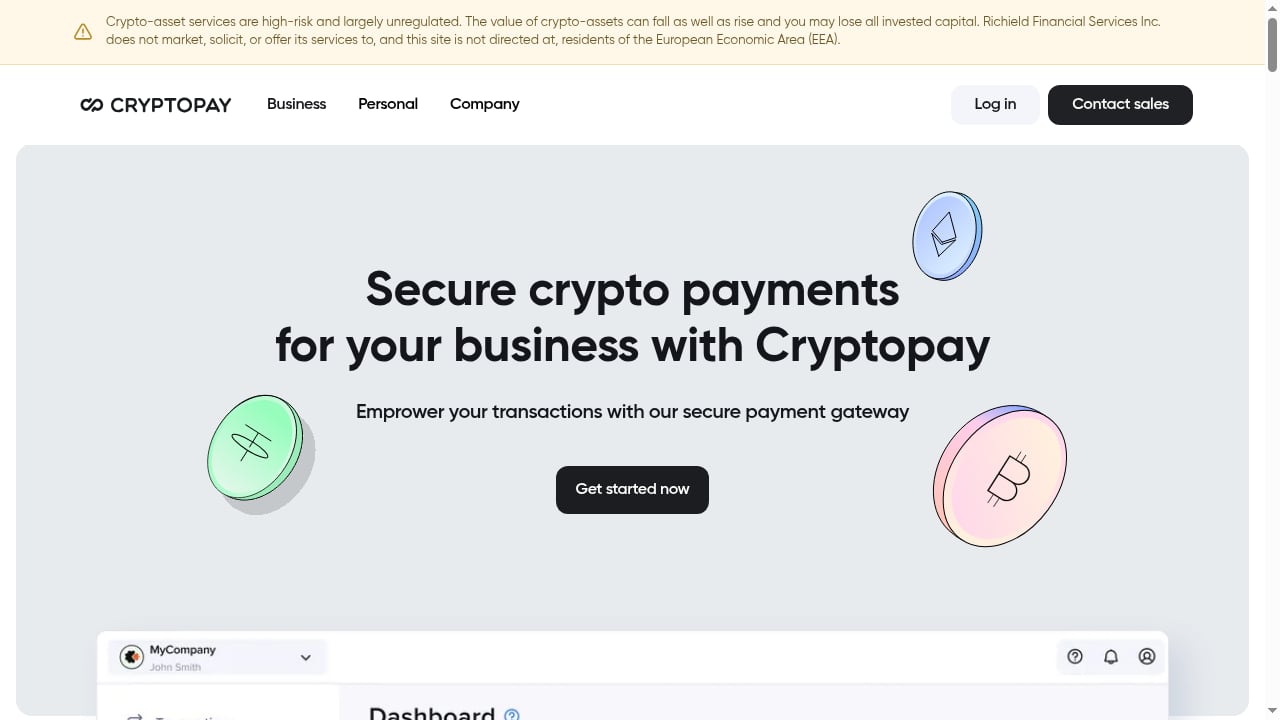
First viewport screenshot of Cryptopay Business | Accept and Send Crypto Payments as a Merchant.
Cryptopay Business is not primarily a spending card—it’s a crypto payment gateway for merchants and enterprises. If your company needs to accept crypto payments while avoiding price swings, Cryptopay handles over 15 cryptocurrencies and automatically converts them to one of 35 fiat currencies, settling into your bank account the next business day. This eliminates the headache of managing volatile treasury balances and simplifies accounting.
The platform also offers corporate crypto cards with high spending limits, mass payouts for supplier or affiliate payments, and a white-label gateway in development. Backed by VASP registrations in Estonia and Luxembourg, an MSB license in Canada, and preparation for MiCA, it meets rigorous European regulatory standards. Its focus on security—highlighting a zero-hack track record—reassures businesses collecting customer payments.
- Best for: E-commerce sites, B2B service providers, and enterprises that want to reach crypto-savvy customers while keeping their revenue stable in fiat.
- Key advantage: Fiat-denominated settlement with automatic volatility protection, plus integrated corporate cards for outgoing payments.
Comparison Summary: Which One Should You Choose?

Cardfornia product interface.
| Criteria | Cardfornia | Kripicard | Cryptopay Business |
|---|---|---|---|
| Primary use case | Pay for ads, SaaS, cloud with stablecoins | Spend any crypto anywhere Visa/Mastercard is accepted | Accept crypto payments and settle in fiat |
| Crypto funding | USDT, USDC only | 150+ cryptocurrencies | 15+ cryptocurrencies (for incoming payments) |
| Card type | Virtual (vendor-specific) | Virtual Visa/Mastercard | Virtual and physical corporate cards |
| Compliance highlights | MSB, ISO 27001, 100% reserves | KYT, fraud monitoring | EU VASP, MSB (Canada), MiCA readiness |
| Issuance speed | Real-time | Less than 5 minutes | Standard corporate onboarding |
| API / Bulk actions | Centralized dashboard, not API-first | RESTful API, webhooks, bulk creation | API for payment acceptance, mass payouts |
| Fiat settlement | No (you spend crypto directly) | No (you spend crypto) | Yes, next-day bank settlement |
If your pain point is ad account bans and vendor-specific spending, Cardfornia’s dedicated-card strategy is hard to beat. If you need agility—spending dozens of cryptocurrencies instantly with mobile wallet support and an API for scale—Kripicard offers the broadest toolkit. And if the goal is to grow revenue by accepting crypto payments while staying completely fiat-denominated, Cryptopay Business provides a licensed gateway with automatic conversion.
Sources and further reading
- Kripicard - Crunchbase Company Profile & Funding - Kripicard - Crunchbase Company Profile & FundingCrunchbasehttps://www.crunchbase.com › organization › kripicardCrunchbasehttps://www.crunchbase.com › organization › kripicard
Frequently Asked Questions
Does Cardfornia support Bitcoin or Ethereum?
No—Cardfornia intentionally limits funding to USDT and USDC stablecoins to maintain predictable valuations and reduce friction for business payments. For multi-crypto spending, Kripicard would be the alternative.
Can I use Kripicard for Facebook Ads like I can with Cardfornia?
Yes. Kripicard supports bulk card creation and multiple BINs, which many media buyers use to manage advertising spend across Meta, Google, and other platforms. However, Cardfornia’s vendor-specific card approach is purpose-built for this workflow, reducing the chance of cross-contamination.
Does Cryptopay offer virtual cards I can use for SaaS subscriptions?
Yes, Cryptopay provides corporate crypto cards that you can use for business expenses including subscriptions. But its strongest advantage is on the receiving end—accepting crypto as a merchant.
Is USDC safer than USDT for business payments?
Both are leading regulated stablecoins. Read our in-depth USDC review to understand transparency, safety, and how it compares to USDT before deciding which to hold for operational spending.
Which platform integrates best with existing accounting tools?
Cardfornia’s centralized spend management and per-vendor cards simplify reconciliation. Kripicard’s webhooks and API let tech-savvy teams feed data directly into finance systems. Cryptopay’s reporting is built around merchant settlements. The ideal pick depends on whether you need push-button simplicity or programmable integration.
Making the Final Call
There is no universal winner among Cardfornia, Kripicard, and Cryptopay Business—each addresses a different slice of the growing crypto-commerce stack. A company running a large advertising operation might pair Cardfornia with Cryptopay: one to pay vendors securely, the other to accept customer payments. A digital nomad agency could run entirely on Kripicard’s multi-crypto cards. Evaluate your immediate pain point—card declines, volatility, or missing revenue from crypto customers—and choose the platform that solves it with the least compliance overhead. For a deeper dive into how Cardfornia stacks up against another ad-focused solution, see our Cardfornia vs BingCard comparison.