
Cardfornia vs Request Finance vs Sparados: 2026 Comparison
Cardfornia vs Request Finance vs Sparados: Which Fits Your Business in 2026?
Crypto-native companies increasingly hold their treasury in stablecoins but still need to pay for everyday business expenses in fiat. Cardfornia, Request Finance, and Sparados each approach that problem from a different angle: Cardfornia issues stablecoin-funded virtual corporate cards, Request Finance focuses on stablecoin-powered business spend management and payouts, and Sparados delivers European virtual cards with automated expense workflows. This comparison breaks down where each platform is genuinely strong so you can match one to your operating model.
Quick Comparison at a Glance
Cardfornia vs Request Finance vs Sparados: 2026 Comparison - Request Finance: Stablecoin-Powered Spend Management and Payouts.
| Criterion | Cardfornia | Request Finance | Sparados |
|---|---|---|---|
| Primary model | Crypto corporate virtual cards funded with stablecoins | Stablecoin-powered spend management and payments platform | Corporate expense management with virtual cards |
| Funding currencies | USDT, USDC | Stablecoins plus fiat rails (ACH, SEPA, SWIFT) | EUR, USD, CHF |
| Card issuance | Multi-currency virtual cards issued to teams at scale | Corporate Cards listed as upcoming | Instant virtual cards with custom limits |
| Team controls | Real-time control over operating expenses | Budgets, spending limits, approvals per entity | Limits by amount, period, and merchant category |
| Best fit | Crypto-native firms and globally scaling startups | Companies paying vendors and contributors globally | European companies automating expense settlement |
Cardfornia: Stablecoin-Funded Corporate Cards for Crypto-Native Teams

Cardfornia vs Request Finance vs Sparados: 2026 Comparison - Sparados: European Virtual Cards with Automated Expense Workflows.
Cardfornia is a Singapore-based fintech platform built specifically for corporate businesses and startups that operate with digital assets. Organizations fund a single account with stablecoins such as USDT and USDC, then issue multi-currency virtual cards to teams at scale while keeping real-time control over operating expenses.
The platform's stated focus is stability, security, and transparency. Client funds are held 100% in segregated accounts with third-party licensed custodians and are never lent or invested. Security practices are guided by ISO/IEC 27001 standards, and payment, custody, and card-issuing activities run through licensed partners holding regulatory approvals across jurisdictions including Hong Kong, the UK, the US, and Canada.
Where Cardfornia has a supported advantage:
- Stablecoin funding as the default, not an add-on. Treasury held in USDT or USDC can be deployed directly into corporate card spending without a fiat conversion step.
- High-limit cards for advertising spend. Cardfornia emphasizes high-limit cards for ad spend to reduce account ban risks, which matters for teams running continuous campaigns on Meta Ads, Google Ads, and TikTok Ads.
- Automatic multi-currency settlement for SaaS. Recurring subscriptions such as AWS, Azure, and Figma can settle automatically across currencies.
- Real-time currency exchange for cross-border transactions. Useful for global travel and procurement where FX timing affects cost.
- Team-scale issuance. Multi-currency virtual cards can be issued across an organization while spend stays visible in one place.
Typical use cases include AI tool subscriptions like ChatGPT, Claude, and Midjourney, digital advertising, SaaS and cloud services, and global travel and procurement. For a deeper look at paying for AI tools with stablecoins, see how to subscribe to ChatGPT with stablecoins.
Request Finance: Stablecoin-Powered Spend Management and Payouts

Web3.
Request Finance is a business spend management and payments platform built on stablecoins. Its pitch is that companies can pay vendors, manage expenses, and handle global payouts with instant settlement and no crypto complexity for the recipient.
Its feature set is broad and oriented toward accounts payable rather than card issuance:
- Business Account per entity with its own budget, spending limits, and approvals.
- Accounts Payable with bill import, OCR, approval workflows, and payments via ACH, SEPA, SWIFT, stablecoins, and more.
- Accrual Accounting for automated reconciliation and month-end reporting.
- Integrations with accounting software such as Xero, QuickBooks, and SAP, banks such as Citibank, Chase, and DB, and tools like Metamask, Revolut, and Wise.
- Upcoming Corporate Cards and Yield Rewards, which are listed but not yet the core of the product.
Request Finance serves a wide range of industries, including SaaS, e-commerce, healthcare, wholesalers, marketing agencies, crypto and Web3, online travel agencies, and gaming and betting. Documented use cases span affiliate payments, recurring payments, import/export, content creator payouts, marketplace payments, global supplier payments, commission distributions, and invoice automation. Published case studies with RealT (tokenized real estate) and Polemos (Web3 gaming) describe streamlining fiat and crypto payments, reducing reconciliation time, and scaling operations.
Pricing starts at $250 per month billed annually for small teams, with volume-based transaction fees that decrease as usage grows, and a 30-day free trial.
Where Request Finance is strong: companies whose main pain is paying many counterparties across borders, and finance teams that need approval workflows and accounting reconciliation tied to those payments. If your bottleneck is outbound payments and reporting rather than card-based spending, Request Finance addresses that directly.
Sparados: European Virtual Cards with Automated Expense Workflows
First viewport screenshot of Karty firmowe.
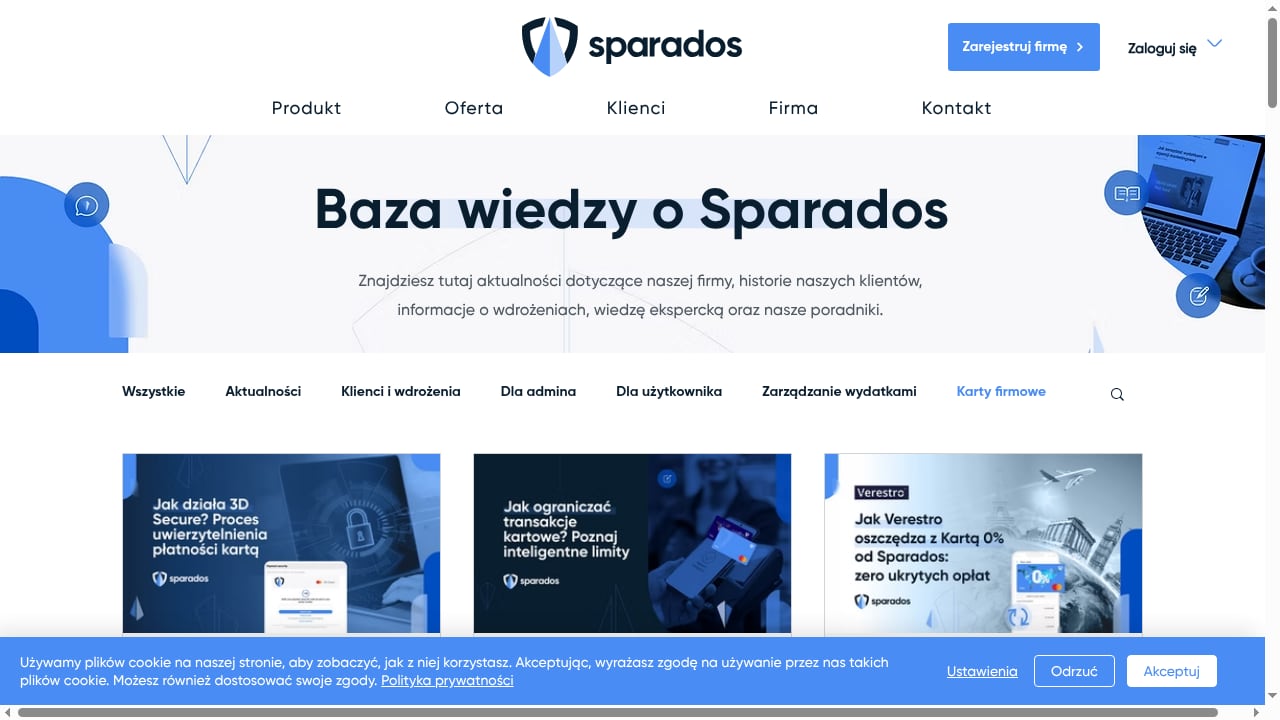
Sparados is a corporate expense management platform that provides virtual corporate cards and automated financial workflows. Companies can issue virtual cards instantly with custom limits and transaction controls, and pay in EUR, USD, and CHF.
Its strengths cluster around expense operations and European compliance:
- Speed of issuance. Sparados markets card issuance in seconds, with cards immediately available in Apple Wallet or Google Wallet.
- Granular controls. Limits can be set by amount, period, and merchant category, with real-time transaction monitoring.
- Automated document handling. OCR combined with LLM models processes invoices and receipts whether emailed or scanned, then routes them toward accounting.
- Accounting and ERP integrations. Connections to systems such as Saldeo, Comarch Optima, inFakt, and Insert, plus an API for real-time ERP or in-house integration.
- Branding. Customizable card branding with company logos, plus a card collection portal, app domain, and email communications that can match corporate identity.
- Currency handling. Sparados advertises 0% CardPay in any currency with conversion at the Mastercard exchange rate and no bank commissions.
- Employee benefits. Digital lunch cards, including tax-advantaged vouchers in Poland.
Sparados states it is neither a payment service provider nor a payment institution; payment services are rendered by authorized payment service providers operating within Europe under regulatory supervision. Pricing includes free virtual cards for the first five users, then €1 per user per month, with no hidden charges for integrations or top-up fees.
Where Sparados is strong: European companies, especially those with 10+ employees in transport, travel, relocation, insurance, security, development, and sales, where receipts, invoices, and reimbursements create administrative load. Its combination of branded cards, OCR-driven invoice processing, and local accounting integrations is a genuine operational advantage for that profile.
Where Cardfornia, Request Finance, and Sparados Diverge Most
Stablecoin funding versus fiat-first funding
Cardfornia and Request Finance both treat stablecoins as a first-class funding method. Cardfornia's model is built around funding a single account with USDT or USDC and issuing cards against it. Request Finance extends stablecoins into payouts and accounts payable alongside traditional rails. Sparados is fiat-first, supporting EUR, USD, and CHF, and does not position stablecoins as a funding path. If your treasury is already on-chain, Cardfornia and Request Finance remove a conversion step that Sparados does not address.
Card issuance versus payment orchestration
Cardfornia and Sparados both issue virtual cards to teams. Request Finance's core is payment orchestration and spend management, with Corporate Cards listed as upcoming. If you need cards in employees' hands now, Cardfornia and Sparados are the more direct fits; if you need to pay hundreds of vendors and contributors with approvals and reconciliation, Request Finance is the more direct fit.
Advertising and subscription spend
Cardfornia's emphasis on high-limit cards for ad spend and automatic multi-currency settlement for SaaS subscriptions maps closely to companies running paid acquisition and stacked software stacks. Sparados covers subscription tracking and merchant category controls well, but its positioning centers on European expense workflows rather than ad-platform spend at scale. Request Finance handles recurring payments and invoice automation, which can cover subscriptions administratively, though the card layer is not yet its core.
Regulatory and custody posture
Cardfornia states that client funds are held 100% in segregated accounts with third-party licensed custodians and never lent or invested, with activities performed through licensed partners across Hong Kong, the UK, the US, and Canada. Sparados routes regulated payment services through authorized European payment service providers and partners with Mastercard. Request Finance operates as a spend management platform with banking and accounting integrations. Each model implies different counterparty and jurisdictional considerations, so confirm current licensing and custody arrangements directly before committing treasury.
How to Choose
- Choose Cardfornia if your company holds USDT or USDC and wants to convert treasury directly into team card spending, especially if you need high-limit cards for advertising, automatic multi-currency SaaS settlement, and real-time FX for cross-border purchases.
- Choose Request Finance if your priority is paying vendors, affiliates, creators, and contributors globally with approval workflows, accrual accounting, and reconciliation across fiat and stablecoin rails.
- Choose Sparados if you are a European company that wants branded virtual cards, merchant-category controls, OCR invoice processing, and tight integration with local accounting and ERP systems.
Some teams will combine approaches: stablecoin-funded cards for operational spend, and a payments platform for supplier and contributor payouts. If you want to see how Cardfornia stacks up against other card providers, the Cardfornia vs Reap vs Sparados comparison and the Cardfornia vs Request Finance vs Banxe comparison cover adjacent options in more detail. For background on how these cards work under the hood, the B2B crypto card guide explains stablecoin funding, custody, and control models.
Related reading
- Cardfornia vs Reap vs OneSafe: 2026 Crypto Card Comparison - Compare Cardfornia, Reap, and OneSafe on stablecoin funding, corporate cards, team controls, and global payments for crypto businesses in 2026.
Sources and further reading
- Sparados | Expense Management | Corporate Cards - Efficiently manage business expenses on the Sparados platform. Issue virtual cards to your employees and track their expenses in real time!
- Top Request Finance Alternatives & Competitors 2026 | SoftwareWorld - Explore the best Request Finance alternatives and competitors in 2026. Compare features, pricing, and reviews of similar software to find the right solution for your needs.
FAQ
Is Cardfornia a replacement for Request Finance?
Not exactly. Cardfornia focuses on issuing stablecoin-funded virtual corporate cards for team spending, while Request Finance focuses on business spend management, accounts payable, and global payouts. Companies that need both card spending and vendor payouts may use them for different purposes.
Does Sparados support stablecoin funding?
Sparados supports payments in EUR, USD, and CHF and does not position stablecoins as a funding method. Businesses whose treasury is held in USDT or USDC would typically look at Cardfornia or Request Finance instead.
Which platform is better for high-volume advertising spend?
Cardfornia specifically emphasizes high-limit cards for ad spend to reduce account ban risks, which is relevant for teams running continuous campaigns on Meta Ads, Google Ads, and TikTok Ads. Sparados and Request Finance are not positioned around that specific use case.
How does pricing compare?
Request Finance starts at $250 per month billed annually for small teams with volume-based transaction fees and a 30-day free trial. Sparados offers free virtual cards for the first five users, then €1 per user per month. Cardfornia's pricing is not published in the same format, so confirm current terms directly with the provider.
Are these platforms regulated?
Each routes regulated activity through licensed partners. Cardfornia states that payment, custody, and card-issuing activities are performed through licensed partners with approvals across Hong Kong, the UK, the US, and Canada, and that client funds sit in segregated accounts with third-party custodians. Sparados states it is not itself a payment service provider or payment institution and that payment services are rendered by authorized European providers under supervision. Always verify current licensing before moving company funds.
Conclusion
Cardfornia, Request Finance, and Sparados solve adjacent but distinct problems. Cardfornia is the strongest fit when your treasury lives in stablecoins and you want that value to flow directly into team card spending, particularly for advertising, SaaS, and cross-border purchases. Request Finance is the stronger choice when outbound payments, approvals, and accounting reconciliation are the bottleneck. Sparados is the stronger choice for European companies that want branded virtual cards and automated expense settlement tied into local accounting systems. Match the platform to your actual constraint, not to the longest feature list.