
Cardfornia vs Sparados: Crypto Cards vs Expense Tools
Cardfornia vs Sparados: Crypto Cards vs Expense Management
Cardfornia and Sparados both issue virtual corporate cards, but they solve different problems. Cardfornia is built for companies that hold and spend stablecoins, with multi-currency cards, high limits for ad spend, and funds held in segregated accounts with licensed custodians. Sparados is a European expense management platform that issues branded virtual cards in EUR, USD, and CHF and automates receipt capture, invoicing, and accounting sync.
This comparison breaks down funding, currencies, controls, security, and pricing so you can decide which model fits your business.
Quick comparison
First viewport screenshot of Benefity pracownicze.
| Dimension | Cardfornia | Sparados |
|---|---|---|
| Primary model | Crypto corporate virtual cards funded with stablecoins | Corporate expense management with virtual cards |
| Funding | Single account funded with USDT, USDC, and other stablecoins | Fiat funding; payments in EUR, USD, CHF |
| Card issuance | Multi-currency virtual cards issued to teams at scale | Virtual cards issued in seconds with custom limits |
| Spend controls | Real-time control over operating expenses | Limits by amount, period, and merchant category |
| Currency handling | Automatic multi-currency settlement and real-time FX | 0% CardPay conversion at the Mastercard exchange rate |
| Expense workflow | Built around crypto-native operations | OCR and LLM invoice processing, ERP and accounting integrations |
| Custody | Client funds 100% in segregated accounts with third-party licensed custodians, never lent or invested | Regulated operations handled by partner financial institutions; tokenized payments |
| Best fit | Crypto-native companies and globally scaling businesses | European companies with 10+ employees managing fiat expenses |
What Cardfornia does well
Cardfornia is a Singapore-based fintech platform founded in 2026 that provides crypto virtual cards designed specifically for corporate businesses and startups. Its core strength is bridging digital assets and everyday business spending without forcing a conversion to fiat first.
Stablecoin funding in one account
Organizations fund a single account with stablecoins such as USDT and USDC, then issue multi-currency virtual cards to teams at scale. That removes the recurring friction of moving money between a crypto treasury and a bank account before every purchase.
High-limit cards for ad spend
Cardfornia emphasizes high-limit cards for advertising, which matters for teams running Meta Ads, Google Ads, and TikTok Ads. Ad platforms frequently decline or ban cards that fail verification or hit limits mid-campaign, so a card designed for sustained ad spend reduces account disruption risk.
Automatic settlement for SaaS and subscriptions
Paying for AI tool subscriptions such as ChatGPT, Claude, and Midjourney, or cloud and design services like AWS, Azure, and Figma, is a recurring operational need for modern companies. Cardfornia handles automatic multi-currency settlement for SaaS, so subscriptions renew without manual intervention.
Real-time exchange for cross-border spending
For global travel and procurement, Cardfornia offers real-time currency exchange, keeping cross-border transactions predictable rather than dependent on batch conversion.
Security and fund transparency
Client funds are held 100% in segregated accounts with third-party licensed custodians and are never lent or invested. Security practices are guided by ISO/IEC 27001 standards, and payment, custody, and card-issuing activities run through licensed partners with regulatory approvals across jurisdictions including Hong Kong, the UK, the US, and Canada. The founding team brings expertise from a well-known crypto card background, and the company operates with a stated commitment to channel stability and fund transparency.
Where Sparados fits
First viewport screenshot of Baza wiedzy | Poradniki, case study, aktualności | Blog Sparados.
Sparados is a corporate expense management platform that provides virtual corporate cards and automated financial workflows. It is a strong option for European finance teams that want to digitize expense reporting rather than spend stablecoins.
Speed and card controls
Sparados issues virtual cards in seconds with custom limits and transaction controls, and supports payments in EUR, USD, and CHF. Cards can be branded with the company logo, and the platform offers a card collection portal with company colors.
Expense automation
Sparados centralizes expense tracking, receipt capture, and invoice management. It integrates OCR with LLM models to process invoices and receipts sent by email or scanned, then syncs with accounting systems such as Saldeo, Comarch Optima, inFakt, and Insert. It also provides an API for ERP or in-house integrations.
Employee benefits and pricing
Sparados offers lunch cards as an employee benefit, with tax advantages in Poland, and pricing that includes free virtual cards with per-user fees beyond five users (€1 per user per month).
Important limitations to weigh
Sparados states plainly that it is neither a payment service provider nor a payment institution. Payment services, including account management, card issuance, and transaction execution, are rendered by authorized payment service providers operating within Europe under regulatory supervision. That is a normal partner model, but it means the regulated relationship sits with the partner, not Sparados itself.
Sparados also does not support stablecoin funding. If your treasury is held in USDT or USDC, you cannot fund Sparados cards directly with those assets. Its currency coverage is EUR, USD, and CHF, which is narrower than what globally scaling crypto-native businesses often need. And its positioning is explicitly European, with benefits such as Polish lunch cards that do not apply to most international teams.
Funding and currency: the decisive difference
The clearest split is where your money lives before it is spent.
- If your operating capital is in stablecoins, Cardfornia lets you deploy it directly. You fund one account, issue cards, and spend without a conversion step. Automatic multi-currency settlement and real-time exchange handle cross-border needs.
- If your operating capital is in a European bank account and your priority is closing the books faster, Sparados is the more natural fit. Its 0% CardPay conversion at the Mastercard exchange rate removes currency conversion costs, and its accounting integrations shorten month-end closing.
Neither approach is universally better. The question is whether your constraint is treasury friction or expense administration.
Controls and team management
Both platforms let you issue cards to individuals and teams with limits, but the emphasis differs.
Cardfornia focuses on real-time control over operating expenses for teams issuing cards at scale, with multi-currency cards and automatic settlement. Sparados focuses on rule granularity: spending limits by amount, period, and merchant category, plus real-time transaction monitoring and automatic report generation.
If your team spends heavily on digital advertising and SaaS across multiple currencies, Cardfornia's model is oriented toward that pattern. If your priority is enforcing merchant-category rules across a large European employee base, Sparados offers detailed rule-setting.
Security and custody
Cardfornia holds client funds 100% in segregated accounts with third-party licensed custodians, never lent or invested, with security practices guided by ISO/IEC 27001 standards and regulated activities performed through licensed partners in Hong Kong, the UK, the US, and Canada.
Sparados relies on tokenization and digitization so sensitive card data is never exposed, backs cards with Mastercard's security program including identity protection and fraud monitoring, and works with a licensed financial institution partner for regulated operations.
Both use partner-based regulated infrastructure. The difference is that Cardfornia's custody model is explicitly designed around stablecoin holdings and segregation, while Sparados's model is designed around European fiat payment services.
Pricing considerations
First viewport screenshot of Dla admina.
Sparados publishes simple pricing: free for the first five users, then €1 per user per month, with no hidden charges for integrations or top-up fees.
Cardfornia's pricing is not published in the same per-seat format in the available material, so evaluate it against your transaction volume, currency needs, and ad spend levels rather than assuming a like-for-like comparison. For teams spending heavily on advertising and SaaS, card reliability and limit headroom often matter more than a per-seat fee.
Which should you choose?
Choose Cardfornia if:
- Your treasury is held in stablecoins such as USDT or USDC
- You need high-limit cards for Meta Ads, Google Ads, or TikTok Ads
- You pay for AI tools, cloud services, and SaaS subscriptions across currencies
- You want automatic multi-currency settlement and real-time FX
- You need funds held in segregated accounts with licensed custodians
Choose Sparados if:
- Your operations and banking are based in Europe
- Your primary goal is automating expense reporting, receipts, and invoicing
- You need tight merchant-category and period-based spending rules
- You want branded virtual cards and lunch cards as an employee benefit
- You prefer transparent per-user pricing at €1 per user per month after five users
If you are weighing a broader set of providers, see our comparison of Cardfornia vs Banxe vs Sparados for a wider view of corporate card options.
Practical examples
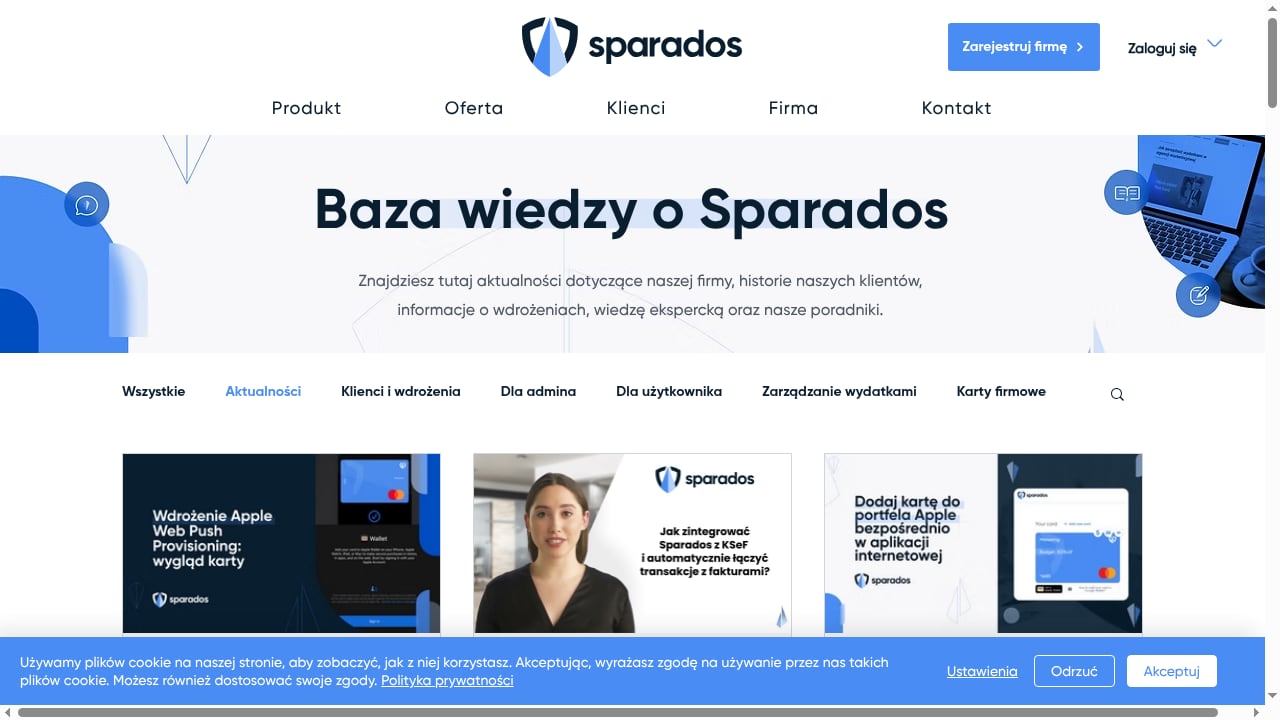
First viewport screenshot of Aktualności.
A crypto startup paying for AI tools. A team holds USDC from a token sale and pays for ChatGPT, Claude, and Midjourney subscriptions. With Cardfornia, the treasury funds one account and cards settle subscriptions automatically across currencies. With Sparados, the team would first need to convert stablecoins to EUR or USD in a bank account.
A European logistics company with 40 employees. Staff travel frequently and submit receipts in multiple currencies. Sparados issues branded cards in seconds, captures receipts by email or scan, and syncs invoices to the accounting system, reducing manual reconciliation.
A performance marketing agency running global ad campaigns. High ad volumes across Meta and Google require cards that do not fail mid-campaign. Cardfornia's emphasis on high-limit ad spend cards and real-time expense control addresses this directly.
Related reading
- Cardfornia vs Wirex vs BVNK: Best Crypto Card for Business? - Compare Cardfornia, Wirex, and BVNK for corporate crypto cards, stablecoin payments, and business spending in 2026. Find the right fit for your team.
- Cardfornia vs Wirex: Best Crypto Card for Business? - Cardfornia vs Wirex compared for 2026: corporate crypto cards vs a consumer wallet, fees, rewards, custody, and which fits your business spending.
- Stablecoin Savings in 2026: Yield, Risk, and Business Use - Stablecoin savings explained: how yield really works, the risks behind high APYs, regulation, and how businesses put idle stablecoins to work.
Sources and further reading
- Sparados | Expense Management | Corporate Cards - Efficiently manage business expenses on the Sparados platform. Issue virtual cards to your employees and track their expenses in real time!
FAQ
Is Cardfornia a replacement for Sparados?
Not exactly. Cardfornia replaces the funding and card layer for companies holding stablecoins. Sparados replaces the expense administration layer for European fiat-based companies. Some businesses may need both capabilities, but they are not direct substitutes for every use case.
Can I fund Sparados with USDT or USDC?
No. Based on the available material, Sparados supports payments in EUR, USD, and CHF and does not offer stablecoin funding. Cardfornia is designed specifically for stablecoin funding.
Does Cardfornia support EUR, USD, and CHF like Sparados?
Cardfornia offers multi-currency virtual cards with automatic multi-currency settlement and real-time currency exchange for cross-border transactions. For specific currency coverage, confirm details directly with Cardfornia.
Which platform is better for ad spend?
Cardfornia emphasizes high-limit cards for ad spend specifically to reduce account ban risks on platforms like Meta Ads, Google Ads, and TikTok Ads. Sparados focuses on expense controls and reporting rather than advertising-specific card limits.
Is my money safe with either platform?
Both use regulated partner infrastructure. Cardfornia holds client funds 100% in segregated accounts with third-party licensed custodians and never lends or invests them. Sparados relies on tokenization and Mastercard's security program, with regulated payment services provided by authorized European payment service providers.
Who regulates Sparados?
Sparados states it is not a payment service provider or payment institution. Payment services are rendered by authorized payment service providers operating within Europe, supervised by competent regulatory authorities.
Conclusion
Cardfornia and Sparados sit on opposite sides of the same problem. Cardfornia is a crypto corporate virtual card platform for businesses that hold stablecoins and need to spend them on advertising, SaaS, travel, and procurement without friction. Sparados is an expense management platform for European companies that want branded virtual cards and automated accounting workflows in fiat currencies.
If your capital is in USDT or USDC and your spending is global, Cardfornia's stablecoin funding, high-limit ad cards, and segregated custody model align with how you actually operate. If your capital is in a European bank account and your bottleneck is receipt chasing and month-end closing, Sparados is the more direct fit.
Before committing, map your funding source, currency needs, and biggest administrative pain point. That mapping will tell you which platform belongs in your stack. For a deeper grounding in how these cards work, read our guide to crypto virtual cards for business.