
ConnexPay Review 2026: Unified B2B Payments Platform
ConnexPay Review 2026: Unified B2B Payments Platform
ConnexPay positions itself as the world's first truly connected payments platform: customer sales (PayIns) and supplier payouts (PayOuts) run through one system, with incoming funds immediately available to fund outgoing supplier payments. For businesses that sit between buyers and suppliers — travel agencies, ad networks, insurance brokers, and marketplaces — that single flow can remove the traditional cash-flow gap and cut reconciliation work substantially.
This review breaks down how ConnexPay actually works, who benefits most, where it falls short, what pricing signals to expect, and how to decide whether it fits your operation.
What Is ConnexPay?
First viewport screenshot of Industries - ConnexPay.
ConnexPay is a B2B payments platform that combines payment acceptance with virtual card issuing in one connected flow. When a customer pays you, the authorized funds become immediately available to pay your supplier — no waiting for settlement, no separate prefunding account, no manual transfer between systems.
The company holds a patent on this connected payments approach and has focused heavily on industries where a business collects money from one party and pays another: leisure travel, business travel, advertising, insurance, and embedded payments for software platforms.
Core capabilities include:
- PayIns: credit card, mobile wallet, ACH, and alternative payment method acceptance, with BNPL listed as coming soon
- Self-funding: prefund in more than 30 currencies
- Integrated credit: a credit facility option for preserving operating cash
- PayOuts: virtual card issuing across 40+ products, plus ACH, bank-to-bank transfer, closed-loop payments, and physical cards
- Payment Valet: payee enablement and payment delivery services that manage supplier preferences and contact data
How the Connected Payments Model Works
First viewport screenshot of ConnexPay News | Payment Industry Updates | Company News.
The standard payment flow for a travel agency or marketplace looks like this:
- A customer books a trip or places an order and pays by card, wallet, or bank transfer.
- ConnexPay authorizes the incoming payment and makes those funds available in real time.
- The business immediately issues a virtual card to pay the supplier — hotel, airline, ad platform, or carrier.
- Reconciliation happens automatically because the incoming sale and outgoing supplier payment are linked in one system.
This removes the traditional settlement delay. In a conventional setup, a business might wait two to five business days for customer funds to settle before it can pay a supplier. With ConnexPay, the supplier payment can happen the moment the customer payment is authorized.
The company reports an average card issue speed of 722 milliseconds, issuance in 210 countries, and more than 81,000 cards issued per day — figures that signal a mature, high-volume issuing operation rather than an early-stage pilot.
Who ConnexPay Is Best For
First viewport screenshot of B2B Payment Solutions | ConnexPay.
ConnexPay is not a general-purpose payment processor for every business. It is built for companies that have a clear two-sided payment flow.
Travel Agencies, Consolidators, and Aggregators
This is ConnexPay's strongest vertical. Travel businesses collect customer payments for bookings and then pay airlines, hotels, and ground transportation suppliers. The connected model lets an agency issue a virtual card to a hotel the moment the traveler's payment is authorized, eliminating the need to prefund supplier accounts or wait for settlement.
Customer stories on the ConnexPay site highlight an early-adopter OTA that built its payment flow on the platform, a travel tech company that replaced three separate payment systems, and a travel management company using multi-currency virtual card issuing for international suppliers.
Travel Management Companies and MICE Agencies
Business travel involves complex supplier networks, multi-currency payments, and corporate client expectations. ConnexPay's virtual card issuing and multi-currency support target TMCs that need to pay suppliers across borders without maintaining local banking relationships in every market.
Advertising and Performance Marketing Agencies
Media buyers collect budgets from clients and pay publishers, ad networks, and platforms. The connected flow means an agency can pay a media supplier as soon as client funds are authorized, keeping campaigns running without internal float. Virtual cards also add spend controls — each supplier payment can be limited to a specific amount, merchant category, or time window.
Insurance Brokers and Claims Businesses
Insurance intermediaries collect premiums or claims funding and disburse to carriers, warranty providers, or claimants. ConnexPay's customer stories include a warranty claims provider that improved rebates and service across 60+ clients, and a maritime insurance technology company that moved commission payments to real time.
Platforms Embedding Payments
ConnexPay offers an embedded payments path for ticketing and event apps, loyalty and rewards apps, and vertical software commerce platforms. This is a white-label or private-label model where the software platform integrates ConnexPay's processing and issuing behind its own brand.
Key Strengths
Real-Time Cash Flow Linkage
The core advantage is structural. By connecting PayIns to PayOuts, ConnexPay removes the settlement waiting period that forces many intermediaries to hold working capital or use credit lines. For a travel agency processing $1 million per month, eliminating even a three-day settlement delay frees meaningful cash.
Virtual Card Rebates
ConnexPay routes supplier payments through virtual cards and claims to optimize rebate earnings based on supplier acceptance patterns and business profile. For high-volume payers, interchange rebates can turn a cost center into a revenue stream — though actual rebate rates depend on volume, supplier categories, and negotiated terms.
Automated Reconciliation
Because each incoming sale and outgoing supplier payment is linked in one system, reconciliation is largely automated. This reduces manual matching work and the errors that come from running separate acquiring and issuing platforms.
Fraud Protection Built Into Acceptance
ConnexPay includes fraud scanning on the PayIn side, with dynamic rules that businesses can configure. For travel and advertising — both high-fraud verticals — having fraud tools integrated with the payment flow rather than bolted on is a practical advantage.
Industry-Specific Depth
Rather than being a generic processor, ConnexPay has built features for travel, advertising, insurance, and embedded payments. That focus shows up in supplier network knowledge, virtual card acceptance patterns, and support teams that understand the vertical.
Limitations and Trade-offs
Not a Fit for Simple One-Sided Businesses
If you only accept payments and do not pay suppliers — a typical e-commerce store, SaaS business, or service provider — ConnexPay's connected model adds little value. You would be paying for issuing infrastructure you do not need.
Pricing Is Not Public
ConnexPay does not publish transaction fees, rebate rates, or platform costs. Pricing is negotiated based on volume, industry, payment mix, and credit requirements. That is normal for enterprise payment platforms, but it makes comparison shopping harder and means smaller businesses may not get the most competitive terms.
Travel and Intermediary Focus
While ConnexPay lists embedded payments and other industries, its product depth is concentrated in travel and adjacent intermediary models. A business outside those verticals may find the platform's feature set less tailored to its needs.
Credit Facility Terms Vary
The integrated credit option is a differentiator, but credit terms depend on underwriting, business history, and risk profile. Newer or thinner-margin businesses may not qualify for meaningful credit lines.
Integration Effort
ConnexPay is an API-first platform. While it offers developer resources and white-label options, businesses without technical resources will need development support to integrate. This is not a plug-and-play checkout widget for non-technical teams.
Pricing Signals: What to Expect
ConnexPay does not publish a public price list. Based on the platform's structure and industry norms for connected payment platforms, expect pricing to include:
- PayIn processing fees: typically a percentage plus per-transaction fee, varying by card type, region, and payment method
- PayOut or virtual card fees: per-card issuance or per-transaction costs, sometimes offset by rebates
- Platform or monthly fees: possible for API access, support tiers, or embedded payments programs
- Credit facility costs: interest or fees on any integrated credit used
Businesses evaluating ConnexPay should request a detailed proposal that models their actual payment mix: what percentage of customer payments come by card versus ACH, what supplier categories they pay, average transaction size, and monthly volume. Rebate assumptions should be validated against real supplier acceptance data, not generic estimates.
For comparison, general-purpose processors like Stripe publish flat-rate pricing but do not offer the connected PayIn-to-PayOut flow. Adyen targets enterprise omnichannel merchants with custom pricing and strong global acquiring. The right comparison depends on whether your business needs the two-sided flow or simply needs to accept payments.
Setup and Implementation
ConnexPay's onboarding follows a typical enterprise payment platform path:
- Commercial discussion: volume, industry, payment mix, and credit needs are assessed
- Underwriting and compliance: standard KYC/KYB checks, plus industry-specific review for travel, insurance, or advertising
- API integration: development work to connect PayIn acceptance and PayOut issuing to your systems
- Supplier enablement: ConnexPay's Payment Valet service can help update payee preferences and contact data so virtual card payments are accepted smoothly
- Go-live and optimization: fraud rules, rebate routing, and reconciliation settings are tuned based on live data
Businesses should budget for integration time and involve technical stakeholders early. The platform's developer resources and customer stories suggest that travel companies with existing payment infrastructure can migrate, but it is not a weekend project.
ConnexPay vs. Alternatives: Decision Criteria
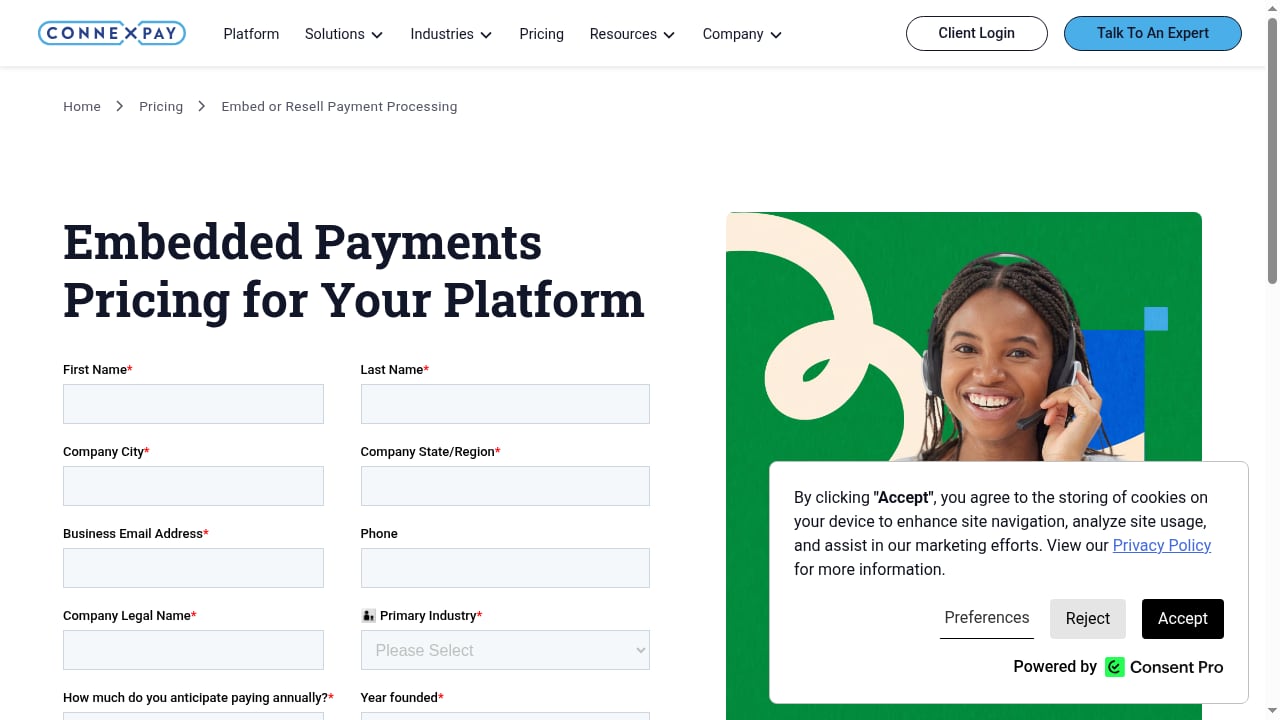
First viewport screenshot of Embedded Payments Pricing - API Payment Platform Cost - ConnexPay.
Choosing ConnexPay depends on a few clear questions:
Do you both collect customer payments and pay suppliers? If yes, ConnexPay's connected model is directly relevant. If you only accept payments, a general processor like Stripe or Adyen is likely simpler and more cost-effective.
Is your supplier payment volume meaningful? The rebate and cash-flow benefits scale with payout volume. A business paying $50,000 per month to suppliers will see less absolute benefit than one paying $5 million.
Are you in travel, advertising, insurance, or a marketplace model? ConnexPay's industry depth is strongest here. Businesses in other verticals may find the platform functional but less tailored.
Do you need embedded or white-label payments? If you are a software platform that wants to offer payments under your own brand, ConnexPay's embedded payments path is a direct fit. If you are a merchant, that capability is irrelevant.
How important is public pricing? If you need transparent, published fees to make a quick decision, ConnexPay's sales-led pricing will be a friction point. If you are comfortable negotiating an enterprise agreement, this is standard practice.
For businesses exploring stablecoin-based corporate cards or alternative payout rails, comparisons like Cardfornia vs Request Finance or the Reap review cover different models that may suit crypto-native teams. Traditional card-based business spending is covered in the corporate travel crypto card guide.
Related reading
- Cardfornia Pricing: Fees, Limits & Plans Explained - Understand Cardfornia pricing for crypto corporate virtual cards. See card fees, stablecoin funding, limits, and how costs compare for business spending.
- How to Transfer USDC: Networks, Fees & Steps in 2026 - Learn how to transfer USDC safely in 2026. Compare networks, fees, wallet steps, native vs USDC.e, and avoid the most common sending mistakes.
Frequently Asked Questions
What makes ConnexPay different from Stripe or Adyen?
Stripe and Adyen are primarily payment acceptance platforms. ConnexPay connects acceptance with supplier payouts in one system, so incoming customer funds are immediately available to issue virtual card payments to suppliers. That two-sided flow is the core difference.
Does ConnexPay publish its pricing?
No. Pricing is negotiated based on volume, industry, payment mix, and credit needs. Businesses should request a proposal modeled on their actual transaction patterns.
What industries does ConnexPay serve?
ConnexPay focuses on leisure travel, business travel, advertising, insurance, and embedded payments for software platforms. Its product depth is strongest in travel and intermediary models.
Can ConnexPay issue physical cards?
Yes. While virtual card issuing is the primary PayOut method, ConnexPay also supports physical cards, ACH, bank-to-bank transfers, and closed-loop payments.
How long does implementation take?
Implementation varies by integration complexity, industry underwriting, and supplier enablement needs. API-first integration requires development resources, and businesses should plan for a structured onboarding process rather than instant setup.
Does ConnexPay offer credit?
Yes. ConnexPay offers an integrated credit facility for preserving operating cash, but terms depend on underwriting and business profile.
Final Verdict
ConnexPay solves a specific, expensive problem: the cash-flow gap and reconciliation burden that comes from collecting customer payments and paying suppliers through separate systems. For travel agencies, TMCs, ad networks, insurance intermediaries, and marketplaces with meaningful two-sided volume, the connected model is genuinely valuable — real-time supplier funding, automated reconciliation, and rebate optimization are not marketing fluff when the volume supports them.
The trade-offs are equally clear. Pricing requires a sales conversation. The platform is overkill for one-sided businesses. Integration is API-driven and needs technical resources. And the deepest product fit remains in travel and adjacent intermediary verticals.
If your business sits between buyers and suppliers and processes enough volume to matter, ConnexPay deserves a serious evaluation. If you simply need to accept payments, a general processor will likely be simpler and cheaper. The right choice depends on whether the connected flow solves a real problem in your operation — or adds complexity you do not need.
For further context on ConnexPay's model and customer results, see the official ConnexPay platform overview and customer success stories. For a broader comparison of payment processing options across Europe, the UK, and the US, ConnectPay's 2026 payment processor guide offers useful context.