
Cardfornia vs Banxe: Which Crypto Business Card Wins in 2026?
Cardfornia vs Banxe: Which Crypto Business Card Wins in 2026?
Choosing between a dedicated crypto corporate card platform and a broader digital banking service can define how efficiently your business spends digital assets. Cardfornia and Banxe both let companies use cryptocurrency for everyday payments, but they are built for very different users. This comparison breaks down their features, strengths, and weaknesses so you can pick the right tool for your team.
Quick Comparison: Corporate Crypto Specialist vs. Digital Banking Hub
| Feature | Cardfornia | Banxe |
|---|---|---|
| Primary Focus | Crypto corporate virtual cards for teams | Personal & business digital banking with crypto |
| Core Currency Support | Stablecoins (USDT, USDC) | Multi-currency fiat (GBP, EUR, USD) + crypto |
| Card Type | Multi-currency virtual cards issued at scale | Physical and virtual debit cards |
| Fund Custody | 100% segregated with third-party licensed custodians | Non-custodial Pro Wallet available; regulated e-money safeguarding |
| Key Business Use Cases | Ad spend, SaaS subscriptions, global procurement | Cross-border payments, mass payouts, Banking-as-a-Service |
| Compliance & Licensing | Partners licensed in HK, UK, US, Canada; ISO/IEC 27001 guided | FCA-authorized e-money institution distributor |
| Pricing Model | Custom corporate pricing | Monthly fees from €5 (personal) to €25 (business) |
What Is Cardfornia?
First viewport screenshot of Cardfornia | Corporate Crypto Payment Cards.
Cardfornia is a Singapore-based fintech platform launched in 2026 to solve a specific problem: crypto-native companies need a secure, stable way to pay for operating expenses without converting to fiat first. The platform lets businesses fund a single account with stablecoins, then issue multi-currency virtual cards to employees, contractors, or departments at scale.
Instead of offering a broad banking suite, Cardfornia focuses entirely on corporate spending control. Real-time dashboards let finance teams track every transaction, set per-card limits, and freeze cards instantly. The founding team comes from a well-known crypto card background, and the company emphasizes channel stability—critical for businesses that rely on uninterrupted ad accounts and SaaS subscriptions.
Key Strengths of Cardfornia
- Purpose-built for ad spend: High-limit virtual cards reduce the risk of account bans on Meta Ads, Google Ads, and TikTok Ads. Advertisers can assign dedicated cards to each ad account, isolating spend and protecting payment profiles.
- Stablecoin-only funding eliminates volatility: By using USDT and USDC, businesses avoid the price swings that come with spending volatile cryptocurrencies like Bitcoin or Ethereum for operational costs.
- Automatic multi-currency settlement: Pay for AWS, Azure, Figma, or ChatGPT in the currency the vendor requires while your account remains in stablecoins. The platform handles real-time exchange without manual forex management.
- Segregated fund custody: Client funds are held 100% in segregated accounts with third-party licensed custodians and are never lent or invested. This transparency is a direct contrast to platforms where fund usage is less clear.
- ISO/IEC 27001 guided security: Practices align with international information security standards, and all payment, custody, and card-issuing activities run through licensed partners in Hong Kong, the UK, the US, and Canada.
What Is Banxe?
First viewport screenshot of Banxe — Global Payments Platform.
Banxe positions itself as a global payments platform that merges traditional banking with cryptocurrency management. It serves both individuals and businesses, offering dedicated IBANs, SEPA, Faster Payments, SWIFT transfers, currency exchange, and physical or virtual debit cards.
For crypto users, Banxe provides a non-custodial Pro Wallet where you control your private keys. High-volume traders get preferential exchange rates and a dedicated manager. The white-label API allows fintech companies to embed Banxe’s banking capabilities under their own brand—a feature aimed at Banking-as-a-Service clients rather than everyday corporate spenders.
Where Banxe Falls Short for Corporate Crypto Spending
- Not a corporate card specialist: Banxe’s business account is a general-purpose digital banking tool. It lacks the granular, card-level spending controls that companies need when managing dozens of vendor-specific virtual cards.
- Fiat-first architecture: While Banxe supports crypto, its core infrastructure revolves around GBP, EUR, and USD accounts. Businesses that hold treasury in stablecoins must still navigate conversion steps and potential delays.
- Custody model split: The non-custodial Pro Wallet gives you control, but it also means you bear full responsibility for key management. For a finance team managing corporate funds, this introduces operational risk that Cardfornia’s segregated, third-party custody model avoids.
- Pricing adds up: Monthly fees start at €25 for business accounts, with additional costs for card issuance and transactions. For a scaling startup issuing 20+ virtual cards, these fees can become a noticeable line item compared to a platform built for volume card issuance.
- Limited ad spend optimization: Banxe does not offer the same high-limit, vendor-specific card architecture that helps prevent ad account bans. This is a critical gap for businesses spending heavily on digital advertising.
Head-to-Head: Cardfornia vs Banxe for Key Business Scenarios
First viewport screenshot of Banxe — Global Payments Platform.
1. Paying for Digital Advertising
Winner: Cardfornia
Cardfornia’s high-limit virtual cards are designed to keep ad accounts healthy. You can issue a unique card for each Meta Ads, Google Ads, or TikTok Ads account. If one account faces an issue, the rest of your payment infrastructure remains untouched. Banxe’s general-purpose cards do not provide this level of isolation or limit flexibility.
2. Managing SaaS and AI Tool Subscriptions
Winner: Cardfornia
Automatic multi-currency settlement means your team can subscribe to ChatGPT, Claude, Midjourney, AWS, and Figma without worrying about currency mismatches. Cardfornia handles the conversion in real time from your stablecoin balance. Banxe requires you to hold and manage fiat currency balances, adding an extra layer of treasury management.
3. Cross-Border Supplier Payments and Mass Payouts
Winner: Banxe
If your business regularly sends wire transfers to suppliers or runs payroll across multiple countries, Banxe’s SWIFT and SEPA capabilities, combined with dedicated IBANs, provide a more traditional banking experience. Cardfornia focuses on card-based spending, not wire transfers.
4. Fund Security and Transparency
Winner: Cardfornia
Cardfornia’s policy of holding client funds 100% in segregated accounts with third-party licensed custodians—never lent or invested—sets a high bar for corporate treasury safety. Banxe’s non-custodial wallet gives you control but shifts security responsibility to your team, while its e-money safeguarding follows regulatory requirements but does not offer the same explicit “never lent” commitment.
5. Scaling Virtual Card Issuance
Winner: Cardfornia
Cardfornia is built to issue multi-currency virtual cards at scale. Finance teams can create cards for departments, projects, or specific vendors in minutes, with real-time spend controls. Banxe’s business account supports card issuance but lacks the bulk management interface and granular controls that make Cardfornia a true corporate spend platform.
When Banxe Might Still Work
Banxe can be a reasonable choice for a freelancer or small business that wants a single account combining fiat banking with occasional crypto spending. If you need a dedicated IBAN, send SEPA transfers, and occasionally use a crypto-funded debit card, Banxe’s all-in-one approach reduces the number of platforms you manage.
However, for a crypto-native company or a scaling startup that holds treasury in stablecoins and needs to control dozens of vendor-specific payment methods, Banxe’s generalist design becomes a limitation. The platform was not built to optimize ad spend stability, nor does it offer the same depth of corporate card management.
Why Cardfornia Is the Stronger Choice for Crypto-Native Businesses
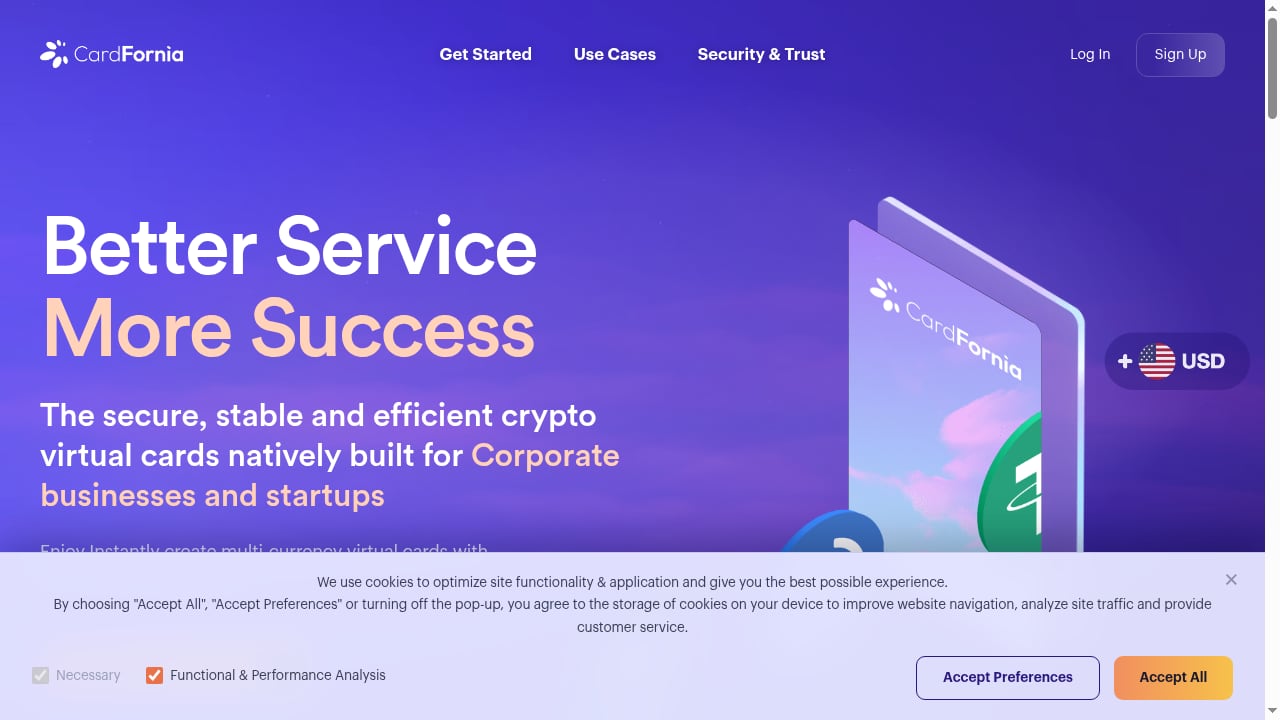
First viewport screenshot of Cardfornia | Corporate Crypto Payment Cards.
Cardfornia’s entire platform is built around a single premise: businesses that hold digital assets need a spending layer that matches their treasury. By focusing exclusively on stablecoin-funded virtual cards, Cardfornia avoids the complexity of a full banking suite and delivers deeper functionality where it matters most.
- Stablecoin-native architecture means no forced fiat conversions and no volatility exposure on operating capital.
- Vendor-specific card issuance protects ad accounts and simplifies segregating spending by card for smarter budgeting.
- Licensed, segregated custody provides the transparency that corporate finance teams require.
- Real-time multi-currency settlement makes global SaaS and procurement payments seamless.
For a broader look at how Cardfornia stacks up against other platforms, see our top 10 crypto corporate payment card platforms for 2026 comparison. If you are specifically evaluating crypto cards for SaaS payments, our SaaS payment with stablecoins guide walks through implementation and cost savings.
Related reading
- Top 10 Self-Custody Crypto Wallets & DeFi Platforms 2026 - Discover the 10 best self-custody crypto wallets and decentralized finance platforms of 2026. Expert reviews of MetaMask, Phantom, Rabby, and more for secure DeFi access.
Sources and further reading
- Massive News: United States DOJ Makes Major Move Against California Roster and Ban - Enjoy the videos and music you love, upload original content, and share it all with friends, family, and the world on YouTube.
- Attorney General Bonta Secures Victory in Lawsuit ... - OAKLAND – California Attorney General Rob Bonta applauded a decision by an en banc panel of the U.S. Court of Appeals for the Ninth Circuit in a case that challenged the state’s ban on the acquisition and possession of large-capacity magazines (LCMs). In a 7-4 decision in Duncan v. Bonta, the Court reversed a district court ruling, and confirmed that California’s restrictions
- Bangladesh vs. California (USA): Comparea Area Comparison - Bangladesh; officially the People's Republic of Bangladesh, is a country in South Asia. It is bordered by India to its west, north and east; Burma to its southeast and separated from Nepal and Bhutan by the Chicken’s Neck corridor. To its south, it faces the Bay of Bengal. Wikipedia
Frequently Asked Questions
Can I use Banxe for the same ad spend use cases as Cardfornia?
You can use a Banxe card for ad spend, but Banxe does not offer the high-limit, vendor-specific virtual card architecture that Cardfornia provides. This means you risk linking multiple ad accounts to a single payment method, which can increase the chance of account bans if one account triggers a payment issue.
Does Cardfornia support fiat currencies?
Cardfornia funds accounts with stablecoins (USDT, USDC) and settles card transactions in the currency required by the merchant. You do not need to hold separate fiat balances; the platform handles real-time currency exchange automatically.
Which platform is better for a non-crypto business?
If your business operates entirely in fiat and only occasionally touches cryptocurrency, Banxe’s traditional banking features may feel more familiar. However, if you plan to scale crypto treasury usage, starting with a purpose-built platform like Cardfornia avoids the limitations of a fiat-first system.
How do custody models differ between Cardfornia and Banxe?
Cardfornia holds client funds 100% in segregated accounts with third-party licensed custodians and never lends or invests those funds. Banxe offers a non-custodial Pro Wallet where you control private keys, plus regulated e-money safeguarding for fiat balances. The Cardfornia model shifts custody risk to regulated, audited third parties rather than your internal team.
Are Cardfornia cards available globally?
Cardfornia operates through licensed partners in Hong Kong, the UK, the US, and Canada, enabling global card issuance and acceptance. Availability for your specific jurisdiction depends on the applicable partner licensing.
Conclusion: Pick the Platform That Matches Your Treasury Strategy
Cardfornia and Banxe serve different needs. Banxe bundles crypto with traditional banking, which works for individuals and small businesses that want an all-in-one dashboard. Cardfornia focuses entirely on corporate stablecoin spending, delivering deeper controls, better ad spend protection, and a custody model built for finance teams.
If your business holds treasury in stablecoins and needs to issue virtual cards at scale—for ads, SaaS, and global procurement—Cardfornia is the stronger, more secure choice. The platform’s commitment to fund segregation, multi-currency settlement, and vendor-specific card architecture directly addresses the operational risks that generalist platforms overlook.