
Cardfornia vs Sparados vs BVNK: Best Crypto Card 2026
Cardfornia vs Sparados vs BVNK: Best Crypto Card for Business in 2026
Choosing a corporate card platform in 2026 means deciding how your company wants to hold, move, and spend money. Cardfornia, Sparados, and BVNK all issue virtual cards, but they start from different foundations: Cardfornia is built for crypto-native businesses that fund operations with stablecoins, Sparados is a European expense-management platform for traditional fiat workflows, and BVNK is enterprise stablecoin infrastructure for companies that need to embed payments at scale.
This comparison breaks down where each platform is strongest, where the trade-offs sit, and which one fits your operating model.
Quick comparison at a glance
| Criteria | Cardfornia | Sparados | BVNK |
|---|---|---|---|
| Primary focus | Crypto corporate virtual cards for businesses and startups | Corporate expense management and virtual cards | Enterprise stablecoin payment infrastructure |
| Funding model | Stablecoins (USDT, USDC) into a single account | Fiat top-ups in EUR, USD, CHF | Multi-currency fiat and crypto wallets |
| Card issuance | Multi-currency virtual cards at team scale | Virtual cards issued in seconds with custom limits | Virtual cards linked to stablecoin balances |
| Best for | Crypto-native teams paying for AI tools, ads, SaaS, and travel | European finance teams automating expense reporting | Fintechs, treasury teams, and institutions embedding stablecoin payments |
| Regulatory posture | Funds in segregated accounts via licensed custodians; ISO/IEC 27001-guided security | Payment services delivered by licensed European providers | ISO 27001:2022 and SOC 2 certified |
Cardfornia: stablecoin-funded cards built for crypto-native operations

BVNK product interface.
Cardfornia is a Singapore-based fintech platform that provides crypto virtual cards designed specifically for corporate businesses and startups. Founded in 2026, it lets organizations fund a single account with stablecoins such as USDT and USDC, then issue multi-currency virtual cards to teams at scale while keeping real-time control over operating expenses.
The platform targets companies that already hold digital assets and want to spend them without converting to fiat first. Core use cases include paying for AI tool subscriptions like ChatGPT, Claude, and Midjourney, running digital advertising on Meta Ads, Google Ads, and TikTok Ads, covering SaaS and cloud services such as AWS, Azure, and Figma, and handling global travel and procurement.
Where Cardfornia stands out
- High-limit cards for ad spend. Advertising platforms are sensitive to payment failures and mismatched cardholder data. Cardfornia emphasizes high-limit cards for ad spend to reduce account ban risks, which matters for teams running continuous campaigns.
- Automatic multi-currency settlement for SaaS. Subscriptions billed in different currencies are settled automatically, reducing the manual reconciliation burden on finance teams.
- Real-time currency exchange for cross-border transactions. Teams paying vendors across jurisdictions can transact without pre-funding multiple currency accounts.
- Segregated custody. Client funds are held 100% in segregated accounts with third-party licensed custodians and are never lent or invested.
- Regulated partner network. Payment, custody, and card-issuing activities are performed through licensed partners holding approvals across jurisdictions including Hong Kong, the UK, the US, and Canada, with security practices guided by ISO/IEC 27001 standards.
The founding team brings expertise from a well-known crypto card background, and the company positions itself as a technology company building corporate spending solutions for the digital-asset era.
If your team is issuing cards for the first time, the mechanics matter as much as the features. See Instant Crypto Card Issuance: How It Works in 2026 for how stablecoin-funded virtual cards are approved and rolled out at scale.
Sparados: expense management and branded virtual cards for European teams
First viewport screenshot of Aktualności.
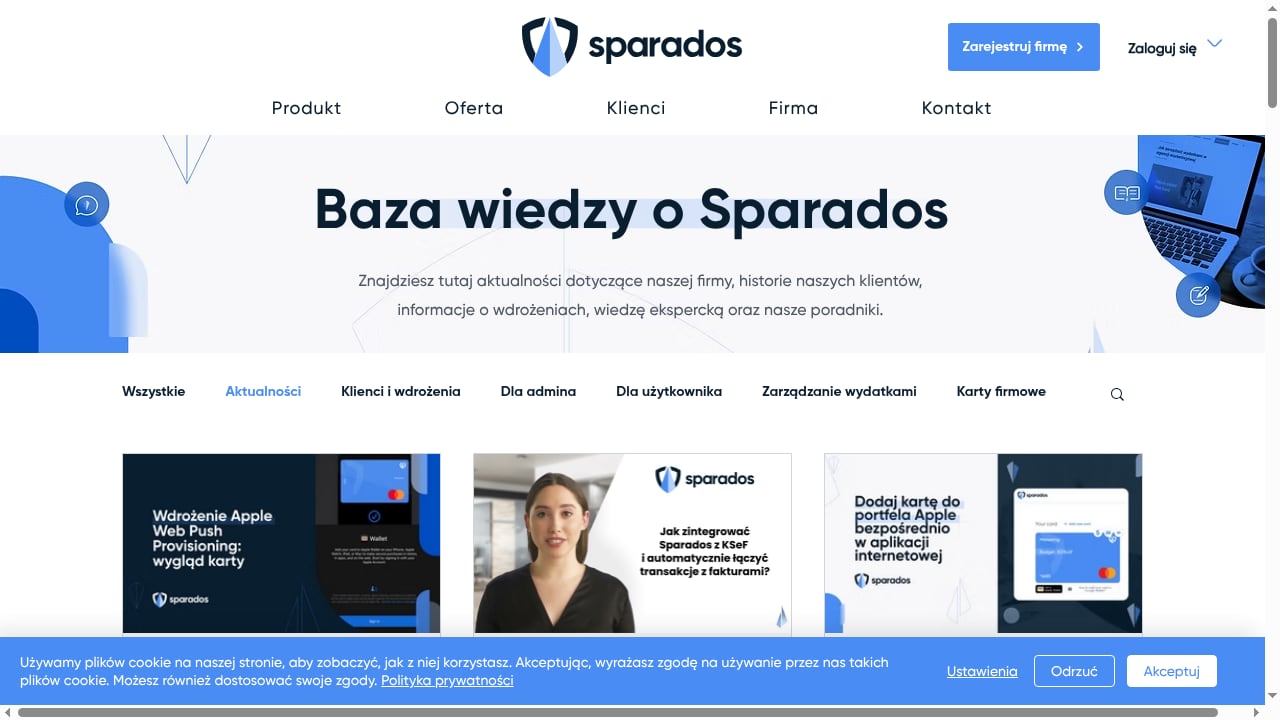
Sparados is a corporate expense management platform that provides virtual corporate cards and automated financial workflows. It enables companies to instantly issue virtual cards with custom limits and transaction controls, supporting payments in EUR, USD, and CHF.
The platform centralizes expense tracking, receipt capture, and invoice management, and automates integration with accounting systems. Real-time transaction monitoring, customizable card branding with company logos, and tools for billing and invoicing round out the feature set. Sparados serves finance teams, administrators, and employees, streamlining expense reporting and approval processes.
Where Sparados stands out
- Speed of issuance. Cards can be issued in seconds with limits and merchant-category rules defined per employee or team.
- Automated expense workflows. OCR and LLM-powered invoice processing handle receipts sent by email or scanned, then sync them into accounting systems such as Saldeo, Comarch Optima, inFakt, and Insert.
- Zero currency conversion markup on card payments. Funds convert in real time at the Mastercard exchange rate, which removes spread costs for cross-currency spending.
- Branding and employee benefits. Companies can put their logo and colors on cards, and Sparados also offers lunch cards as a tax-advantaged employee benefit in Poland.
- Transparent pricing. Virtual cards are free for the first five users, then priced per user per month with no hidden integration or top-up fees.
Sparados is clear that it is neither a payment service provider nor a payment institution; regulated payment services are delivered by authorized European providers under supervision. That structure is common in the expense-management space and is worth understanding before you commit.
Sparados is a strong fit for European companies with 10+ employees where manual expense handling has become costly, particularly in transport, travel, relocation, insurance, security, development, and sales teams.
BVNK: enterprise stablecoin infrastructure for embedded payments

BVNK product interface.
BVNK is an enterprise-grade stablecoin payments infrastructure platform that enables businesses to send, receive, store, spend, and earn with stablecoins. It supports global operations across 130+ countries and is ISO 27001:2022 and SOC 2 certified.
The platform provides both managed and self-managed payment solutions, allowing integration via APIs or a merchant portal. Core capabilities include multi-currency wallets for fiat and crypto, virtual card issuance linked to stablecoin balances, built-in rewards for idle assets, AI-powered onboarding and compliance tools, and comprehensive payment tracking across ACH, Fedwire, and SWIFT.
Where BVNK stands out
- Breadth of infrastructure. BVNK supports major stablecoins (USDC, EURC, USDT) across multiple blockchains including Ethereum, Solana, and BASE.
- Embedded finance. Companies can offer customer virtual accounts and embed stablecoin payments directly into their own products.
- Compliance tooling. AI-powered onboarding reduces application time by 60%, and the platform is built for compliance officers and financial institutions that need audit-ready processes.
- Treasury automation. Partnerships with Layer1 and Tres support automated treasury operations.
- Global reach. 130+ countries of coverage makes it suitable for enterprises moving money across many corridors.
BVNK serves fintech builders, enterprise treasury teams, financial institutions, and compliance officers. It is less a turnkey corporate card product and more a payments layer that other businesses build on top of.
For a broader view of how stablecoin rails compare with traditional methods, see Cross-Border Payments Explained: Methods, Costs & 2026 Trends.
How to choose between Cardfornia, Sparados, and BVNK
First viewport screenshot of Benefity pracownicze.
Choose Cardfornia if:
- Your company holds USDT or USDC and wants to spend it directly on operations.
- You need high-limit virtual cards for digital advertising on Meta, Google, or TikTok.
- You pay for AI tools, SaaS, and cloud services in multiple currencies and want automatic settlement.
- You want funds held in segregated accounts with licensed custodians and a card platform built specifically for crypto-native businesses.
Choose Sparados if:
- Your finance team works primarily in EUR, USD, or CHF and wants to automate expense reporting.
- You need branded virtual cards with granular merchant-category controls.
- Accounting integration and invoice automation are higher priorities than crypto funding.
- You operate in Europe and want tax-advantaged employee benefit cards.
Choose BVNK if:
- You are building a fintech product and need to embed stablecoin payments via API.
- Your treasury team manages fiat and crypto across many corridors and blockchains.
- You need enterprise-grade compliance certifications and payment tracking across ACH, Fedwire, and SWIFT.
- Virtual cards are one component of a much larger payments strategy.
Can you use more than one?
Yes. Some companies use BVNK for enterprise treasury and settlement while issuing operational cards through a platform like Cardfornia. Others use Sparados for European expense management and a separate provider for crypto-funded spending. The key is to avoid duplicating custody and reconciliation work across platforms.
Related reading
- Remote Worker Crypto Card: Spend USDT & USDC Anywhere - A remote worker crypto card turns USDT or USDC income into spendable money without exchange detours. Compare fees, FX, and card options.
- Cardfornia vs Request Finance vs OneSafe (2026) - Compare Cardfornia, Request Finance, and OneSafe for stablecoin business spending: virtual cards, AP automation, neo-banking, and which fits your team.
- How to Earn USDC in 2026: Yields, Wallets & Business Use - Learn how to earn USDC through exchange rewards, DeFi vaults, and self-custody wallets, plus how businesses put USDC yield to work on real expenses.
Sources and further reading
- CardFornia Blog - Instant crypto card issuance explained: how stablecoin-funded virtual cards are approved in minutes, what KYC checks apply, and how teams issue cards at scale.
- Sparados | Expense Management | Corporate Cards - Efficiently manage business expenses on the Sparados platform. Issue virtual cards to your employees and track their expenses in real time!
Frequently asked questions
Is Cardfornia a bank?
No. Cardfornia is a technology company building corporate spending solutions. Payment, custody, and card-issuing activities are performed through licensed partners holding regulatory approvals across jurisdictions including Hong Kong, the UK, the US, and Canada. Client funds are held 100% in segregated accounts with third-party licensed custodians and are never lent or invested.
Does Sparados support cryptocurrency funding?
Sparados is built around fiat payments in EUR, USD, and CHF. Its strengths are expense management, card controls, and accounting automation rather than crypto funding.
Is BVNK a card provider?
BVNK issues virtual cards linked to stablecoin balances, but its core product is enterprise payment infrastructure. Most customers use it to embed stablecoin payments, manage treasury, or move money globally rather than as a standalone corporate card program.
Which platform is best for paying for AI subscriptions and digital ads?
Cardfornia is designed around these use cases, with high-limit cards for ad spend and automatic multi-currency settlement for SaaS. Sparados can handle subscription payments in supported fiat currencies, while BVNK is better suited to companies that want to build payment flows themselves.
What should I check before signing up?
Confirm where your funds are held, which licensed entity provides payment services, what currencies and blockchains are supported, and how reconciliation works with your accounting stack. For crypto-funded teams, also verify card limits, FX handling, and how the platform manages payment failures on advertising platforms.
Conclusion
Cardfornia, Sparados, and BVNK solve different problems. Cardfornia is the strongest fit for crypto-native companies that want to fund a single account with stablecoins and issue multi-currency virtual cards for ads, AI tools, SaaS, and travel. Sparados is a well-rounded European expense-management platform with fast card issuance and deep accounting integrations. BVNK is enterprise infrastructure for companies that need to embed stablecoin payments and manage treasury across many countries and chains.
Start with how your company holds money today. If stablecoins are already on your balance sheet, a platform built for that reality will save you conversion steps and reconciliation work. If your finance team runs on fiat and needs automation, an expense-management platform will deliver faster. If you are building payments into a product, infrastructure is the right layer.