
Cardfornia vs WaldenPay vs Brex: Which Fits Your Business?

Cardfornia vs WaldenPay vs Brex: Which Fits Your Business?
Choosing a payment platform in 2026 means separating three very different products. Cardfornia is built for businesses and AI agents that want self-custodied stablecoin funding with granular card controls. WaldenPay is a fast, low-friction crypto prepaid card for individuals and small teams. Brex is an enterprise-grade finance stack for corporate cards, expense management, travel, and treasury. This comparison lays out where each one is strong, where it falls short, and which use cases map to which platform.
Quick comparison at a glance
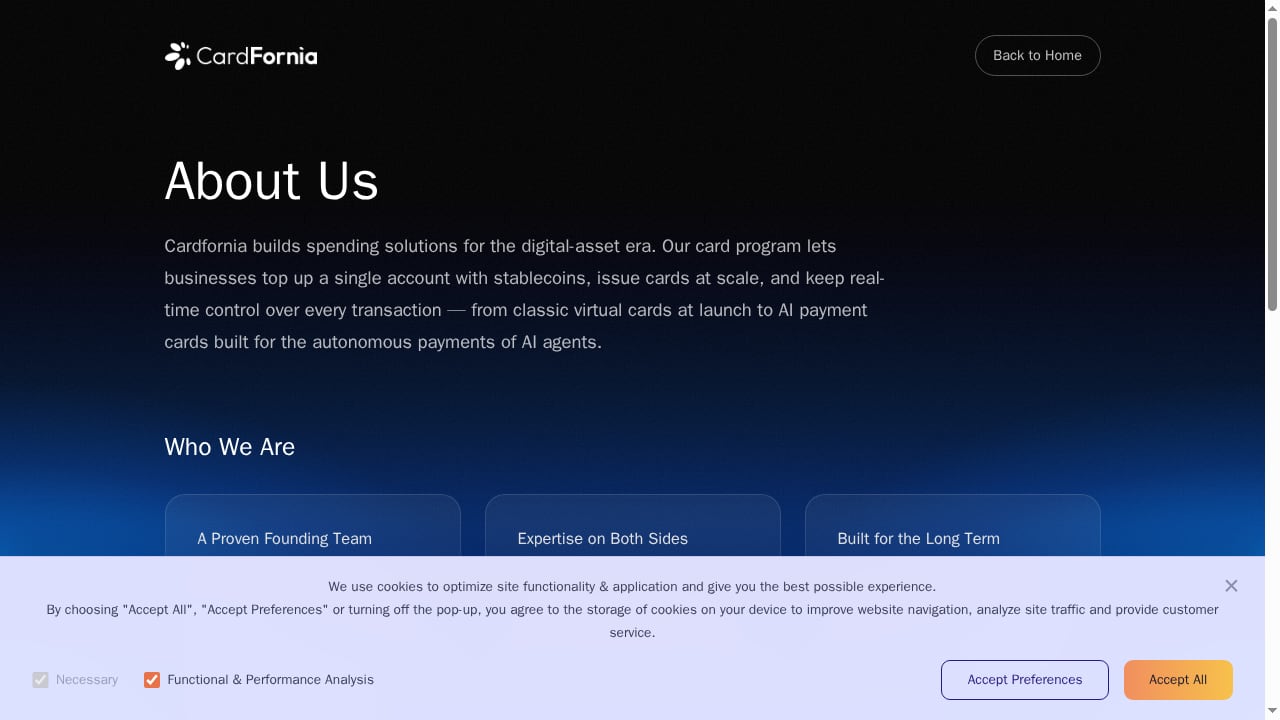
First viewport screenshot of www.cardfornia.com.
| Criterion | Cardfornia | WaldenPay | Brex |
|---|---|---|---|
| Primary audience | Businesses and AI agents paying for tools, ads, SaaS, and travel | Crypto holders, freelancers, media buyers | Startups through global enterprises |
| Funding model | Self-custodied stablecoins (USDT/USDC) into your own wallet, then a dedicated sub-account with a licensed card provider | Custodial prepaid balance converted from 135+ cryptocurrencies across 35+ networks | Business bank account, treasury, and corporate card credit lines |
| Card type | Virtual cards issued at scale, including cards for AI agents | Virtual Visa/Mastercard, Apple Pay and Google Pay | Corporate cards with global acceptance in 120+ countries |
| Issuance speed | Dynamic issuance with merchant whitelisting and minute-level authorization | Virtual card in about 10 minutes | Application and underwriting process |
| Fees | Not publicly itemized in this comparison; confirm current pricing directly | $10 one-time issuance, $0 monthly, top-up fee from 5% falling to 3% as 30-day spend grows | Essentials free; Premium $12 per user per month; Enterprise custom |
| Controls | Merchant whitelisting, real-time transaction control, full audit logs | Standard card controls | Real-time policy enforcement, AI-powered approvals, expense reports |
| Best fit | Crypto-native businesses and agentic AI payment workflows | Individuals who want to spend crypto quickly with minimal setup | Finance teams that need a full spend management stack |
Cardfornia: self-custodied stablecoin cards for businesses and AI agents
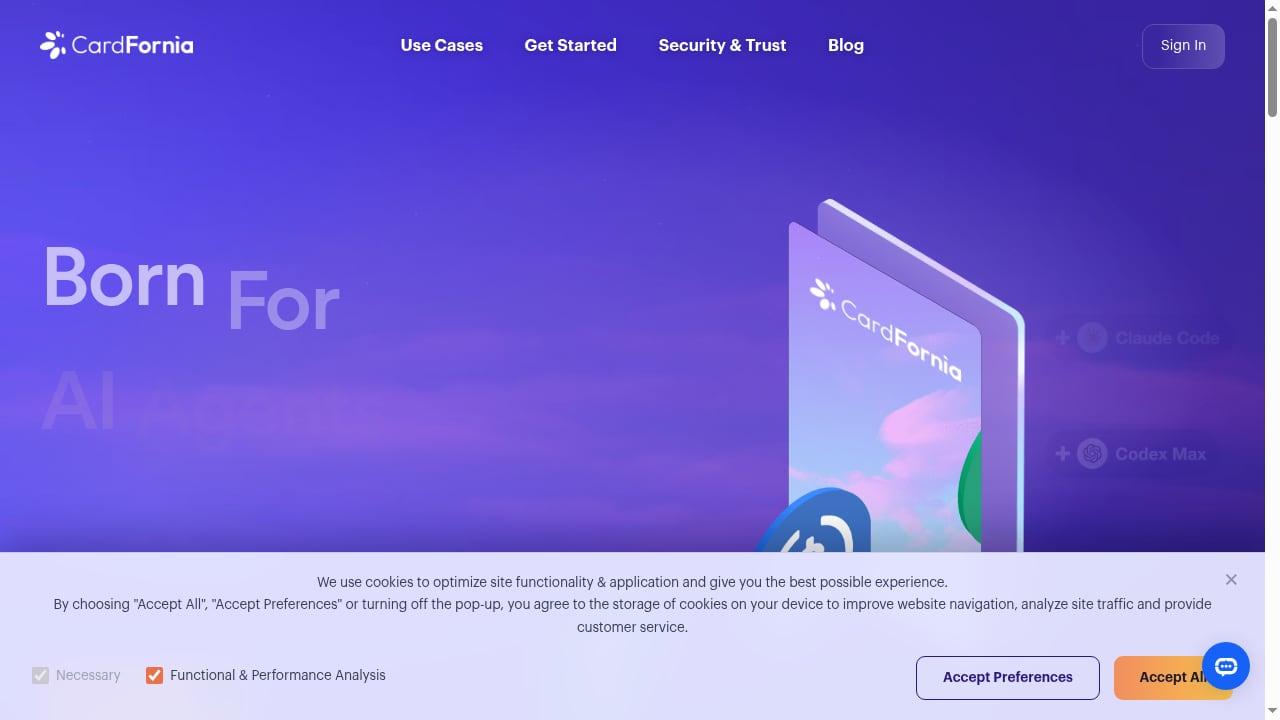
First viewport screenshot of www.cardfornia.com.
Cardfornia is a crypto virtual card and payment platform aimed at two audiences: businesses that pay for digital services, and AI agents that need to make autonomous payments. The model is distinctive. You top up a single account with stablecoins (USDT or USDC) into your own self-custodied wallet, and funds move directly to a dedicated sub-account with a licensed card provider. Cardfornia never holds your funds.
That architecture supports several features that matter for operational finance:
- Dynamic card issuance at scale. Issue many virtual cards, each with its own limits and purpose, without a manual approval bottleneck.
- Merchant whitelisting. Restrict a card to specific merchants so a card issued for OpenAI, Anthropic, or Cursor cannot be used elsewhere.
- Minute-level authorization and full audit logs. Every transaction is traceable, which helps with reconciliation and with detecting anomalous agent behavior.
- Stable, high-limit payments. Cardfornia positions its cards as reducing the risk of account bans that can hit cards with unstable funding or unusual patterns.
Cardfornia reports average monthly volumes per card by use case: $200+ for AI tools, $2,800+ for digital ads (Meta, Google, TikTok, AppLovin), and $150+ for SaaS such as AWS, Azure, and Google Cloud. The company is incorporated in Singapore as CARDFORNIA PTE. LTD., and its team is certified to ISO/IEC 27001, with licensed white-label partners holding MSO, API, MSB, and MTL licenses.
Where Cardfornia is strongest: businesses that already hold stablecoins and want to keep custody while issuing controlled cards, and teams building AI agents that need a payment rail with merchant-level restrictions and audit trails.
Where to look elsewhere: if you need a full expense management suite with reimbursements, travel booking, and accounting integrations, Brex is the more complete system. If you are an individual who wants a card in ten minutes with minimal setup, WaldenPay is simpler.
WaldenPay: fast crypto-to-spend conversion
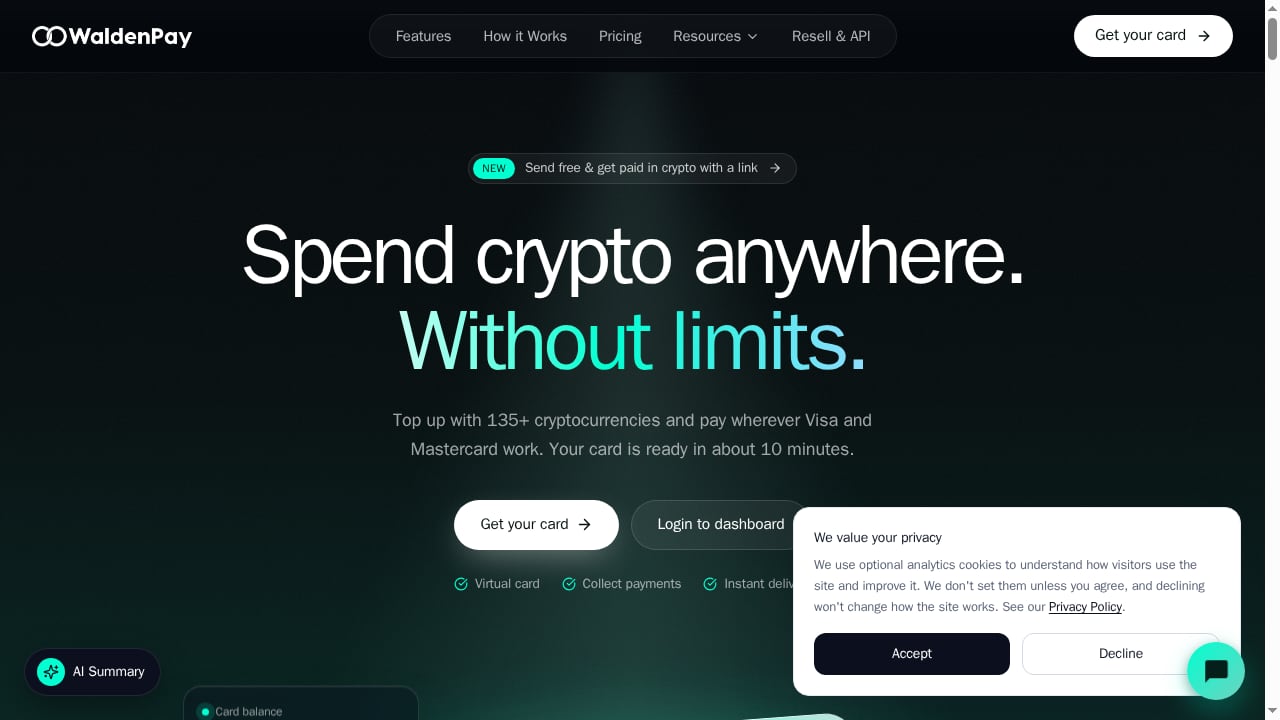
First viewport screenshot of waldenpay.com.
WaldenPay is a crypto prepaid card platform that converts 135+ cryptocurrencies across 35+ networks into a spendable Visa or Mastercard balance. A virtual card can be issued in about 10 minutes, top-ups are available 24/7, and the card works anywhere Visa and Mastercard are accepted, including Apple Pay and Google Pay.
Pricing is transparent: a $10 one-time card issuance fee, no monthly fee, and a top-up fee that starts at 5% and automatically drops to 3% as 30-day spending grows. WaldenPay also supports peer-to-peer sending to other users via email and crypto payment collection through shareable links or QR codes, with payers not needing an account. Sending and collecting are free for the WaldenPay user, with the payer covering a small 0.2% conversion fee on collections.
WaldenPay's own comparison pages position it against a long list of crypto cards, emphasizing minimal signup friction and broad asset support. Its knowledge base covers crypto card fees, chargebacks, AML, security, and reloadability, and the platform notes that all services are subject to AML and regulatory requirements. Third-party feedback exists on Trustpilot, where customers have shared experiences; read recent reviews before funding a card.
Where WaldenPay is strongest: crypto holders, freelancers paid in crypto, and media buyers who want to turn assets into spendable balance quickly without routing through a traditional bank. The broad network support is useful if your holdings are spread across chains.
Trade-offs to weigh: WaldenPay is a custodial prepaid model, so you give up self-custody while funds sit on the card. The top-up fee, even at the reduced 3% tier, is a meaningful cost for high-volume spenders. And it is a consumer-oriented card, not a spend management platform with policy enforcement or audit logs.
Brex: the full corporate finance stack
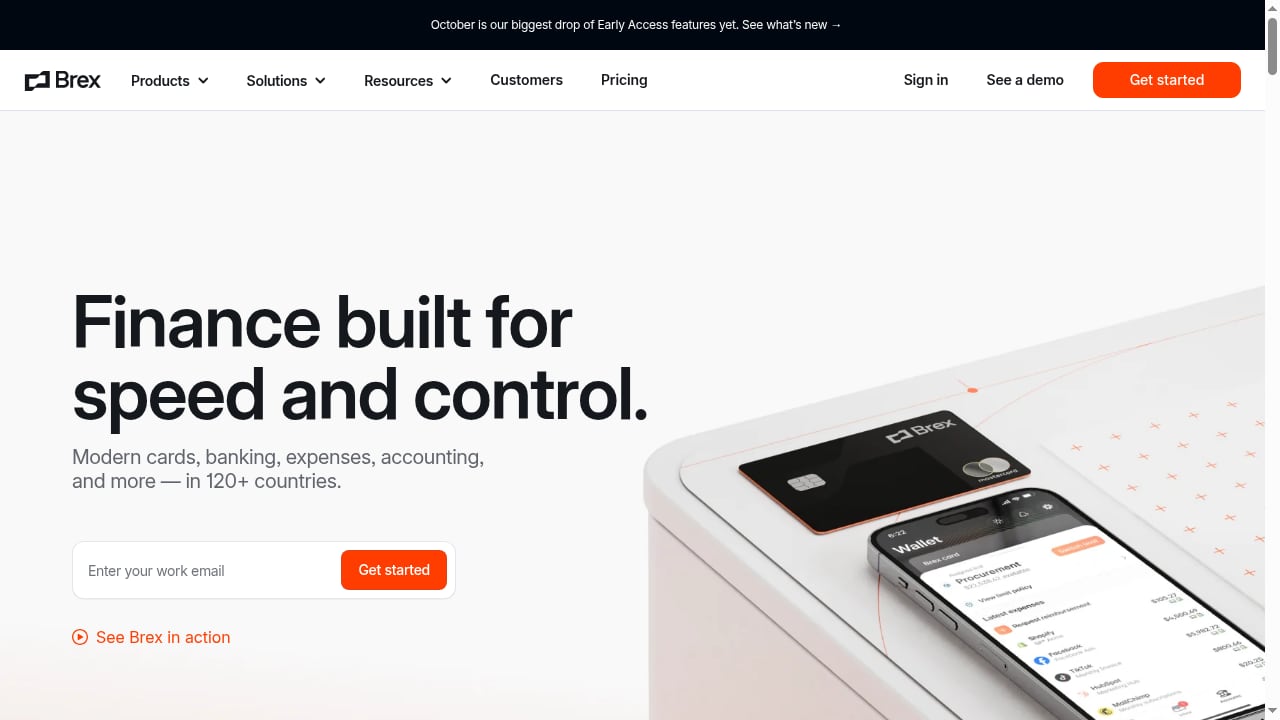
First viewport screenshot of www.brex.com.
Brex combines corporate cards, expense management, travel, bill pay, and business banking and treasury into one system. It is used by more than 35,000 companies and is designed for organizations from startups to global enterprises.
Core capabilities include AI-powered expense approvals and expense reports, AI-assisted invoice entry and payment automation, in-app travel booking, and business accounts with checking, treasury, and vault options that offer yield and expanded FDIC insurance. Brex also provides accounting and ERP integrations, reimbursements, real-time reporting, API access, and multi-entity support. Cards are accepted in 120+ countries.
Pricing has three tiers: a free Essentials plan for startups and growing companies, a $12 per user per month Premium plan for mid-sized companies with advanced policy, approval, compliance, and integration features, and an Enterprise plan for global enterprises. Brex cites proof points including $51B in customer spend kept in policy automatically, $680M in total customer rewards earned, and 11M hours saved with automation.
Where Brex is strongest: finance teams that need to enforce spend policy in real time, automate expense reporting, manage travel and bills, and hold operating cash in a treasury account. If your priority is a single system of record for company spend, Brex is the most complete option here.
Trade-offs to weigh: Brex is a fiat-first banking and card stack. It is not designed for stablecoin funding, self-custody, or AI agents making autonomous payments with merchant-level whitelisting. Onboarding involves underwriting, which can take longer than a crypto card's ten-minute issuance.
Head-to-head on the criteria that matter
Custody and funding
Cardfornia is the only option here that keeps funds in your own self-custodied wallet, with stablecoins moving directly to a dedicated sub-account with a licensed card provider. WaldenPay is custodial: you convert crypto into a prepaid balance held by the platform. Brex operates through business bank accounts and card credit, with no crypto funding path.
Choose Cardfornia if self-custody and stablecoin funding are non-negotiable.
Card issuance speed and scale
WaldenPay issues a virtual card in about 10 minutes, which is excellent for an individual. Cardfornia issues cards dynamically at scale, which matters when you need dozens or hundreds of cards for different vendors or agents. Brex issuance is tied to an application and underwriting process, but once approved, teams can issue cards to employees with policy controls.
Choose WaldenPay for the fastest single-card setup. Choose Cardfornia when you need many cards with distinct controls.
Transaction controls and auditability
Cardfornia offers merchant whitelisting, minute-level authorization, and full audit logs, which are specifically useful for AI agent payments where a card should only work at approved merchants. Brex offers real-time policy enforcement, AI-powered approvals, and detailed expense reporting, which is stronger for human employee spend. WaldenPay offers standard card controls without a spend management layer.
Choose Brex for employee expense policy and reporting. Choose Cardfornia for agent-level and merchant-level controls.
Fees and cost structure
WaldenPay's $10 issuance fee and $0 monthly fee are simple, but the top-up fee of 5% falling to 3% is a real cost on every load. Brex's Essentials plan is free, with Premium at $12 per user per month. Cardfornia's pricing is not itemized in this comparison; confirm current fees directly before committing. For high-volume spenders, the percentage-based top-up fee is often the deciding factor.
Global acceptance and travel
Brex cards are accepted in 120+ countries and include in-app travel booking. WaldenPay works anywhere Visa and Mastercard are accepted, including Apple Pay and Google Pay. Cardfornia supports global purchases including travel, with stable, high-limit cards. All three are viable for travel spend; Brex adds the booking and management layer.
AI agent payments
This is where the three diverge most. Cardfornia is explicitly designed for AI agents' autonomous payments, with dynamic issuance, merchant whitelisting, and audit logs. WaldenPay and Brex are built for human cardholders. If your roadmap includes agents that pay for API credits, compute, or tools, Cardfornia is the only one of the three with a purpose-built model.
Practical examples
A crypto-native startup paying for AI tools and cloud. The team holds USDC and wants to keep custody. It issues separate Cardfornia cards for OpenAI, Anthropic, Cursor, AWS, and Google Cloud, each whitelisted to its merchant, and reconciles from audit logs. Monthly volume per card is modest ($150–$200+), but control matters more than speed.
A media buyer scaling ad accounts. Ad spend runs $2,800+ per card per month. A WaldenPay card can be funded quickly from multiple chains, but the 3–5% top-up fee adds up. A Cardfornia card keeps stablecoin funding self-custodied and avoids percentage-based load costs, subject to confirming current pricing.
A 200-person company with a finance team. Brex Premium at $12 per user per month enforces policy, automates expense reports, and books travel in-app. Crypto funding is irrelevant here; the priority is a single system of record.
How to decide
- Choose Cardfornia if you are a crypto-native business or AI agent builder that wants self-custodied stablecoin funding, many controlled cards, merchant whitelisting, and audit logs.
- Choose WaldenPay if you are an individual or small operator who wants a virtual card in minutes, broad crypto support, and simple transparent pricing, and you are comfortable with a custodial prepaid model and a percentage top-up fee.
- Choose Brex if you need a complete corporate finance stack with expense management, travel, bill pay, treasury, and policy enforcement for employees.
For adjacent options, see our reviews of Reap's stablecoin payments and card issuing and Banqa's self-custody USDC Visa card.
Related reading
- BVNK Review 2026: Enterprise Stablecoin Payments Tested - Evidence-based BVNK review for 2026: enterprise stablecoin payments, ideal users, use cases, pricing signals, setup, limitations, and decision criteria.
- Sparados Review 2026: Corporate Cards & Expense Management - Evidence-based Sparados review: virtual corporate cards, real-time expense tracking, accounting sync, ideal users, limitations, pricing signals, and setup.
Sources and further reading
- WaldenPay — Crypto Prepaid Card | Pay With Crypto Anywhere - Get a crypto prepaid card in minutes. Top up with 135+ cryptocurrencies across 35+ networks and spend anywhere Visa & Mastercard are accepted.
- Compare Crypto Cards — WaldenPay vs Alternatives - Side-by-side crypto card comparisons: KYC, fees, supported coins and wallets. See how WaldenPay stacks up against Crypto.com, Wirex, BitPay and more.
FAQ
Is Cardfornia a bank?
No. Cardfornia is a platform incorporated in Singapore as CARDFORNIA PTE. LTD. It works with licensed white-label partners that hold MSO, API, MSB, and MTL licenses. Funds move from your self-custodied wallet to a dedicated sub-account with a licensed card provider.
Does WaldenPay require KYC?
WaldenPay notes that all services are subject to AML and regulatory requirements. Its comparison pages describe a minimal-data signup, but you should confirm current verification requirements directly on its site before funding a card.
Can Brex be funded with crypto?
Brex is a fiat-first finance platform with business banking, treasury, and corporate cards. It does not offer stablecoin funding or self-custody.
Which platform is best for AI agent payments?
Cardfornia is the only one of the three explicitly designed for AI agents, with dynamic card issuance, merchant whitelisting, minute-level authorization, and full audit logs.
Which has the lowest fees?
It depends on volume. WaldenPay charges a $10 issuance fee and a 3–5% top-up fee. Brex Essentials is free, with Premium at $12 per user per month. Cardfornia's pricing should be confirmed directly. For high-volume stablecoin spenders, percentage-based top-up fees are usually the largest cost.
Conclusion
Cardfornia, WaldenPay, and Brex are not direct substitutes so much as answers to different questions. WaldenPay answers "how do I spend crypto quickly?" Brex answers "how do I run company spend?" Cardfornia answers "how do I let businesses and AI agents pay with self-custodied stablecoins under tight control?" Match the platform to your funding model, your control requirements, and whether agents are part of your payment workflow. For a broader view of stablecoin business accounts, see our Request Finance review.