
Circle Stablecoin Explained: USDC, EURC & Business Use

Circle Stablecoin Explained: USDC, EURC, and How Businesses Use Them
A Circle stablecoin is a digital token designed to hold a steady value against a national currency. Circle issues two of the best-known examples: USDC, pegged to the US dollar, and EURC, pegged to the euro. For businesses that hold digital assets, these tokens are less a trading instrument and more a settlement layer — a way to move dollar- or euro-denominated value globally in minutes rather than days.
This guide explains how Circle stablecoins work, how they differ from other stablecoins, and where they fit into real corporate spending workflows.
What Is a Circle Stablecoin?

Circle Stablecoin Explained: USDC, EURC & Business Use - What Is a Circle Stablecoin?.
Circle Internet Group is a payments technology company founded in 2013 and headquartered in New York City. It issues stablecoins and the infrastructure that moves them between blockchains and financial institutions. Its flagship product, USDC, launched in 2018 and has grown into one of the largest regulated stablecoins by circulation.
A Circle stablecoin works like this:
- Peg: Each token targets a 1:1 value with its reference currency — one USDC for one US dollar, one EURC for one euro.
- Reserves: Circle states that USDC is backed 100% by highly liquid cash and cash-equivalent assets, with holdings equal to or exceeding the amount in circulation.
- Redemption: Institutional users can redeem USDC 1:1 for US dollars through Circle Mint.
- Transparency: Circle publishes monthly reserve attestations prepared by a Big Four accounting firm.
That combination of a stable peg, disclosed reserves, and a regulated issuer is what separates a Circle stablecoin from algorithmic or undercollateralized designs.
USDC vs EURC: Two Circle Stablecoins Compared
Circle Stablecoin Explained: USDC, EURC & Business Use - USDC vs EURC: Two Circle Stablecoins Compared.
| Feature | USDC | EURC |
|---|---|---|
| Reference currency | US dollar | Euro |
| Primary use | Global dollar settlement, treasury, payments | Euro-denominated settlement and European operations |
| Redemption | 1:1 for USD via Circle Mint | 1:1 for EUR via Circle Mint |
| Typical business fit | Cross-border payouts, vendor payments, stablecoin-funded cards | EU payroll, European supplier invoices, FX diversification |
For most companies, USDC is the default because so much global commerce is invoiced in dollars. EURC becomes relevant when you have euro-denominated obligations and want to avoid a double conversion through USD.
How Circle Stablecoins Differ From Other Stablecoins

Circle Stablecoin Explained: USDC, EURC & Business Use - How Circle Stablecoins Differ From Other Stablecoins.
Not all stablecoins are built the same way. Three differences matter most for business users:
- Regulatory posture. Circle operates under a broad licensing footprint and has pursued formal regulatory approvals in multiple jurisdictions, including a national trust bank charter process in the United States. That matters if your finance team needs a counterparty that can be audited and explained to a board.
- Reserve composition. USDC reserves are held in cash and short-term government instruments, with the majority in a government money market fund. This is a conservative structure aimed at liquidity rather than yield.
- Multi-chain reach. USDC is natively issued across dozens of blockchain networks, so you are not locked into a single chain for settlement.
If you are comparing stablecoins for operational use rather than trading, these structural points usually outweigh small differences in on-chain liquidity.
Why Businesses Hold and Spend Circle Stablecoins
Circle Stablecoin Explained: USDC, EURC & Business Use - Why Businesses Hold and Spend Circle Stablecoins.
Companies increasingly treat USDC as working capital rather than a speculative position. The practical reasons:
- 24/7 settlement. Transfers settle in seconds, including weekends and holidays, which traditional wires do not.
- Predictable accounting. A dollar-pegged token keeps your books in a single unit of account instead of marking positions to market.
- Global reach. USDC is available in a very large number of countries, making it usable for contractors and vendors in markets where opening a USD bank account is slow.
- Programmability. Payments can be automated, batched, or triggered by smart contracts.
For a broader look at how these tokens fit into day-to-day operations, see our guide to corporate crypto expense cards.
From Stablecoin Balance to Everyday Spending
Holding USDC is only half the problem. The harder question is how a team actually pays for software, ads, and travel without converting to fiat manually every time.
This is where stablecoin-funded corporate cards come in. A company funds a single account with USDC or USDT, issues virtual cards to team members, and each card settles in the currency the merchant expects. The stablecoin stays on the balance sheet until spend occurs, and finance keeps real-time visibility into every transaction.
Cardfornia is a Singapore-based platform built for this workflow. It lets crypto-native companies and startups fund one account with stablecoins such as USDC and USDT, issue multi-currency virtual cards at scale, and control operating expenses in real time. Common use cases include AI tool subscriptions, digital advertising on Meta, Google, and TikTok, cloud and SaaS services, and global travel. Funds are held 100% in segregated accounts with third-party licensed custodians and are never lent or invested — a structure that mirrors the reserve discipline Circle applies to USDC itself.
If you are evaluating this category, our startup founder crypto card guide covers what to check before issuing cards to a team.
Practical Examples: Where Circle Stablecoins Fit
Paying a distributed contractor team. A company holds USDC and pays contractors in several countries. Settlement happens in minutes, and no intermediary bank takes a cut on the currency conversion.
Funding ad spend. Performance marketing teams need high-limit cards because ad platforms are sensitive to payment failures. Funding a card account with USDC keeps the balance in stable value while the card settles in the platform's billing currency.
Managing euro exposure. A business with European suppliers can hold EURC to pay euro invoices directly, avoiding a USD round trip. If your exposure runs through North America instead, our USDCAD rate and FX strategy guide explains the drivers to watch.
Treasury operations. Because USDC is redeemable 1:1 for dollars through Circle Mint, institutional holders can move between on-chain balances and bank accounts without taking price risk.
Risks and Limitations to Understand
A Circle stablecoin is not risk-free, and a useful article should say so plainly:
- Issuer and reserve risk. The peg depends on Circle's reserves being sufficient and liquid. Attestations reduce uncertainty but are not the same as a full audit.
- Regulatory change. Stablecoin rules are still developing in many markets. Licensing status can shift, and access may differ by jurisdiction.
- Banking rails. Minting and redeeming at scale still touch the traditional financial system, so bank counterparty risk does not disappear.
- Operational security. Self-custodied balances introduce key management risk that a corporate treasury function must control.
None of these are reasons to avoid stablecoins, but each belongs in a treasury policy.
Related reading
- Cardfornia vs Cryptopay Business vs Banxe - Compare Cardfornia, Cryptopay Business and Banxe on crypto corporate cards, stablecoin funding, fiat settlement and compliance for business spending.
FAQ
What is a Circle stablecoin?
A Circle stablecoin is a digital token issued by Circle Internet Group that targets a 1:1 value with a national currency. The two main examples are USDC (US dollar) and EURC (euro).
Is USDC the same as a Circle stablecoin?
USDC is Circle's flagship stablecoin, but Circle also issues EURC and USYC, a tokenized money market fund. When people say "Circle stablecoin," they usually mean USDC.
How are USDC reserves held?
Circle states that USDC is backed 100% by highly liquid cash and cash-equivalent assets, with the majority held in a government money market fund. Monthly attestations are published by a Big Four accounting firm.
Can businesses spend USDC directly?
Not at most merchants. Businesses typically convert USDC to fiat at the point of payment, or use a stablecoin-funded corporate card that settles in the merchant's currency while the company's balance stays in USDC.
Is USDC available on multiple blockchains?
Yes. USDC is natively issued on dozens of blockchain networks, including Ethereum, Solana, Base, Arbitrum, and Polygon, among others.
How does USDC compare to USDT?
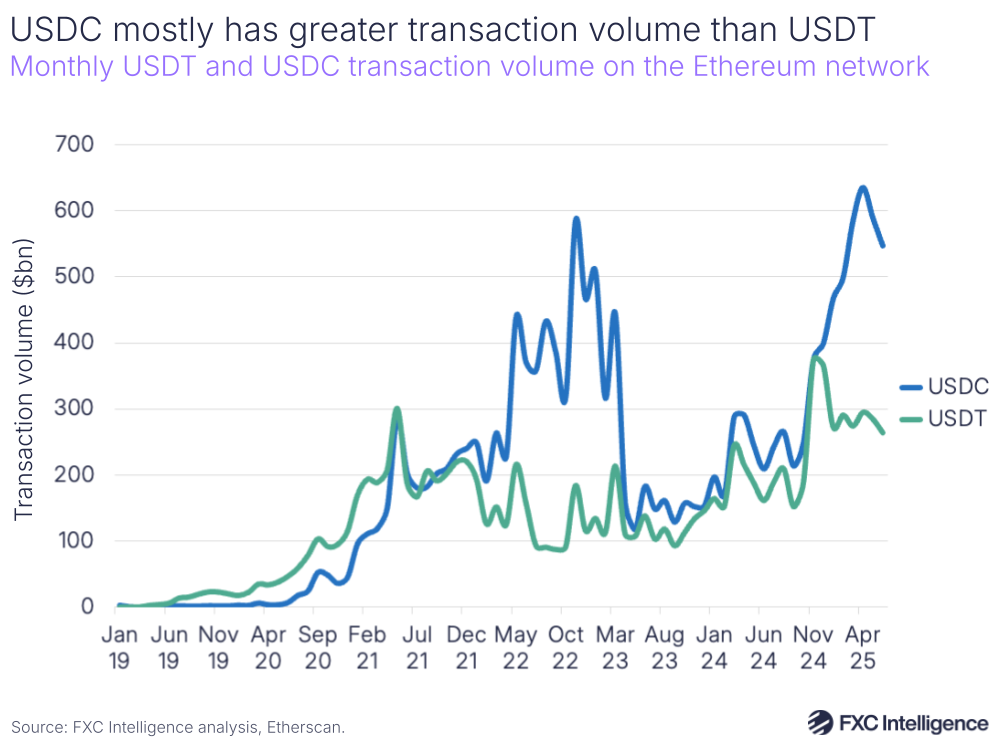
Both are dollar-pegged stablecoins. USDC is issued by Circle with a stated focus on regulatory compliance and published reserve attestations. USDT is issued by Tether. The practical choice often comes down to which one your counterparties, exchanges, and payment providers support.
Conclusion
A Circle stablecoin is best understood as regulated digital cash rather than a crypto investment. USDC and EURC give businesses a dollar- and euro-denominated settlement layer that works around the clock, across borders, and on-chain. The remaining operational question is how to turn that balance into real spending — software subscriptions, ad campaigns, contractor payments, and travel — without reintroducing the friction stablecoins were meant to remove. For crypto-native teams, pairing a stablecoin treasury with corporate virtual cards is the most direct answer.
To see how that stack compares across providers, read our Cardfornia vs Reap vs Sparados comparison.