
Global Business Payments: Stablecoin Cards for Modern Teams

Global Business Payments: Stablecoin Cards for Modern Teams
Global business payments have long been a patchwork of bank wires, correspondent fees, and currency spreads that punish companies for operating across borders. Stablecoin virtual cards offer a different path: fund a card with USDT or USDC, keep custody of the funds until you spend, and settle international purchases without waiting on a traditional bank chain. This article explains where that model fits, how to evaluate it, and how Cardfornia implements it for business and AI-agent spending.
Why global business payments remain painful
Traditional cross-border payments are slow because value passes through several institutions, each with its own cut-off times, compliance checks, and FX markup. A supplier invoice paid on Friday may not clear until mid-week, and the recipient may receive less than expected after intermediary deductions. For businesses with global footprints, these frictions compound: payroll, cloud bills, ad platforms, and travel bookings all hit different rails at different speeds.
Consumer fintech solved much of this for individuals. Business payments lagged behind, as CNN Business notes: consumer apps made foreign currency convenient, but companies with more complex needs remained underserved. That gap is where stablecoin rails and programmable cards become relevant.
What a stablecoin virtual card changes
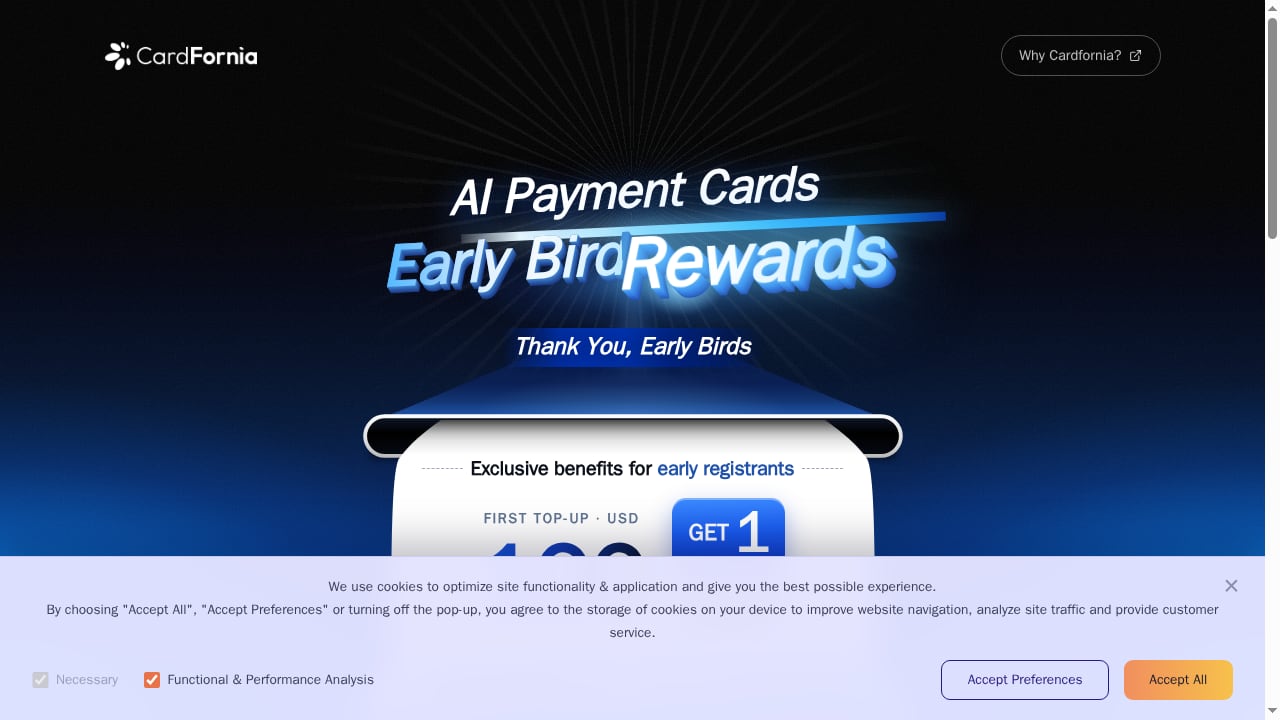
First viewport screenshot of www.cardfornia.com.
A stablecoin virtual card is a payment card funded by a dollar-pegged token rather than a bank balance. The practical differences are meaningful:
- Funding speed. USDT or USDC can move in minutes on-chain, so a card can be topped up when needed rather than waiting for a wire to land.
- Custody. In a self-custody model, the business holds its own keys and funds a dedicated card sub-account only when it chooses to spend.
- Control. Virtual cards can be issued per vendor, per team, or per agent, with merchant restrictions and short authorization windows.
- Auditability. Every authorization can be logged, which matters for finance teams reconciling subscriptions and ad spend.
These properties do not replace a treasury function. They change how quickly and precisely a business can deploy working capital into global purchases.
Where Cardfornia fits
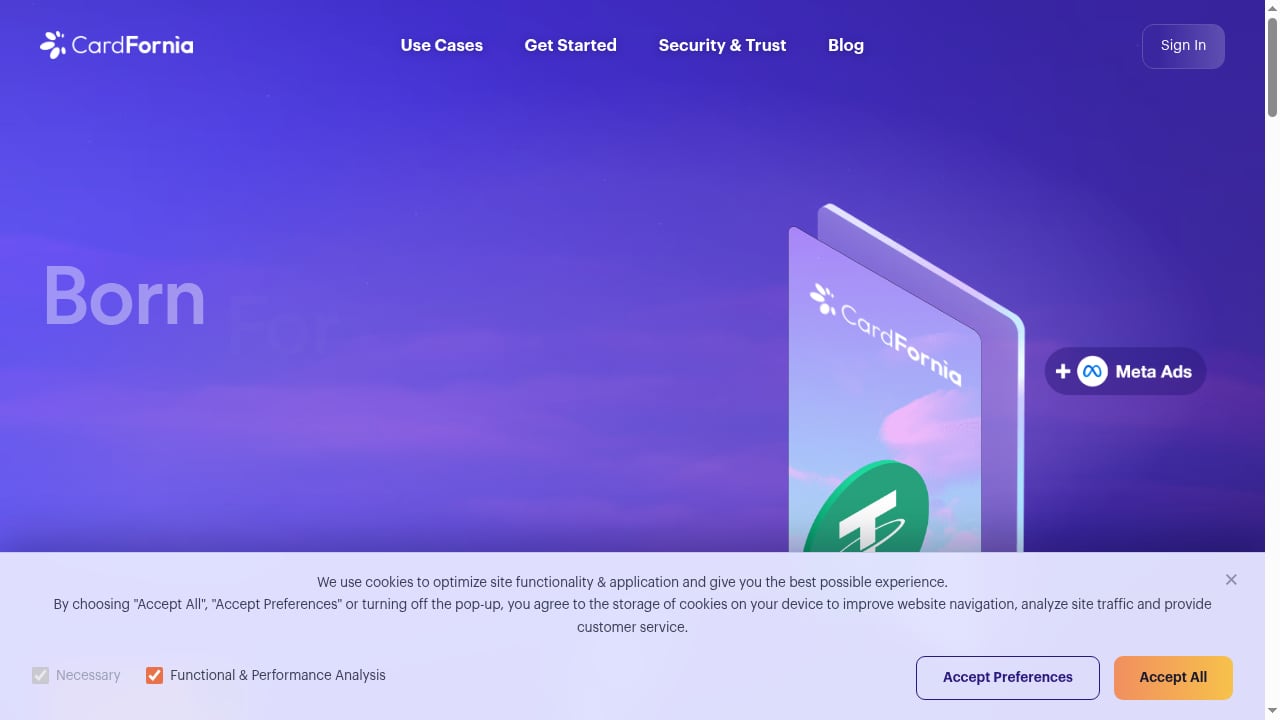
First viewport screenshot of www.cardfornia.com.
Cardfornia is a crypto virtual card and payment platform built around self-custodied stablecoin funding. Users top up with USDT or USDC into their own wallet, then issue virtual cards for business payments or for AI agents making autonomous purchases. Cards are issued and processed through licensed white-label providers, while Cardfornia operates as the technology layer.
Key design choices include:
- Self-custodied funds. Users hold their own keys; Cardfornia does not take custody of the underlying stablecoin balance.
- Direct funding to a dedicated sub-account. Funds move to a sub-account with the licensed card provider, and the same funds are not reused across cards.
- Dynamic card issuance. Cards can be created for specific purposes, merchants, or agents rather than one card shared across the company.
- Merchant whitelisting and minute-level authorization. Spend can be limited to approved merchants and narrow time windows.
- Full audit logs. Each card's activity is recorded for reconciliation.
- ISO/IEC 27001 certified security practices. The platform's security program follows a recognized information-security standard.
Cardfornia reports average monthly volumes per card that vary by use case: roughly $200+ for AI tool subscriptions, $2,800+ for digital ads, and $150+ for SaaS platforms. Those figures are useful benchmarks when sizing card limits, not guarantees of spend.
Common use cases for global business payments
First viewport screenshot of www.cardfornia.com.
AI tool and SaaS subscriptions
Teams paying for ChatGPT, Claude, Cursor, AWS, Azure, or Google Cloud often hit card declines when a domestic card is used for a foreign merchant. A stablecoin-funded virtual card with a fixed merchant whitelist reduces that friction and keeps each subscription on its own card for clean accounting.
Digital advertising
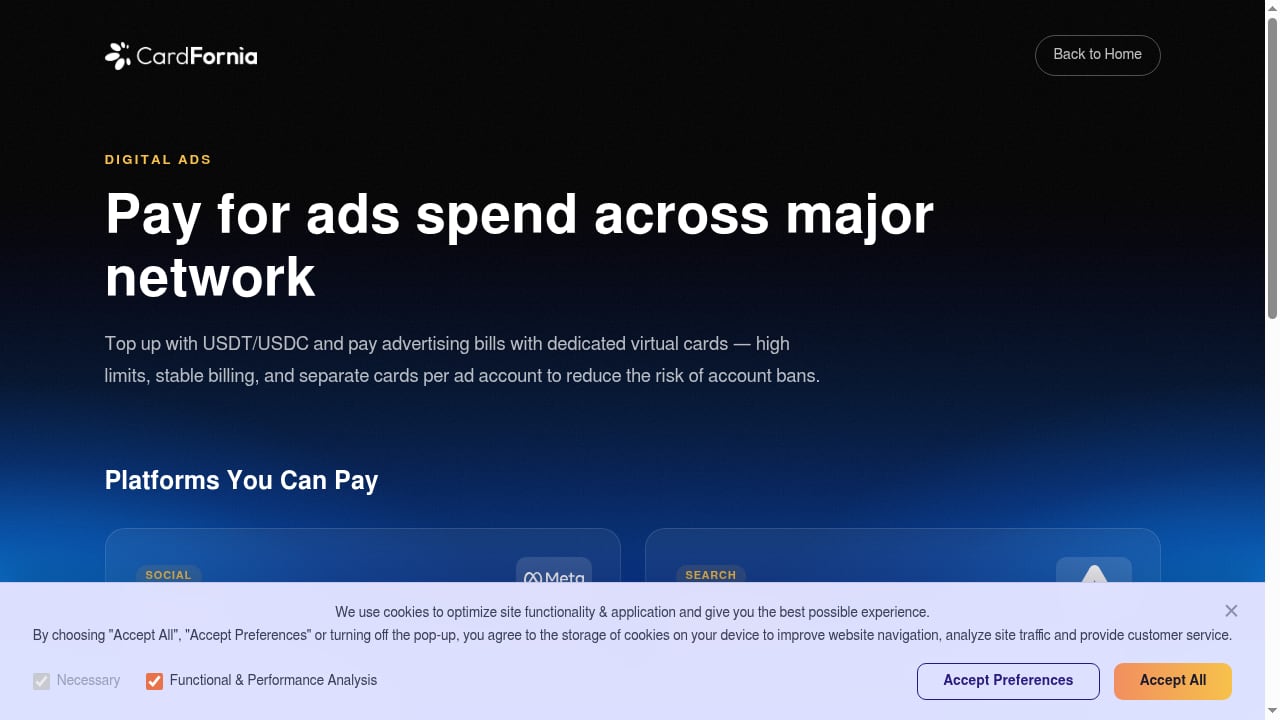
Meta, Google, TikTok, and AppLovin bill in multiple currencies and can suspend accounts over payment failures. A dedicated ad-spend card with a set limit and rapid top-up keeps campaigns running without exposing the main treasury.
AI agent payments
Autonomous agents need a payment method that can be scoped tightly. Dynamic issuance, merchant whitelisting, and minute-level authorization let an agent pay only for the tools it is permitted to use, while audit logs give operators a record of every transaction.
Global purchases and travel
Flights, hotels, and international vendor purchases can be paid on a card funded in stablecoins, avoiding a separate FX conversion step at the bank.
How to evaluate a global business payments provider
First viewport screenshot of www.cardfornia.com.
Not every stablecoin card is built the same. Use these criteria:
- Custody model. Does the provider hold your funds, or do you? Self-custody reduces counterparty exposure but requires key management discipline.
- Licensing and issuance. Who issues and processes the card, and which licenses do they hold? Cardfornia's cards are issued through licensed white-label providers holding MSO, API, MSB, MTL, and other licenses.
- Spend controls. Look for per-card limits, merchant whitelists, and short authorization windows rather than a single company-wide card.
- Audit and reconciliation. Confirm that transaction logs can be exported and matched to vendors.
- Funding assets. Check which stablecoins are supported and on which networks.
- Fees. Card creation fees, transaction fees, and any subscription costs should be modeled against your expected volume.
For a broader comparison of platforms, see our ranked review of stablecoin money apps and crypto cards and the head-to-head Cardfornia vs Ramp vs Digitap breakdown.
A practical setup sequence
A workable rollout for a small finance team looks like this:
- Open a self-custody wallet and fund it with USDT or USDC.
- Create a dedicated sub-account with the card provider through Cardfornia.
- Issue one card per vendor or agent, starting with the highest-friction payment, such as ad platforms or cloud billing.
- Set merchant whitelists and limits based on the benchmarks above.
- Reconcile weekly using audit logs, then adjust limits as spend patterns stabilize.
This sequence keeps the first card small and testable. Once the workflow is proven, expanding to more vendors is straightforward.
Risks and limits to plan for
Stablecoin payments introduce their own operational requirements. Key management must be handled carefully, because self-custody means lost keys are lost funds. Stablecoin values can deviate slightly from the dollar, so treasury teams should monitor peg stability. On-chain transfer times and network fees vary by chain. And card acceptance still depends on the underlying card network, so some merchants may remain out of reach.
Regulatory treatment of stablecoins and crypto cards also differs by jurisdiction. Businesses should confirm their own compliance obligations before routing significant spend through any crypto-funded card.
Related reading
- Top 10 Stablecoin Money Apps & Crypto Cards 2026 - Ranked 2026 review of stablecoin money apps and crypto cards, scored on global coverage, card acceptance, fees, yield, and self-custody.
- Cardfornia vs Ramp vs Digitap: Which Fits Your Business? - Compare Cardfornia, Ramp, and Digitap on crypto payments, spend management, and multi-currency banking to pick the right platform for your business.
- Cardfornia vs Bitsa Card: Which Crypto Card Fits? - Cardfornia vs Bitsa Card: compare self-custody, AI agent payments, fees, cashback, and global coverage to pick the right crypto card for business or everyday spend.
Sources and further reading
- Global Business Pay | Online E-Wallet & Global Payment Solutions - Global Business Pay is an online e-wallet and payment platform for digital payments, money transfers, cross-border transactions and international payment solutions.
- Global Payments: Payment Solutions and Software - Global Payments delivers flexible, future-ready payment processing solutions, software and systems that fuel the growth of businesses and organizations of all sizes. Learn more today.
FAQ
What is a global business payment? It is any payment a company makes to a counterparty in another country, including supplier invoices, SaaS subscriptions, ad spend, and contractor payments. The term covers both the movement of funds and the currency conversion involved.
Can a stablecoin virtual card be used for international suppliers? Yes, where the supplier accepts card payments. The card settles in fiat through the issuer, while the business funds it with USDT or USDC.
Does Cardfornia hold customer funds? Cardfornia is designed around self-custody: users hold their own keys and fund a dedicated sub-account with the licensed card provider when they want to spend.
Are stablecoin cards suitable for AI agents? They can be, provided the card supports tight scoping. Merchant whitelisting, per-card limits, and minute-level authorization are the controls that make agent spending manageable.
How much does a Cardfornia card cost? Pricing is not detailed publicly in the product context; the model involves card creation fees and potentially transaction or subscription fees. Confirm current pricing directly before committing to volume.
Conclusion
Global business payments do not have to mean multi-day wires and unpredictable FX costs. Stablecoin virtual cards give finance teams a faster funding path, tighter spend controls, and clearer audit trails, particularly for subscriptions, ad platforms, and AI-agent purchases. Cardfornia's self-custody model, licensed issuance partners, and dynamic card controls make it a credible option for businesses already operating in stablecoins. Start with one high-friction vendor, measure the results, and expand from there.
For a closer look at how Cardfornia compares with other stablecoin card platforms, read Cardfornia vs KAST.