
Rizon Review 2026: Stablecoin Wallet, Visa Card & Fees

Rizon Review 2026: A Non-Custodial Stablecoin Wallet With Visa Spending
Rizon is a global USD stablecoin wallet that positions itself as a dollar banking alternative. It lets users hold, send, spend, save, and invest digital dollars across 122 countries, with self-custody at the core and a Visa-enabled card for real-world payments. This review breaks down how Rizon works, who it suits, where it falls short, and what to check before you trust it with your everyday money.
If you are comparing stablecoin money apps more broadly, our ranked 2026 review of stablecoin money apps and crypto cards puts Rizon in context against alternatives.
What Rizon actually is

First viewport screenshot of www.getrizon.com.
Rizon is not a bank. It is a non-custodial wallet built around USD stablecoins such as USDC, combined with card infrastructure that makes those balances spendable at merchants. The pitch is simple: keep custody of your dollars, skip the seed-phrase friction, and use a Visa card for purchases and withdrawals.
Three pieces of infrastructure matter:
- Privy handles onboarding so users do not manage a traditional seed phrase while the wallet remains self-custodial.
- Rain provides the card rails that convert stablecoin balances into spendable money at merchants.
- Visa acceptance gives the card reach at millions of merchants worldwide.
That combination is the product. Rizon is a bridge between stablecoin balances and everyday finance, not a yield product or a full-service bank account.
Who Rizon is built for
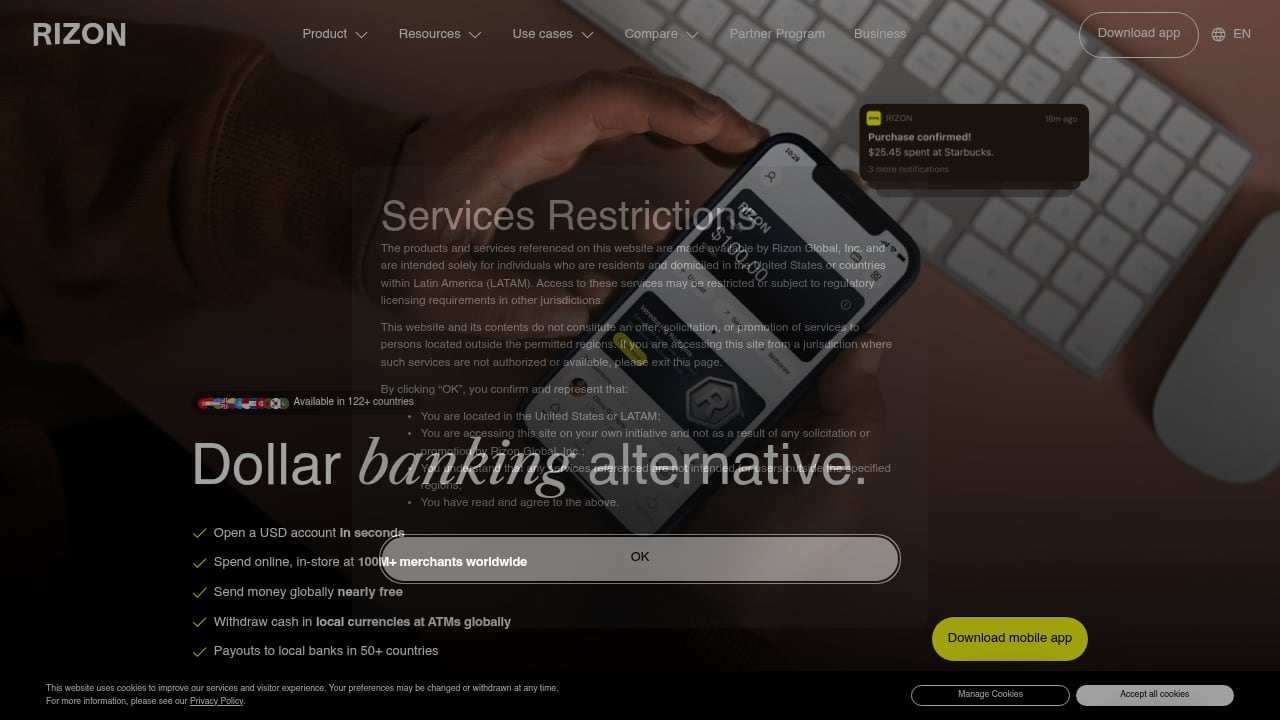
First viewport screenshot of getrizon.com.
Rizon fits people who want dollar exposure and card spending without opening a traditional bank account, and who value holding their own keys. Typical users include:
- Freelancers and remote workers paid in stablecoins who need to spend locally.
- People in markets with currency instability who want a digital dollar savings and spending account.
- Crypto-comfortable individuals who want card payments without moving funds to a custodial exchange.
- Travelers and cross-border households sending and spending dollars across countries.
It is a weaker fit for users who want deposit insurance, credit products, or a full business spend-management stack. If your needs lean toward team cards and controls, see our comparison of stablecoin cards for global business payments.
Core features and how they work
Non-custodial stablecoin wallet
You hold the wallet, not Rizon. Balances sit in stablecoins rather than a fiat account, which means your access depends on your own key management and recovery process. Self-custody is a real advantage for censorship resistance and portability, but it also means there is no customer service line that can reverse a mistaken transfer.
Visa spending via Rain
Through the Rain partnership, Rizon turns stablecoin balances into money that can be spent at Visa merchants. In practice, that means funding the card from your stablecoin balance and using it for groceries, subscriptions, travel, and online purchases. Settlement mechanics and any conversion spread are the details to verify before relying on the card for large expenses.
Privy-powered onboarding
Privy simplifies crypto onboarding without giving up self-custody, removing the seed-phrase step that stops many newcomers. This is one of Rizon's clearest usability advantages: the learning curve is shorter than a typical self-custody wallet, even though the underlying model is the same.
Global reach
Rizon advertises availability across 122 countries. Coverage claims are worth testing against your specific country, because card issuance, supported stablecoins, and local regulations often vary by region.
Strengths
- Self-custody without seed-phrase friction. Privy onboarding lowers the barrier while keeping the non-custodial model.
- Real spending, not just holding. Visa acceptance through Rain makes stablecoins usable at mainstream merchants.
- Dollar access in weak-currency markets. A USD stablecoin wallet can function as a savings and payments account where local banking is unreliable.
- Simple mental model. Hold dollars, spend dollars, send dollars. The product does not overload users with DeFi complexity.
- Global orientation. The 122-country positioning is broader than many crypto cards that concentrate on a handful of markets.
Limitations and risks
- No deposit insurance. Stablecoin balances are not FDIC-insured bank deposits. You carry issuer and smart-contract risk.
- Self-custody means self-recovery. If you lose access, recovery depends on the wallet's safeguards, not a bank's fraud team.
- Pricing transparency varies. Card fees, conversion spreads, and withdrawal costs are the numbers that decide whether Rizon is cheap or expensive in practice. Confirm them in-app for your region.
- Regulatory exposure. Stablecoin rules and card programs change by country; availability can shift.
- Limited banking features. No credit, no lending, and no traditional account protections. It is a wallet plus a card, not a bank.
- Review depth is thin. Public review coverage is limited, so user sentiment should be treated as directional rather than definitive. Sources such as G2's Rizon pros and cons page and BitDegree's Rizon review are useful starting points but not a substitute for your own testing.
Pricing signals: what to check before committing
Rizon's public materials emphasize access and usability more than a published fee schedule, so treat pricing as something to verify rather than assume. The costs that matter most are:
- Card issuance and monthly fees — is there a cost to get or keep the card?
- Conversion spread — the gap between the stablecoin you hold and the fiat a merchant receives.
- ATM and withdrawal fees — cash access is usually where costs hide.
- Network and funding fees — moving stablecoins onto the wallet can cost gas or transfer fees.
- Inactivity or minimum-balance terms — less common, but worth checking.
A practical test: run one small purchase and one small withdrawal, then compare the amount debited against the amount received. That single experiment tells you more than most marketing pages.
Setup: what to expect
Setup is designed to be short. The general flow looks like this:
- Download the app and create a wallet through the Privy-powered onboarding.
- Secure your account with the recovery method the app provides, and store any backup credentials offline.
- Fund the wallet with a supported stablecoin such as USDC.
- Request the Visa card and complete identity verification where required.
- Make a small test purchase, then confirm fees and settlement in your transaction history.
Because the wallet is non-custodial, the recovery step deserves more attention than the rest of setup combined. Treat it like the keys to a safe, not a password reset.
How Rizon compares
First viewport screenshot of getrizon.com.
Rizon sits in the stablecoin wallet-plus-card category alongside products such as Gnosis Pay and other self-custody cards. The main decision axes are:
- Custody model: self-custody versus custodial exchange accounts.
- Card reach: Visa acceptance versus narrower networks.
- Onboarding friction: Privy-style onboarding versus seed-phrase wallets.
- Cost structure: spreads and card fees versus flat subscriptions.
- Regional support: whether your country is actually served.
For a broader field comparison, see our Cardfornia vs Airwallex vs Gnosis Pay breakdown, which covers custody, card issuance, and spend controls in 2026.
Decision criteria: is Rizon right for you?
First viewport screenshot of getrizon.com.
Choose Rizon if you answer yes to most of these:
- You want to hold USD stablecoins yourself rather than on an exchange.
- You need a Visa card that spends from a stablecoin balance.
- You live in or transact with a market where dollar banking is hard to access.
- You are comfortable with self-custody recovery and basic crypto operations.
Look elsewhere if any of these apply:
- You need deposit insurance or regulated bank protections.
- You want credit, lending, or a full business expense platform.
- You require published, predictable fee schedules before signing up.
- Your country is not supported for card issuance.
Related reading
- Cardfornia vs Ramp vs Digitap: Which Fits Your Business? - Compare Cardfornia, Ramp, and Digitap on crypto payments, spend management, and multi-currency banking to pick the right platform for your business.
- Cardfornia vs Bitsa Card: Which Crypto Card Fits? - Cardfornia vs Bitsa Card: compare self-custody, AI agent payments, fees, cashback, and global coverage to pick the right crypto card for business or everyday spend.
Sources and further reading
- Rizon Reviews November 2026: Details, Pricing, & Features | G2 - Filter reviews by the user's company size, role or industry to find out how Rizon works for a business like yours (as of November 2026).
FAQ
Is Rizon a bank?
No. Rizon is a non-custodial stablecoin wallet with a Visa card program. Balances are held in stablecoins, not as insured bank deposits.
Does Rizon hold my funds?
Rizon is designed as non-custodial, meaning you control the wallet. Onboarding through Privy reduces seed-phrase friction but does not turn the product into a custodial account.
Can I spend USDC with Rizon?
Yes. Through its Rain partnership, Rizon converts stablecoin balances into spendable money at Visa merchants. Check supported stablecoins and conversion terms for your region.
How much does Rizon cost?
Pricing depends on card fees, conversion spreads, and withdrawal costs, which can vary by country. Verify the current schedule in the app before relying on it for large payments.
Which countries does Rizon support?
Rizon states coverage across 122 countries. Availability of card issuance and specific features can differ by region, so confirm your country during onboarding.
Is Rizon safe?
Self-custody reduces counterparty risk but shifts responsibility to you. Stablecoin issuer risk, smart-contract risk, and recovery risk remain. Use small test transactions first.
Conclusion
Rizon's strongest idea is combining self-custody with everyday spendability: a stablecoin wallet that behaves more like a dollar account, with Visa acceptance and simplified onboarding. It is a good fit for crypto-comfortable users who want dollar access and card spending without a traditional bank, especially in markets where dollar banking is difficult.
The caveats are equally clear. There is no deposit insurance, recovery is your responsibility, and fee transparency needs hands-on verification. Treat Rizon as a useful tool in a broader money stack rather than a full bank replacement, and test it with small amounts before making it your primary spending account.