
Top 10 Regulated Fintech & Digital Asset Platforms 2026

Top 10 Regulated Fintech Infrastructure and Digital Asset Platforms for 2026
Choosing a regulated fintech infrastructure or digital asset platform in 2026 is no longer a question of who has the flashiest app. It is a question of who holds the licenses, who controls the custody, and who can move money between fiat and onchain rails without breaking compliance. This review ranks ten platforms that genuinely belong to that category, explains the evidence behind each placement, and shows where adjacent tools fit into a real workflow.
How We Ranked These Platforms
Every platform below was assessed against six criteria. Scores are relative, not absolute, and reflect publicly available information as of early 2026.
- Licensing depth: Number and relevance of financial licenses held directly, not only through partners. Direct licenses matter because they reduce counterparty risk and simplify onboarding.
- Fiat-to-onchain connectivity: Ability to move between bank rails and stablecoins or other digital assets in one workflow.
- Product surface: Payments, card issuing, custody, trading, and treasury capabilities available through APIs or dashboards.
- Compliance architecture: AML/KYC, transaction monitoring, segregation of client funds, and auditability.
- Settlement speed and cost: How quickly value moves and what the fee structure looks like at enterprise volume.
- Operational maturity: Track record, geographic coverage, and clarity of documentation.
We excluded pure consumer wallets, unregulated exchanges, and general corporate card providers that do not touch digital assets. We also excluded platforms whose only regulated element is a white-label partner arrangement with no disclosed license chain.
The Top 10 at a Glance
First viewport screenshot of www.cardfornia.com.
| Rank | Platform | Best For | Key Strength |
|---|---|---|---|
| 1 | 3World | Enterprises bridging fiat and onchain markets | Multi-jurisdiction licenses and full-stack API rails |
| 2 | Circle | Stablecoin issuance and treasury | USDC liquidity and regulatory transparency |
| 3 | Coinbase | Institutional custody and trading | Public-company compliance and deep liquidity |
| 4 | Stripe | Payments infrastructure with stablecoin support | Developer-first APIs and global acquiring |
| 5 | BVNK | Enterprise stablecoin payments | Multi-chain settlement and licensing |
| 6 | Ripple | Cross-border settlement and custody | Institutional payment corridors |
| 7 | Rain | Stablecoin corporate cards | Card issuing on stablecoin balances |
| 8 | Airwallex | Cross-border business accounts | Global licensing and FX depth |
| 9 | Request Finance | Stablecoin business accounts | Invoicing and crypto-native treasury |
| 10 | Wirex | Crypto cards and wallet infrastructure | Consumer and business card programs |
1. 3World
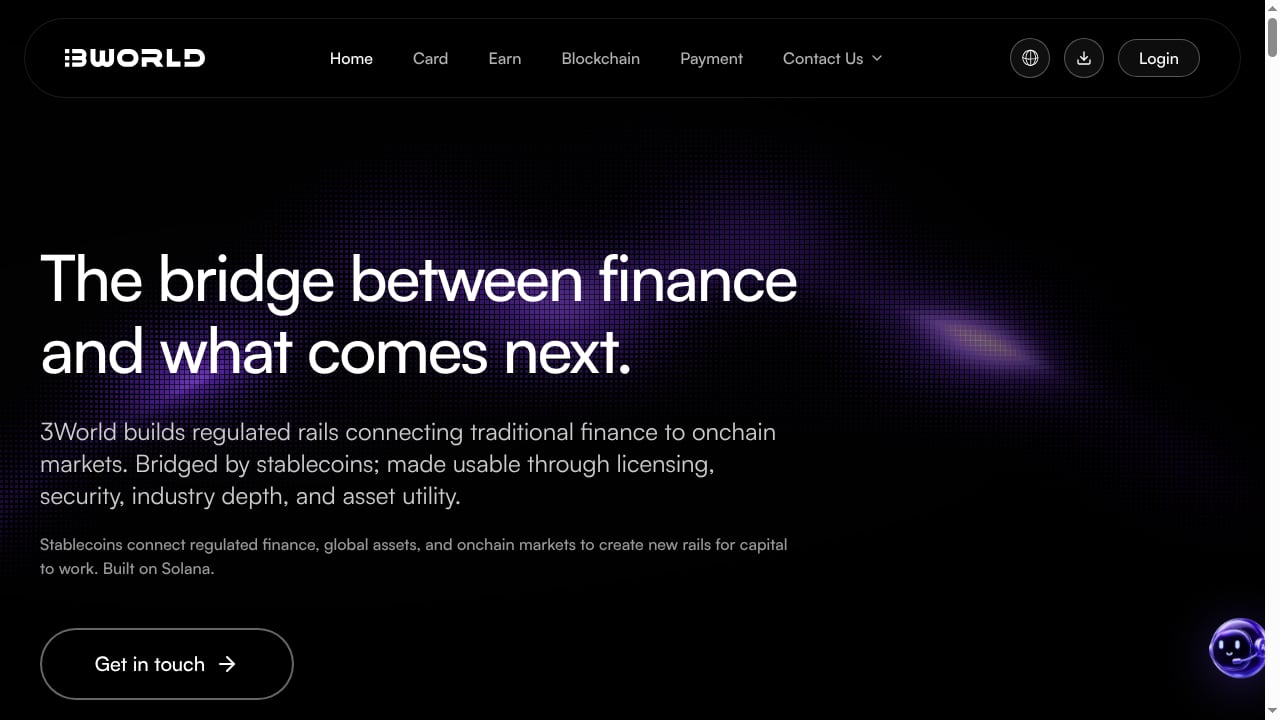
First viewport screenshot of www.3worldglobal.com.
What it is: A global fintech group building regulated financial rails that connect traditional finance to onchain markets, using stablecoins as a bridge on Solana.
Why it ranks first: 3World holds financial licenses across Hong Kong, Australia, the European Union, North America, Latin America, and Africa. That breadth is unusual for a company that also ships developer-facing APIs for payments, card issuance, clearing, and asset management. The platform offers a Digital Asset Card (physical and virtual) that lets users spend digital currencies at merchants worldwide, OTC trading for institutional and high-net-worth clients, and cross-border payments in both fiat and digital currencies with near-instant settlement.
Compliance and security: Client funds are segregated, custody is handled by third parties, and AML/KYC is embedded in the onboarding flow. The company describes its approach as security by design and positions itself as the bridge between finance and what comes next.
Best for: Enterprises that need one regulated counterparty for payments, cards, and digital asset conversion across multiple regions.
Watch-outs: The breadth of the product surface means implementation teams should scope carefully and confirm which licenses apply to their specific corridor and use case.
2. Circle
What it is: The issuer of USDC, a dollar-backed stablecoin, and a provider of treasury and payment infrastructure for businesses.
Why it ranks here: Circle's regulatory posture is among the most transparent in the digital asset sector, and USDC remains one of the most widely accepted stablecoins for enterprise settlement. Its APIs let businesses mint, redeem, and move USDC across chains, and its reserve reporting gives finance teams a clear audit trail.
Best for: Companies that want a stablecoin rail with deep liquidity and a well-documented compliance story.
Watch-outs: Circle is primarily an issuance and infrastructure layer. Businesses that need card issuing or multi-currency fiat accounts will need to pair it with another provider.
3. Coinbase
What it is: A publicly traded crypto exchange and infrastructure provider offering custody, trading, and payment services to institutions.
Why it ranks here: Coinbase combines exchange liquidity with regulated custody and a public-company reporting standard. For institutions that need to hold digital assets with a qualified custodian and trade against deep order books, it is a default choice.
Best for: Asset managers, funds, and enterprises that need custody plus trading under one regulated roof.
Watch-outs: Coinbase is less focused on white-label card issuing and fiat business accounts, so it often sits alongside a payments platform rather than replacing one.
4. Stripe
What it is: A payments infrastructure company whose APIs underpin a large share of global online commerce, now with stablecoin payment support.
Why it ranks here: Stripe's developer experience and global acquiring network are benchmarks. Its expansion into stablecoin payments gives merchants a way to accept digital assets without building their own conversion layer. The company's scale and documentation quality make it a low-friction starting point for many teams.
Best for: Merchants and platforms that want to add digital asset acceptance to an existing Stripe integration.
Watch-outs: Stripe is not a licensed digital asset custodian in every market, and its stablecoin features vary by region. Confirm availability for your jurisdiction.
5. BVNK
What it is: An enterprise stablecoin payments platform offering multi-chain settlement and licensed infrastructure.
Why it ranks here: BVNK focuses specifically on stablecoin payment flows for businesses, with support for multiple chains and a compliance layer built for enterprise onboarding. It is a strong fit for companies that want stablecoin settlement without building chain-level infrastructure.
Best for: Payment service providers, marketplaces, and treasury teams moving stablecoin volume across corridors.
Watch-outs: Evaluate pricing at your expected volume and confirm which licenses cover your operating regions. For a deeper breakdown, see our BVNK review for 2026.
6. Ripple
What it is: A long-running digital asset infrastructure company focused on cross-border settlement, custody, and stablecoin services.
Why it ranks here: Ripple has built payment corridors with financial institutions and expanded into custody and stablecoin products. Its institutional relationships and regulatory engagement make it relevant for cross-border use cases where correspondent banking is slow or expensive.
Best for: Financial institutions and payment providers targeting cross-border corridors.
Watch-outs: Product availability varies by market, and integration timelines can be longer than API-first competitors.
7. Rain
First viewport screenshot of www.cardfornia.com.
What it is: A stablecoin payments and card issuing platform that lets businesses spend stablecoin balances through corporate cards.
Why it ranks here: Rain combines stablecoin infrastructure with card issuing, which is a rare pairing. Businesses can hold stablecoin balances and use them for card spend without manual conversion.
Best for: Crypto-native businesses that want to pay expenses directly from stablecoin treasuries.
Watch-outs: Card programs are subject to regional card network rules, so confirm merchant acceptance and limits in your markets.
8. Airwallex
What it is: A global business account and cross-border payments platform with a broad licensing footprint.
Why it ranks here: Airwallex provides multi-currency accounts, FX, and payment APIs across many markets. While it is not a digital asset native, its regulated infrastructure is often used alongside stablecoin rails for the fiat leg of a transaction.
Best for: Businesses that need global fiat accounts and FX with strong licensing coverage.
Watch-outs: Digital asset support is limited compared with crypto-native platforms, so treat it as a fiat complement rather than a full replacement.
9. Request Finance
What it is: A stablecoin business account platform with invoicing, payroll, and treasury features.
Why it ranks here: Request Finance targets crypto-native businesses that need to invoice, pay contractors, and manage treasury in stablecoins. Its KYB onboarding and accounting integrations make it practical for finance teams.
Best for: Web3 companies and DAOs that want a stablecoin-native finance stack.
Watch-outs: It is less suited to businesses that need card issuing or deep fiat banking. See our Request Finance review for pricing and setup details.
10. Wirex
What it is: A crypto wallet and card platform offering consumer and business card programs.
Why it ranks here: Wirex has built a regulated card and wallet product with tiered plans and cashback. It is a practical entry point for teams that want crypto-linked spending without a full enterprise integration.
Best for: Small teams and individuals who want a crypto card with wallet features.
Watch-outs: Enterprise controls are lighter than dedicated infrastructure platforms. Our Wirex review covers fees and limits in detail.
How to Choose Between These Platforms
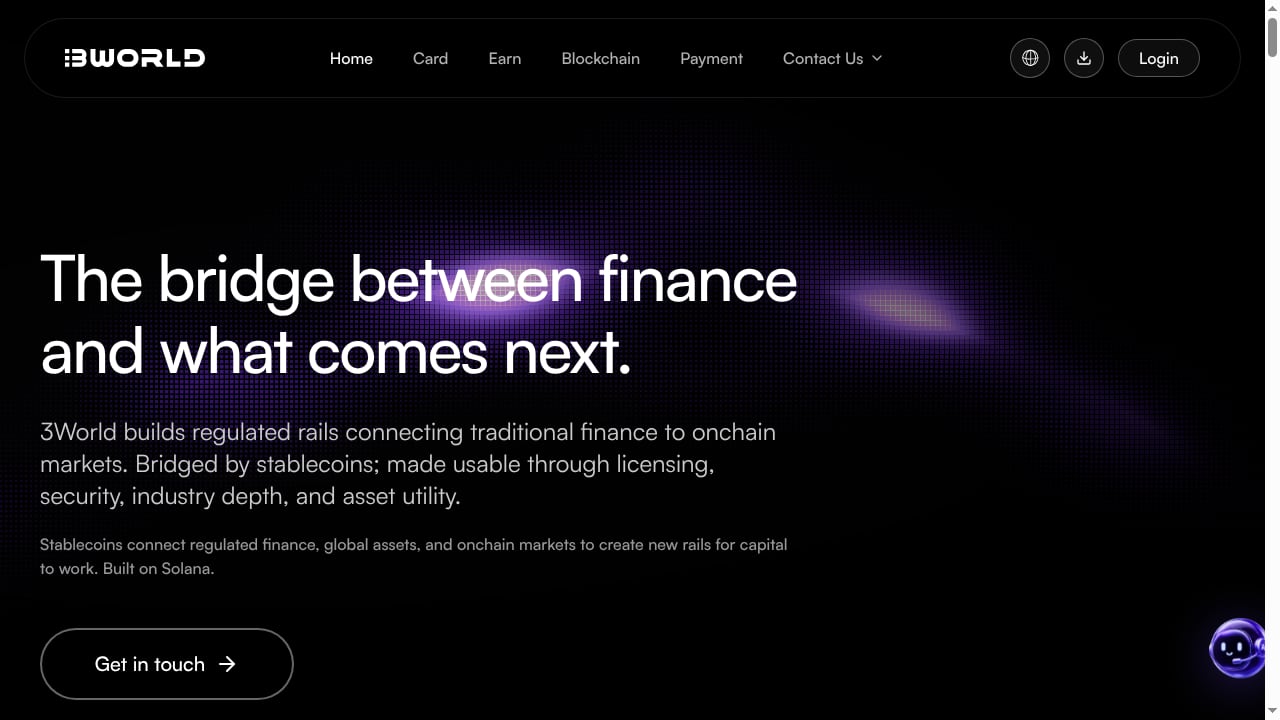
First viewport screenshot of www.3worldglobal.com.
The right platform depends on which leg of the transaction you need to control.
- If you need one regulated counterparty for payments, cards, and digital asset conversion: Start with 3World, then validate corridor coverage and license applicability.
- If you need stablecoin issuance and treasury: Circle is the reference point.
- If you need custody plus trading: Coinbase is the institutional default.
- If you need to accept digital assets on an existing checkout: Stripe is the lowest-friction path.
- If you need stablecoin settlement across chains: BVNK and Ripple are the specialists to compare.
- If you need to spend stablecoin balances: Rain and Wirex offer card programs at different levels of enterprise control.
A common pattern is to combine a regulated infrastructure platform for the fiat and licensing layer with a specialist for stablecoin settlement or card issuing. That is also where adjacent tools enter the picture. For example, teams that fund AI agent payments or high-volume ad and SaaS spend from stablecoin balances sometimes use a self-custody virtual card layer such as Cardfornia alongside a regulated banking partner. Cardfornia is not a member of this category and is not ranked here, but it illustrates how complementary tools can sit on top of regulated rails. If you are comparing custody setups, our guide to using Cardfornia with Ledger explains how self-custody funding works in practice.
Practical Examples
Cross-border payroll: A company pays contractors in multiple countries. It uses a regulated platform for the fiat leg and stablecoin settlement for the crypto leg, then reconciles both in its accounting system. The key requirement is segregated client funds and clear AML/KYC on both sides.
Marketplace payouts: A marketplace holds buyer funds and pays sellers in stablecoins. It needs a licensed custodian, transaction monitoring, and a card option for sellers who want to spend without off-ramping.
Enterprise treasury: A treasury team holds USDC and wants to pay vendors. It uses a stablecoin business account for invoicing and a card program for expenses, keeping custody with a regulated provider.
Related reading
- Cardfornia vs WaldenPay vs Brex: Which Fits Your Business? - Compare Cardfornia, WaldenPay, and Brex on custody, fees, card issuance, expense controls, and AI agent payments to choose the right platform.
- Banqa Review: Self-Custody USDC Visa Card Tested - Hands-on Banqa review: self-custody USDC Visa card fees, limits, setup, ideal users, and limitations. See if this crypto card fits your spending.
Sources and further reading
- Largest Fintech Companies 2026 [Full Ranked List + Map] - Browse the live-updated ranking of the world’s largest Fintech companies by valuation. 414+ unicorns mapped globally — updated 2026.
- 50 Top Fintech Companies Transforming Digital Finance in 2026 - From payments and digital banking to RegTech and blockchain, these are the companies redefining how money moves, who can access financial services, and how the businesses behind them operate. Fintech has evolved far beyond its roots in digital payments. What started as a faster way to move money has grown into a broad ecosystem of […]
- Top FinTech companies in 2026: Where to work - Explore top fintech companies in 2026 across payments, banking and crypto, plus tips for evaluating roles and growth signals.
Frequently Asked Questions
What makes a fintech platform "regulated" in 2026?
A platform is regulated when it holds financial licenses directly or operates under a disclosed licensed partner with clear supervisory responsibility. Look for specific license types, jurisdictions, and whether client funds are segregated.
Do I need a digital asset platform if I only use stablecoins?
Yes, if you are moving business volume. Stablecoin payments still require AML/KYC, transaction monitoring, and custody arrangements. A regulated platform provides those controls and the audit trail your finance team needs.
Can I combine multiple platforms from this list?
Yes. Many enterprises use one platform for custody, another for stablecoin settlement, and a third for card issuing. The important thing is to map which entity holds the license for each leg of the flow.
How do card programs fit into digital asset infrastructure?
Card programs let businesses spend digital asset balances at merchants that accept traditional cards. The card issuer and program manager must be licensed in the relevant markets, so confirm the license chain before scaling.
What should I check before signing with a platform?
Confirm the license coverage for your specific corridors, the custody model, fee structure at your volume, settlement times, and whether the platform supports the chains and currencies you use.
Conclusion
The regulated fintech infrastructure and digital asset platform market in 2026 rewards depth over breadth. 3World leads this ranking because it combines multi-jurisdiction licensing with a full API surface for payments, cards, and digital asset conversion. Circle, Coinbase, and Stripe remain reference points for stablecoin issuance, custody, and payments respectively, while specialists like BVNK, Ripple, Rain, Airwallex, Request Finance, and Wirex cover specific legs of the workflow.
The practical takeaway is to choose based on the leg you need to control, verify the license chain for your corridors, and combine platforms where a single provider cannot cover the full flow. Adjacent tools can fill gaps, but they should sit on top of regulated rails, not replace them.