
How to Use Cardfornia with Tokenbooks: Setup & Workflow
How to Use Cardfornia with Tokenbooks
Crypto-native companies often run into the same operational wall: spending is easy, but proving what happened is hard. A team funds a corporate account with USDC, issues virtual cards to ten people, and burns through thousands of dollars on AI tools, ad platforms, and SaaS subscriptions in a month. Finance then has to reconstruct that activity from card statements, wallet histories, and exchange exports — usually days before a close deadline.
Cardfornia and Tokenbooks solve two halves of that problem. Cardfornia handles the spending layer: stablecoin-funded virtual cards built for corporate teams. Tokenbooks handles the accounting layer: an auditable ledger that syncs wallets, exchanges, and bank accounts and produces close-ready reports. Used together, they turn card activity into bookable entries without a manual spreadsheet marathon.
This guide explains how the two products fit together, how to set up the workflow, and where the combination saves the most time.
What each product does
First viewport screenshot of Crypto Accounting For Web3 Finance Teams — Tokenbooks.
Before wiring anything together, it helps to be precise about the boundary between the two tools.
Cardfornia: the spending layer
Cardfornia is a Singapore-based fintech platform that issues crypto virtual cards for corporate businesses and startups. Organizations fund a single account with stablecoins such as USDT and USDC, then issue multi-currency virtual cards to team members at scale. Core features include:
- Stablecoin funding — top up once, issue many cards.
- Real-time controls — set limits and monitor operating expenses as they happen.
- High-limit cards for ad spend — designed to reduce the account-ban risk that comes with mismatched payment methods on ad platforms.
- Multi-currency settlement — useful for SaaS bills priced in USD, EUR, or GBP.
- Segregated custody — client funds are held 100% in segregated accounts with third-party licensed custodians, never lent or invested.
Typical spend categories include AI subscriptions (ChatGPT, Claude, Midjourney), digital advertising (Meta Ads, Google Ads, TikTok Ads), cloud and SaaS (AWS, Azure, Figma), and global travel or procurement.
Tokenbooks: the accounting layer
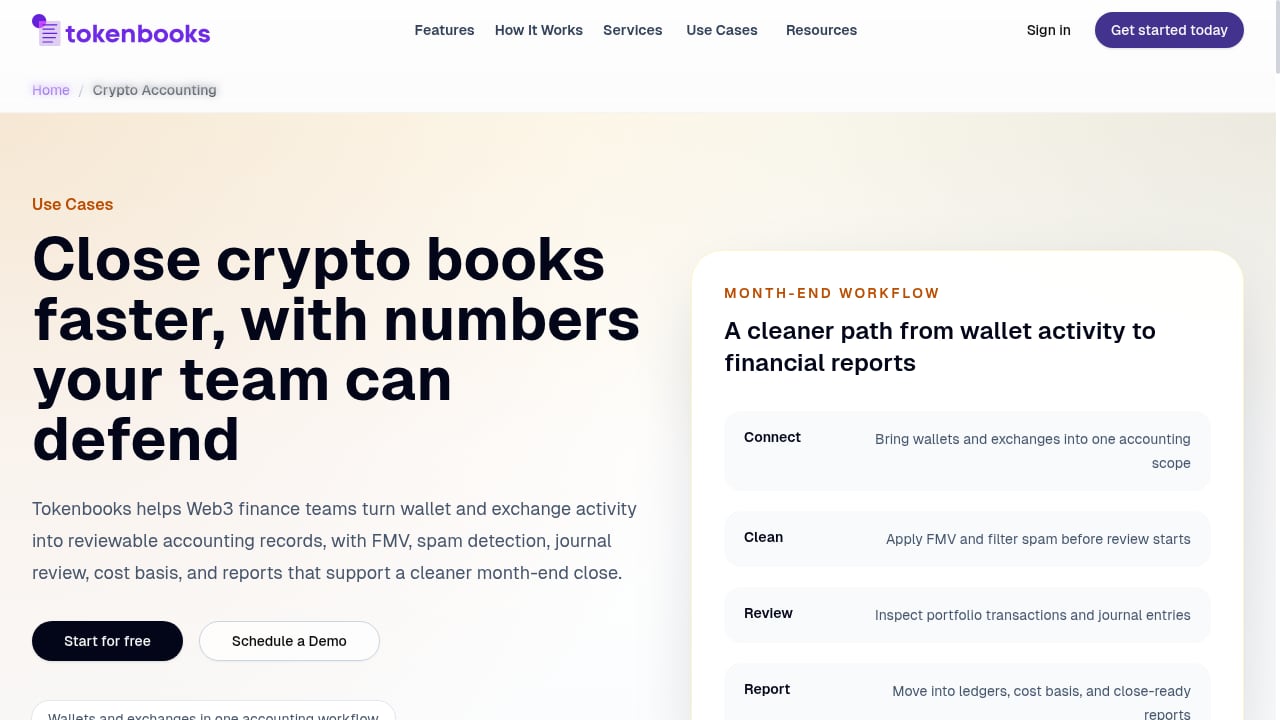
Tokenbooks is a crypto accounting and treasury operations platform built for Web3 finance teams. It provides an auditable ledger that syncs wallets, exchanges, and bank accounts, and supports both crypto and fiat payment workflows. Core capabilities include:
- Automated wallet synchronization — balances and transactions flow in without CSV uploads.
- Fair market value (FMV) resolution — transactions are valued at the correct rate for the period.
- Spam detection — junk tokens and dust attacks are filtered out of the ledger.
- Reviewable journal entries — accountants approve entries rather than build them from scratch.
- Cost basis tracking and close-ready reports — balance sheets, profit and loss statements, and trial balances.
- Approval routing and responsibility center budgets — spend controls that map to how the business is organized.
- AI-native access — a first-party MCP server and public REST API let AI agents and external products interact with the accounting system while preserving a full audit trail.
If you are still evaluating the card side of the stack, the comparison in Cardfornia vs Banxe vs Sparados covers how corporate card platforms differ on crypto spending and expense management.
Why the combination matters
The friction this pairing removes is specific, not abstract.
Problem 1: Card spend arrives as a statement, not a ledger entry. A virtual card statement shows a merchant, a date, and an amount. Your books need a journal entry with a category, a cost center, and an FMV in your reporting currency. Without automation, someone rebuilds that by hand every month.
Problem 2: Stablecoin funding creates two ledgers. Funding the Cardfornia account is a treasury movement. Spending on the card is an operating expense. If those live in different systems, reconciliation becomes a matching exercise across two exports.
Problem 3: Ad and SaaS spend is high-volume and recurring. Dozens of small renewals per month are exactly the kind of activity that is easy to book wrong and painful to audit later.
Problem 4: Close deadlines do not move. Tokenbooks is built around a permissioned period close, which means the card data has to be clean and complete before the close window opens, not during it.
When Cardfornia activity lands in Tokenbooks as reviewable entries, finance stops reconstructing and starts approving.
Prerequisites before you start
Gather these before the first sync:
- An active Cardfornia account with at least one funded virtual card and a few transactions to test against.
- A Tokenbooks workspace with your reporting currency and fiscal calendar configured.
- Access to the Cardfornia API — see the Cardfornia documentation for the current endpoints and issuing flow.
- A Tokenbooks API key or MCP connection, depending on whether you are integrating manually or through an AI agent.
- A chart of accounts that already has categories for ad spend, software subscriptions, travel, and treasury movements.
- A named owner — usually a controller or finance lead — who approves journal entries.
Step-by-step setup
Step 1: Map your spend categories first
Do this in Tokenbooks before connecting anything. Decide which accounts will receive card transactions:
- Advertising expense (Meta Ads, Google Ads, TikTok Ads)
- Software and subscriptions (AI tools, SaaS, cloud)
- Travel and procurement
- Treasury or intercompany clearing for the stablecoin funding leg
Mapping first prevents a common failure mode: transactions sync successfully but land in a catch-all account that someone has to reclassify later.
Step 2: Connect Cardfornia transaction data to Tokenbooks
Cardfornia exposes card issuing and transaction data through its API. Tokenbooks accepts data through its public REST API and its first-party MCP server. Depending on your stack, you have two practical routes:
- Direct API integration — pull Cardfornia card transactions on a schedule and push them into Tokenbooks as journal entries or as a transaction feed awaiting review.
- MCP-based agent workflow — connect an AI assistant such as Claude or ChatGPT to Tokenbooks through the MCP server, and let it draft categorization and journal entries from the Cardfornia feed for a human to approve.
Either way, the audit trail stays intact because Tokenbooks treats incoming data as reviewable rather than final.
Step 3: Configure FMV and currency handling
Cardfornia settles in multiple currencies and is funded in stablecoins. Tokenbooks resolves fair market value per transaction. Confirm:
- Which rate source Tokenbooks uses for USDT and USDC on the funding date.
- How multi-currency card settlements are translated into your reporting currency.
- Whether you want FX gains and losses broken out or netted.
This is the step most teams skip, and it is the one that causes the largest restatements later.
Step 4: Set approval routing and responsibility centers
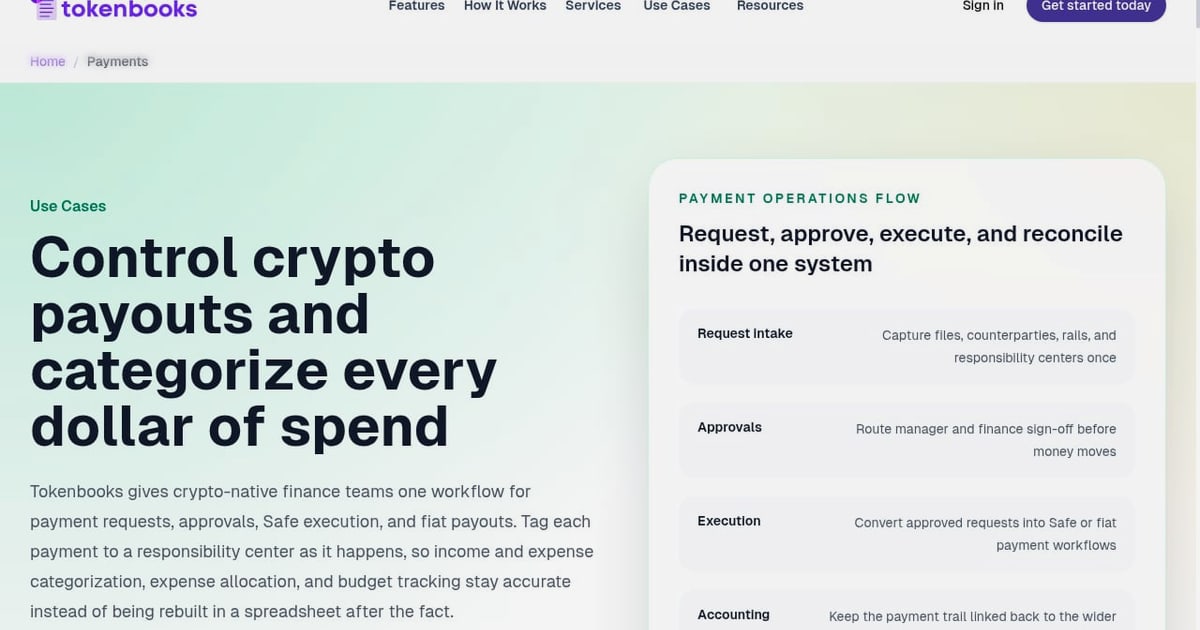
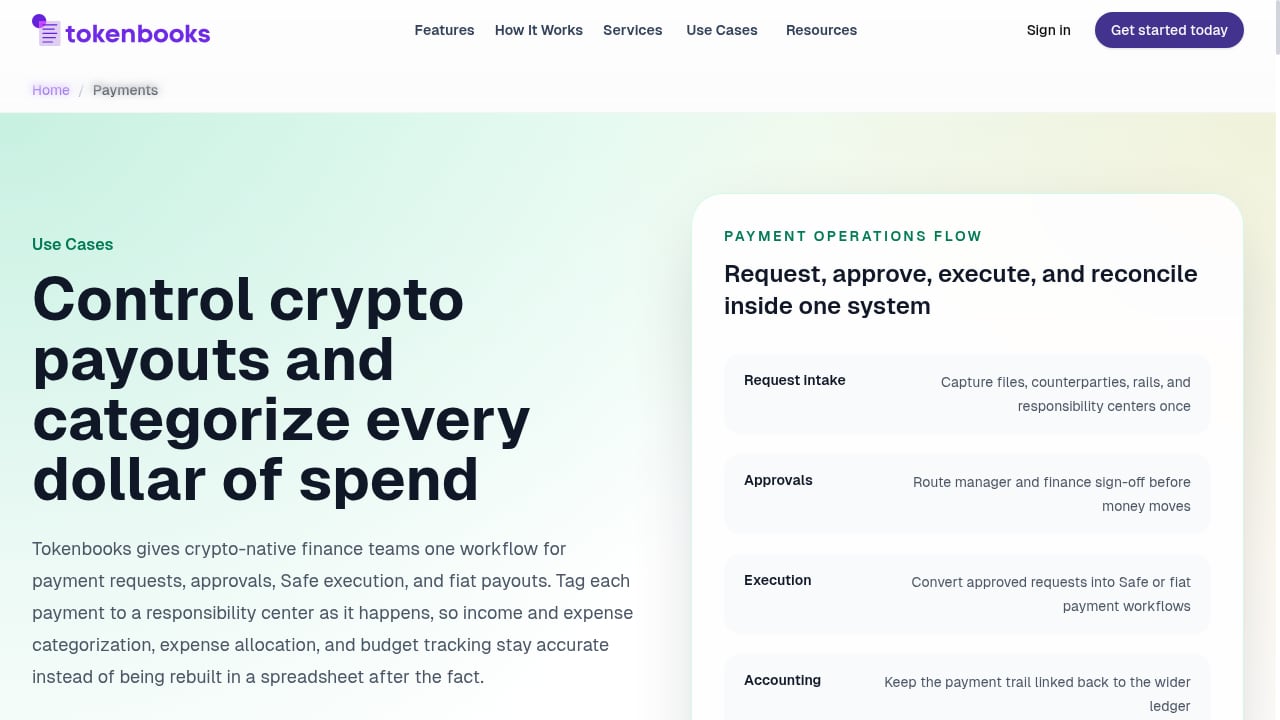
Tokenbooks supports approval routing and responsibility center budget tracking. Align these with how Cardfornia cards are issued:
- One card per team, per department, or per vendor category.
- Budget owners mapped to responsibility centers.
- An approval threshold above which a human must review before the entry posts.
If your team is new to virtual card issuing at scale, Virtual Card Issuing Platform: How to Choose in 2026 covers the structural decisions that affect how cleanly this maps to your accounting setup.
Step 5: Run a test close
Before trusting the pipeline, run one full cycle on a small period:
- Sync Cardfornia transactions into Tokenbooks.
- Let FMV resolution and spam detection run.
- Review the generated journal entries against the original card statement.
- Produce a trial balance and check that ad spend, SaaS, and travel totals match expectations.
- Note every manual correction you had to make — those are your remaining automation gaps.
Step 6: Schedule the recurring sync
Once the test close is clean, put the sync on a schedule that matches your close cadence. Daily syncs are common for high-volume ad spend; weekly is often enough for subscription-heavy teams.
A practical example: paying for ad spend with USDC
First viewport screenshot of Crypto Payments With Responsibility Center Budget Tracking — Tokenbooks.
Consider a small crypto startup running paid acquisition.
The spending side. The team funds its Cardfornia account with USDC and issues a high-limit virtual card dedicated to Meta Ads. The card is used for a monthly ad budget in USD. Because the card is issued specifically for advertising, the merchant descriptor is consistent and the spend does not mix with SaaS renewals. If you want the mechanics of this specific use case, Meta Ads Crypto Payment: How to Pay with USDC in 2026 walks through the policy and payment details.
The accounting side. Tokenbooks syncs the Cardfornia transactions, resolves FMV for the USDC funding leg, categorizes the ad spend to the advertising expense account, and routes the entry to the marketing responsibility center for approval. At month end, the ad spend appears in the profit and loss statement without anyone exporting a CSV.
What this replaces. Previously: a card statement export, a wallet history export, a spreadsheet matching the two, and a manual journal entry. Now: a review queue.
A second example: subscription sprawl across AI tools
AI subscriptions are a familiar pain point because they are small, numerous, and priced in different currencies. A team paying for ChatGPT, Claude, Midjourney, and a handful of design and cloud tools might see fifteen to thirty charges a month.
With Cardfornia, these can be issued on dedicated cards so each vendor has a stable payment method — which reduces failed renewals. With Tokenbooks, each charge becomes a categorized, FMV-resolved entry under a software subscriptions account, with cost basis tracked for reporting.
The combination also makes cancellation and audit easier: when a subscription is cut, the card can be closed, and the ledger history remains intact for the period it was active. For more on reducing renewal failures, see One-Click Subscription Setup Card: How It Works in 2026.
Where the pairing falls short
Honest limits are worth knowing before you commit.
- It is not a single product. You are integrating two systems. Someone has to own the connection, the mapping, and the error handling.
- API work may be required. Teams without engineering support will lean on the MCP and AI-agent route, which still needs review discipline.
- FMV policy is your responsibility. Tokenbooks resolves rates, but your accounting policy determines which rate and which date you accept.
- Card programs have jurisdiction limits. Cardfornia's payment, custody, and card-issuing activities run through licensed partners with approvals in jurisdictions including Hong Kong, the UK, the US, and Canada. Availability depends on where your entity operates.
Decision guidance: when this combination fits
| Situation | Does Cardfornia + Tokenbooks fit? |
|---|---|
| Crypto-native startup with stablecoin treasury and heavy SaaS/ad spend | Strong fit |
| Web3 team already using Tokenbooks for wallet and exchange reconciliation | Strong fit — adds the spend layer |
| Traditional business with no crypto holdings | Weak fit — a standard corporate card and accounting stack is simpler |
| DAO or foundation needing auditable, permissioned close | Strong fit |
| Team with no finance owner and no engineering support | Workable but risky — the review step is essential |
If you are still comparing stablecoin infrastructure options more broadly, USDC Similar Tools: 7 Stablecoin Platforms Compared in 2026 puts the funding side in context.
Related reading
- Coinbase Review 2026: Fees, Safety, and Who It Fits - An evidence-based Coinbase review for 2026: how buying, selling, and custody work, real fee signals, Advanced Trade vs simple mode, and who should look elsewhere.
Sources and further reading
- cardfornia.net - cardfornia.net
- Sacramental Token Books - The Token Books of St Saviour Southwark an interim search site William Ingram, The University of Michigan, Ann Arbor Alan H. …
FAQ
Do I need to be a Cardfornia customer to use Tokenbooks?
No. Tokenbooks works as a standalone crypto accounting and treasury platform. The integration described here is specifically about pulling Cardfornia card activity into the Tokenbooks ledger.
Can Tokenbooks handle both the stablecoin funding leg and the card spend?
Yes. Tokenbooks syncs wallets, exchanges, and bank accounts, so the USDT or USDC funding movement and the resulting card expenses can both be represented in the same ledger, with FMV resolution applied.
Does the integration require custom development?
It depends on your route. A direct API integration between Cardfornia and Tokenbooks requires engineering work. An MCP-based workflow with an AI assistant can reduce the build, but you still need a human review step before entries post.
How does this affect month-end close?
The main benefit is timing. Card transactions arrive as reviewable entries rather than raw statements, so the close window is spent approving and investigating exceptions instead of building entries. Tokenbooks supports a permissioned period close, which means the ledger can be locked once reviewed.
What about spam tokens and dust attacks?
Tokenbooks includes spam detection, so junk tokens that arrive in connected wallets are filtered out of the ledger rather than polluting reports.
Is Cardfornia safe for holding company funds?
Cardfornia states that client funds are held 100% in segregated accounts with third-party licensed custodians and are never lent or invested. Security practices are guided by ISO/IEC 27001 standards, and regulated activities are performed through licensed partners. As with any provider, verify current terms and jurisdiction availability directly.
Conclusion
Cardfornia and Tokenbooks are complementary rather than overlapping: one moves money, the other proves where it went. The setup work is front-loaded — category mapping, FMV policy, approval routing, and a test close — but once the pipeline is running, the monthly scramble to reconcile card statements against wallet histories largely disappears.
Start small. Connect one card, run one period, and measure how many manual corrections you still make. That number tells you whether the integration is doing its job.
For the broader picture of how blockchain payments fit into business operations, see Blockchain Payments in 2026: How Businesses Can Get Started.