
Cardfornia vs KAST: Which Stablecoin Card Fits Your Business?

Cardfornia vs KAST: Which Stablecoin Card Fits Your Business?
Stablecoin cards look similar at first glance: you fund with USDT or USDC, you get a card, you spend. But Cardfornia and KAST are built for different jobs. Cardfornia is a self-custody card platform for businesses and AI agents that need granular control over every transaction. KAST is a stablecoin neobank for individuals and businesses that want a USD account, a debit card, cashback, and yield on idle balances.
This comparison breaks down custody, controls, rewards, licensing, and use cases so you can choose based on how you actually move money.
Quick comparison: Cardfornia vs KAST
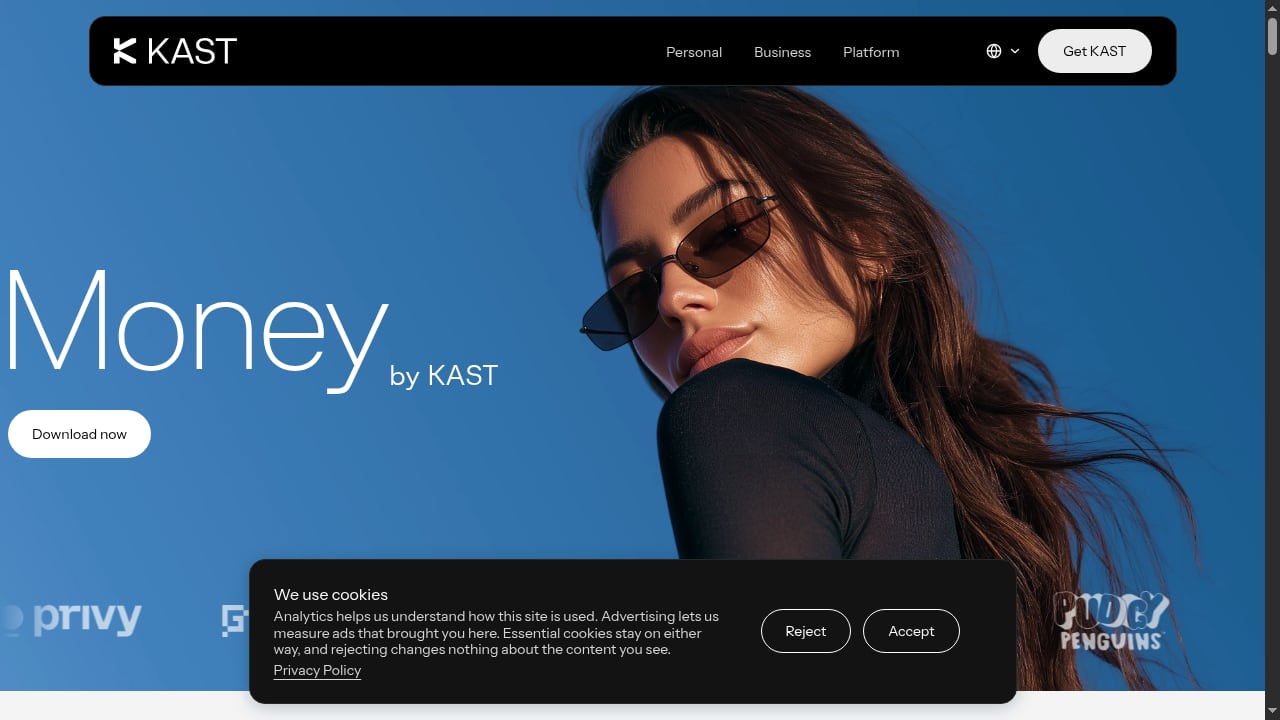
First viewport screenshot of kast.xyz.
| Dimension | Cardfornia | KAST |
|---|---|---|
| Primary audience | Businesses and AI agents making autonomous or high-volume payments | Individuals and businesses using stablecoins for everyday spending and treasury |
| Custody model | Self-custodied wallet; funds go to a dedicated sub-account with a licensed card provider, never through Cardfornia | Stablecoin account with card and vaults; custody details depend on the account structure |
| Card controls | Dynamic issuance, merchant whitelisting, minute-level authorization, full audit logs | Standard debit card controls; cashback on eligible spend |
| Rewards | Not the core pitch; focus is stability and control | Up to 3% cashback on eligible spend; up to 12% reward rate on Reserve account |
| Global reach | Built for global purchases including ads, SaaS, travel, and AI tools | 150M+ merchants in 170+ countries |
| Best for | AI agent payments, ad spend, SaaS bills, scale card issuance | Everyday spending, cross-border payments, yield on idle cash |
Custody: self-custody vs account-based holding
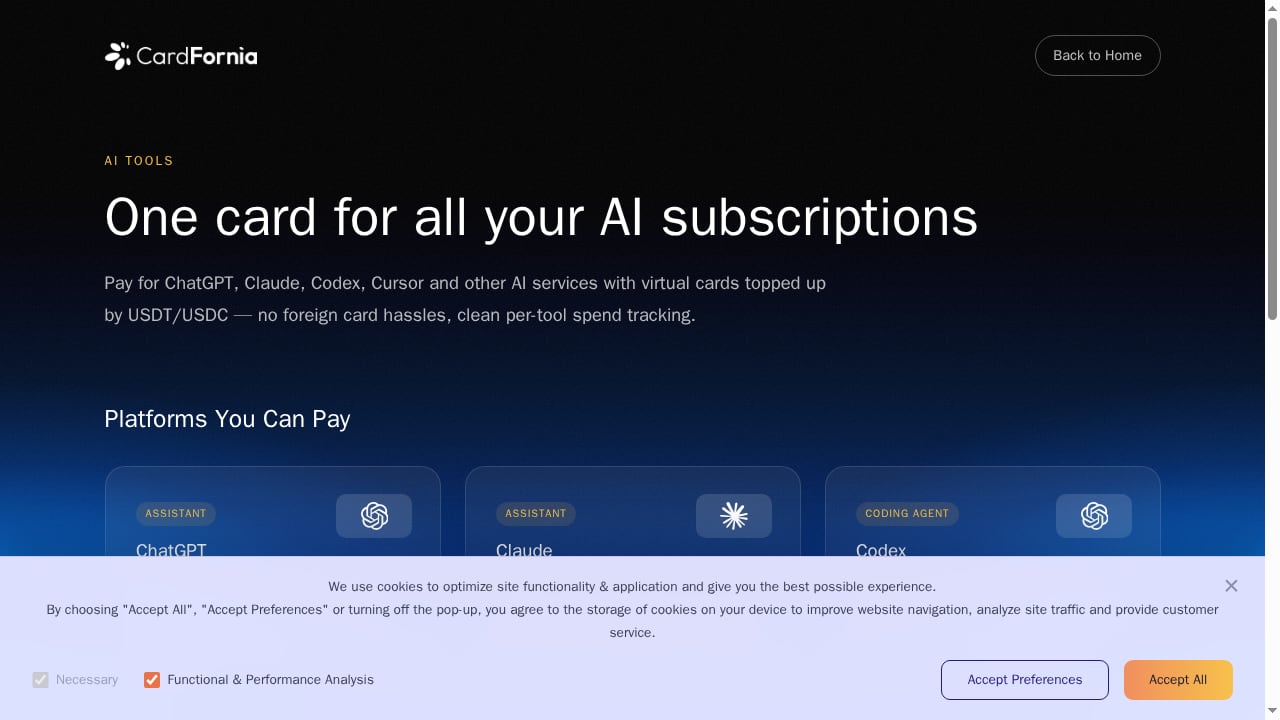
First viewport screenshot of www.cardfornia.com.
Cardfornia's defining feature is that you hold your own keys. You top up a single account with stablecoins into your own self-custodied wallet, and funds move directly to a dedicated sub-account with a licensed card provider. Cardfornia never holds your funds or private keys. That matters if your business has a treasury policy that forbids custodial exposure, or if you are paying AI agents that need a funding source you control.
KAST positions itself as a global money app powered by stablecoins. It combines a USD account, a crypto-funded debit card, and yield-earning vaults. It supports ACH, SEPA, and wire transfers via a US account number and EU IBAN. That account-based model is convenient for receiving fiat and managing cash, but it is a different custody posture from Cardfornia's self-custody wallet.
If self-custody is a hard requirement, Cardfornia is the closer fit. If you want a single app that receives fiat and pays out to a card, KAST's account structure may be more convenient.
Controls for AI agents and high-volume payments
First viewport screenshot of kast.xyz.
Cardfornia was designed for AI agents' autonomous payments. It offers dynamic card issuance, merchant whitelisting, minute-level authorization, and full audit logs. In practice, that means you can issue a card for a specific agent, restrict it to approved merchants such as OpenAI, Anthropic, or Cursor, and review every authorization in near real time. Cardfornia reports average monthly volumes per card of $200+ for AI tools, $2,800+ for ads, and $150+ for SaaS, which reflects how businesses actually use the cards.
KAST's card is built around everyday spending and global acceptance. It offers cashback and works at 150 million merchants in 170+ countries. Its guides cover paying cloud bills like AWS with stablecoins, managing fees, and using the card while traveling. Those are useful for individuals and small teams, but the product is not positioned around per-agent card issuance or merchant-level whitelisting.
For a deeper look at how Cardfornia handles agent payments, see Crypto Dollar Payments for AI Agents: Cardfornia Guide.
Rewards and yield: KAST's advantage
First viewport screenshot of kast.xyz.
KAST's clearest differentiator is its rewards stack. The card offers up to 3% cashback on eligible spend, and the Reserve account offers up to a 12% reward rate. For users who hold idle stablecoin balances, that yield can be meaningful. KAST also emphasizes turning idle cash into active capital, which is a treasury-management pitch rather than a payments-control pitch.
Cardfornia does not compete on cashback or yield. Its value proposition is stable, high-limit card payments that reduce the risk of account bans, plus self-custody and real-time control. If rewards are your priority, KAST is the stronger option. If control and auditability are your priority, Cardfornia is.
Licensing and trust signals
Cardfornia states that its team is certified to ISO/IEC 27001 and that its licensed white-label partners hold MSO, API, MSB, and MTL licenses. It is incorporated in Singapore as CARDFORNIA PTE. LTD. (UEN: 202625775N). Cards are provided by licensed white-label card providers and issued by licensed issuing institutions, and Cardfornia discloses which partner provides a card before it is created.
KAST describes itself as a stablecoin account and card available in 170+ countries. Its product context emphasizes global reach, rewards, and treasury management. When evaluating either platform, confirm the specific licensing and custody arrangements for your jurisdiction, because card programs often rely on partner institutions.
For a broader view of regulated infrastructure, see Top 10 Regulated Fintech & Digital Asset Platforms 2026.
Practical examples: which platform fits which job
Paying AI tool subscriptions at scale. A team running multiple AI agents needs a card per agent, merchant restrictions, and an audit trail. Cardfornia's dynamic issuance and merchant whitelisting fit this job. KAST's card can pay the same subscriptions, but it is not built around per-agent controls.
Running digital ads across Meta, Google, and TikTok. Ad accounts are sensitive to payment instability. Cardfornia's stable, high-limit cards and minute-level authorization help reduce declines and account bans. KAST's global acceptance and cashback are attractive, but the control layer is thinner.
Holding idle stablecoins for yield. A freelancer or small business with a stablecoin balance may prefer KAST's Reserve account and cashback. Cardfornia is not a yield product.
Receiving fiat and spending stablecoins. KAST's US account number and EU IBAN support ACH, SEPA, and wire transfers. Cardfornia focuses on stablecoin top-ups into a self-custodied wallet.
Securing funding with a hardware wallet. If you want to pair self-custody with a Ledger, see How to Use Cardfornia with Ledger: Secure AI Payments.
Decision guide
Choose Cardfornia if:
- You need self-custody of funds and do not want a platform holding your keys.
- You pay AI agents or AI tool subscriptions and need per-card controls.
- You want merchant whitelisting, minute-level authorization, and full audit logs.
- You run ad spend or SaaS bills where payment stability matters.
- You want to issue cards at scale for a globally scaling business.
Choose KAST if:
- You want cashback on everyday spending.
- You want yield on idle stablecoin balances.
- You need a USD account with ACH, SEPA, and wire support.
- You spend across many countries and want broad merchant acceptance.
- You are an individual or small team prioritizing convenience over granular controls.
Related reading
- Ramp Review 2026: Spend Management & Finance Automation - Evidence-based Ramp review for 2026: corporate cards, expense automation, AP, pricing signals, ideal users, limitations, setup, and decision criteria.
Sources and further reading
- Privacy Policy | Cardfornia - How Cardfornia collects, uses, shares and protects personal data for its card services.
- AdsPower Browser (@AdsPowerBrowser) on X - AdsPower – An Antidetect Browser for multi-account management. All platforms. Zero bans. Follow for giveaways, ways to scale your earnings & trending news.
- MC-2026-064 - NIA - Online Memorandum Circular Retrieval System - Go to Last Page. Rotate Clockwise Rotate Counterclockwise. Enable hand tool ... Issuance of New Identification (ID) Card for NIA Officials and Employees.
FAQ
Is Cardfornia a custodian of my funds?
No. Cardfornia states that funds go directly to a dedicated sub-account with a licensed card provider and never through Cardfornia. You hold your own keys in a self-custodied wallet.
Does KAST offer cashback?
Yes. KAST offers up to 3% cashback on eligible spend, and its Reserve account offers up to a 12% reward rate.
Can KAST be used for AI agent payments?
KAST's card can pay AI tool subscriptions, but its product is positioned around everyday spending, global acceptance, and yield. Cardfornia is purpose-built for AI agents with dynamic issuance, merchant whitelisting, and audit logs.
Which platform is better for ad spend?
Cardfornia reports average monthly volumes per card of $2,800+ for ads and emphasizes stable, high-limit payments that reduce the risk of account bans. KAST's cashback may appeal to smaller advertisers, but Cardfornia's controls are more specific to ad operations.
Is Cardfornia regulated?
Cardfornia states that its team is certified to ISO/IEC 27001 and that its licensed white-label partners hold MSO, API, MSB, and MTL licenses. It is incorporated in Singapore. Always confirm the licensing that applies to your jurisdiction and card program.
Conclusion
Cardfornia and KAST solve different problems. KAST is a stablecoin neobank with cashback, yield, and global spending convenience. Cardfornia is a self-custody card platform built for businesses and AI agents that need control, auditability, and payment stability. If your priority is rewards and a single money app, KAST is a strong choice. If your priority is self-custody and granular control over every transaction, Cardfornia is the better fit.
For a wider comparison against other business card platforms, see Cardfornia vs WaldenPay vs Brex: Which Fits Your Business?.