
Cryptopay Business Review 2026: Fees, Features & Verdict
Cryptopay Business Review 2026: A Practical Look at the Crypto Payment Gateway
Cryptopay Business is a crypto payment gateway aimed at merchants and enterprises that want to accept, manage, and send cryptocurrency without holding volatile assets on their books. The platform supports more than 15 cryptocurrencies and 35 fiat currencies, with automatic conversion and next-day bank settlement designed to remove price risk. This review looks at who the service actually fits, how it works, where it shines, and where it falls short.
What Is Cryptopay Business?
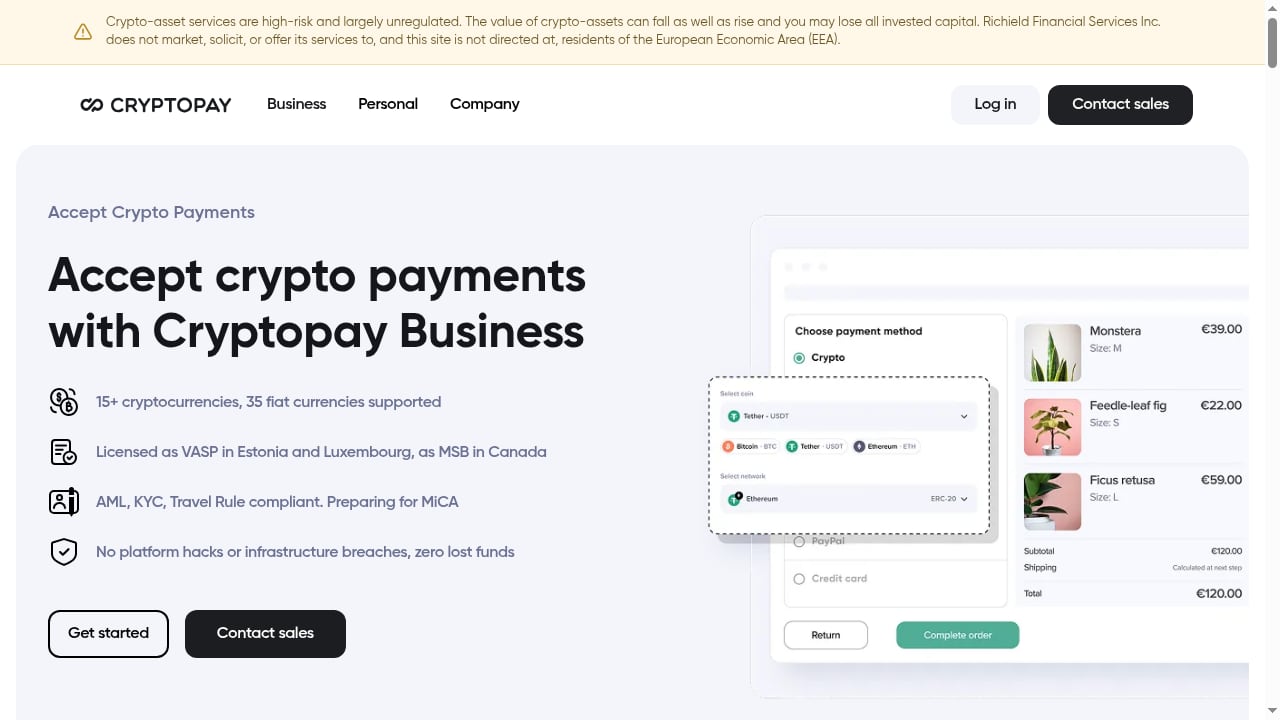
First viewport screenshot of Accept Crypto Payments | Cryptopay.
Cryptopay Business is the commercial arm of Cryptopay, a company that started as one of the first bitcoin debit card providers and has since narrowed its focus exclusively to business clients. Retail services are being discontinued, which means the product is now built around merchant settlement, payouts, and corporate spending rather than personal wallets.
The core promise is simple: a customer pays in crypto, and the merchant receives fiat in their bank account. Cryptopay handles the conversion and settlement behind the scenes, so a business can offer crypto payment options without managing wallets, private keys, or exchange liquidity.
Key capabilities include:
- Online crypto checkout for ecommerce
- Payment links for invoicing and remote sales
- A flexible API for custom integrations
- Static addresses for recurring customer payments
- Mass payouts to contractors, affiliates, or suppliers
- Corporate crypto cards with high spending limits
- A forthcoming white-label payment gateway
Who Cryptopay Business Is For
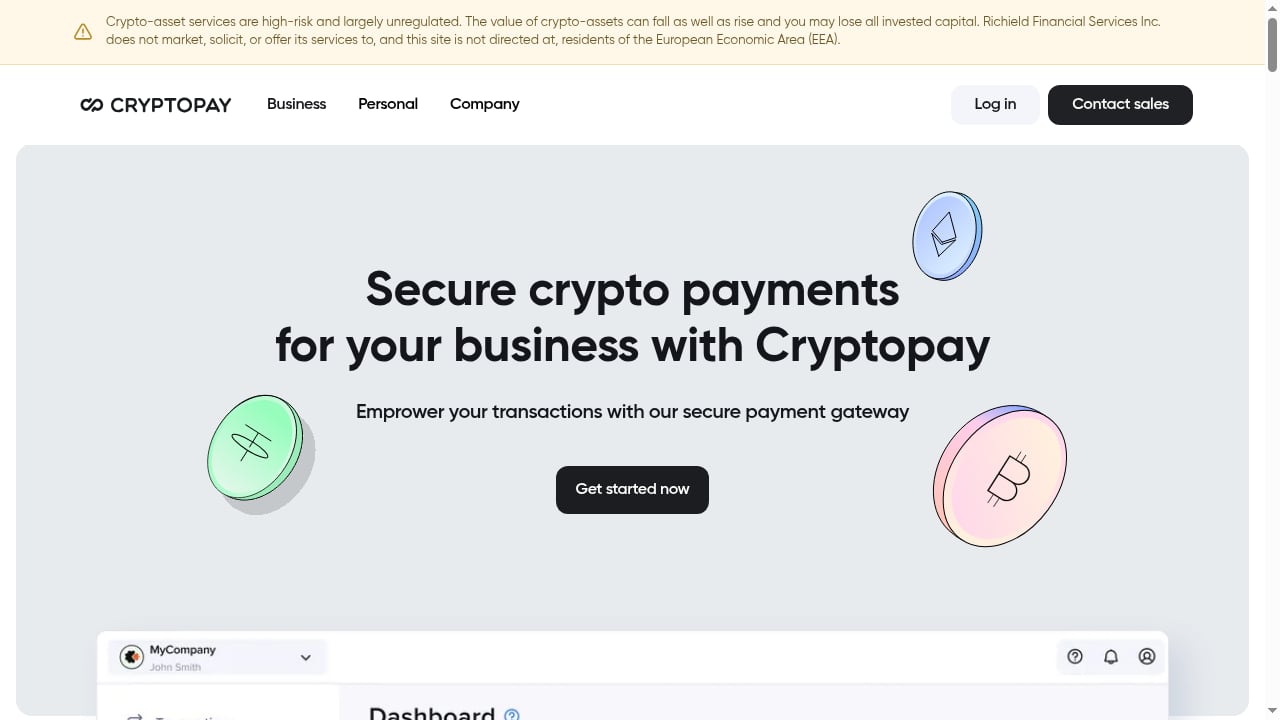
First viewport screenshot of Cryptopay Business | Accept and Send Crypto Payments as a Merchant.
Cryptopay Business is not a general-purpose banking replacement. It is best suited to specific profiles:
Ecommerce Merchants Adding Crypto Checkout
An online store that already accepts card payments can add a crypto checkout option without building blockchain infrastructure. Because settlement is fiat-denominated, the merchant does not need to worry about bitcoin or ether price swings between checkout and bank deposit.
Businesses Paying Remote Teams or Contractors
The mass payout feature is useful for companies that regularly pay freelancers, affiliates, or overseas contractors. Instead of running dozens of individual wire transfers, a business can batch payments in stablecoins or other supported assets.
Companies That Want a Corporate Crypto Card
Cryptopay offers corporate crypto cards with higher spending limits than many consumer-focused alternatives. This can work for teams that need to spend from a crypto balance on travel, software, or operational costs. For a deeper look at how compliant corporate crypto cards work, see this guide to compliant crypto payment cards.
Platforms Exploring White-Label Payments
The planned white-label gateway could appeal to SaaS platforms or marketplaces that want to offer crypto payments under their own brand rather than sending users to a third-party checkout.
Strengths of Cryptopay Business
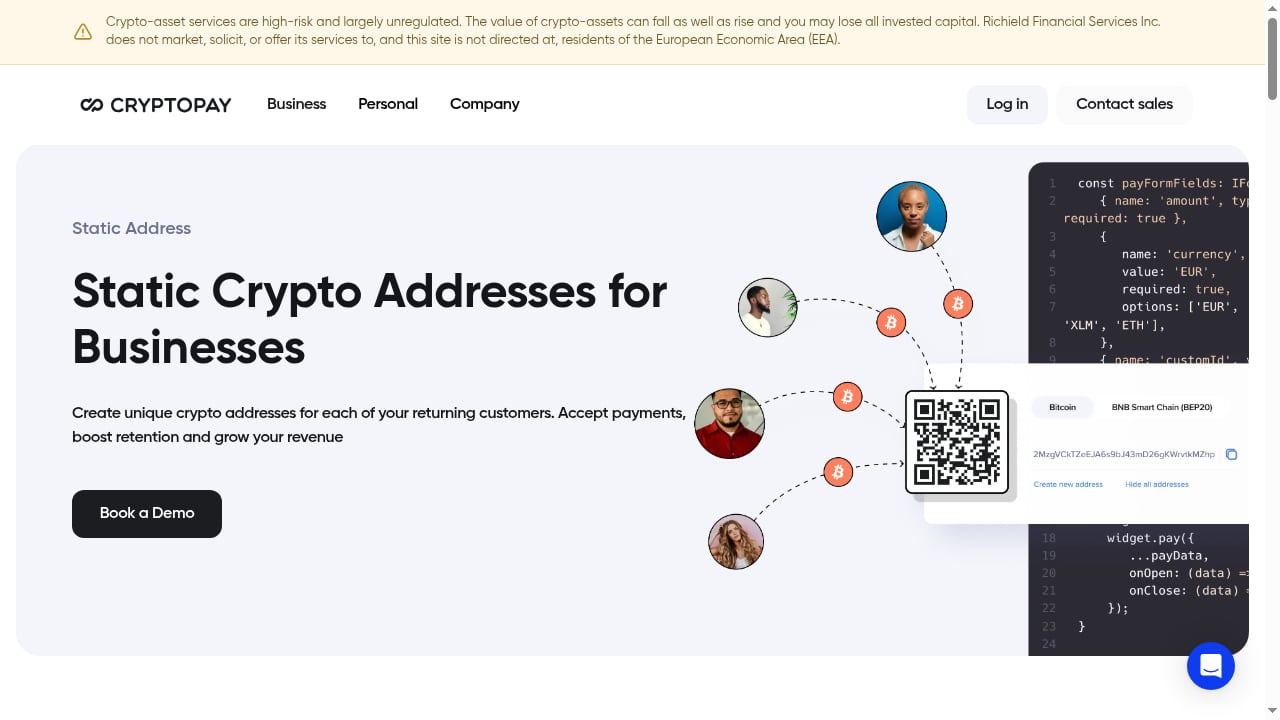
First viewport screenshot of Channels – Receive Crypto from Your Recurring Customers Easily with Cryptopay.
Fiat-Denominated Settlement Removes Volatility
This is the most important feature for most merchants. A customer can pay in bitcoin, ether, or another supported asset, and the merchant receives euros, dollars, or another fiat currency in their bank account. The automatic conversion happens at the point of transaction, with next-day settlement.
For businesses that cannot or do not want to hold crypto on their balance sheet, this is a meaningful advantage over self-custody payment setups.
Multiple Payment Channels
Cryptopay does not force businesses into a single integration method. The same underlying payment engine can power:
- A hosted checkout page for ecommerce
- Payment links sent by email or messaging apps
- API calls from a custom application
- Static addresses for repeat customers
This flexibility means a small business can start with payment links and graduate to API integration without switching providers.
Regulatory Positioning
Cryptopay holds VASP registrations in Estonia and Luxembourg, an MSB license in Canada, and says it follows AML/KYC and Travel Rule requirements. The company is also preparing for MiCA, the EU's crypto-asset regulation framework. For EU-based merchants that need a compliant partner, this is a relevant signal.
Security Track Record
The company emphasizes that the platform has not suffered a major hack. While no provider can guarantee future security, a clean operational history is worth noting when evaluating a payment partner that will touch customer funds.
Corporate Cards with High Limits
Many crypto card products are aimed at individuals and come with low daily or monthly caps. Cryptopay's corporate cards are designed for business spending, with higher limits that make them usable for operational expenses rather than just small purchases.
Limitations and Risks
Mixed Customer Service Feedback
Public reviews on Trustpilot show a pattern of complaints about slow transaction processing and support response times. One reviewer describes funds being debited but a transaction remaining on hold for two days. While any payment processor will have some negative reviews, the recurring theme of delayed processing is worth investigating before committing significant volume.
Retail Services Being Discontinued
If you are an individual looking for a personal crypto wallet or debit card, Cryptopay is no longer the right product. The company has explicitly shifted to business-only services. Individuals should look elsewhere, such as the options covered in this BingCard review.
Pricing Transparency
Cryptopay does not publish a clear, itemized fee schedule on its public-facing pages. Businesses typically need to contact sales or create an account to see exact processing rates, card fees, and settlement costs. This is common in B2B payment services, but it makes comparison shopping harder.
Limited Independent Review Data
Compared to larger payment processors, Cryptopay has a relatively small footprint on independent review platforms. G2 shows positive sentiment from some users, but the sample size is limited. Businesses should request references or run a pilot before committing.
White-Label Gateway Still Forthcoming
If your primary reason for considering Cryptopay is the white-label gateway, note that this feature is described as forthcoming rather than generally available. Roadmap features can slip or change scope.
Pricing Signals
Cryptopay does not publish a standard pricing page with fixed percentages. Based on the product's structure and typical crypto payment gateway economics, businesses should expect:
- A processing fee per transaction, likely in the 0.5% to 1.5% range depending on volume and integration method
- Possible conversion spreads on crypto-to-fiat settlement
- Card issuance and maintenance fees for corporate cards
- Withdrawal or settlement fees depending on the destination bank and currency
The best approach is to request a written quote that covers processing, conversion, settlement, card, and payout fees together. Ask specifically about hidden costs like minimum monthly volume requirements or inactivity fees.
Setup and Onboarding
Getting started with Cryptopay Business generally follows this path:
- Create a business account and complete KYC/AML verification. Expect to submit company registration documents, proof of address, and identity documents for directors and beneficial owners.
- Choose an integration method. Payment links are the fastest path. API integration requires development work but offers the most control.
- Configure settlement preferences. Select the fiat currency and bank account where you want funds deposited.
- Test transactions. Run small test payments before going live to verify conversion rates, settlement timing, and reporting.
- Enable additional features such as mass payouts or corporate cards as needed.
Businesses that process stablecoin payments may also want to understand the underlying assets they are accepting. This guide to what a stablecoin is explains how USDC, USDT, and similar assets maintain their peg and what risks remain.
Cryptopay Business vs. Alternatives
First viewport screenshot of Cryptopay For Business | Privacy Notice for Candidates.
| Feature | Cryptopay Business | Typical Payment Processor | Self-Custody Setup |
|---|---|---|---|
| Crypto acceptance | Yes, 15+ assets | Often limited or none | Yes, full control |
| Fiat settlement | Automatic, next-day | Standard | Manual conversion required |
| Volatility exposure | None for merchant | None | Full exposure unless hedged |
| Compliance burden | Handled by provider | Handled by provider | Entirely on merchant |
| Integration effort | Low to medium | Low | High |
| Corporate crypto card | Yes | Rare | Not included |
| Mass payouts | Yes | Sometimes | Manual |
For businesses that want crypto payment acceptance without operational complexity, Cryptopay sits in a useful middle ground. It offers more crypto-native features than a traditional processor but less technical overhead than running your own node and wallet infrastructure.
If your primary need is stablecoin-based B2B payments and accounts payable automation rather than customer checkout, compare this with the approach covered in this Request Finance review.
Decision Criteria: Should You Use Cryptopay Business?
Consider Cryptopay Business if:
- You run an ecommerce store or service business and want to accept crypto without holding it
- You need next-day fiat settlement in a supported currency
- You want payment links, API access, and static addresses from one provider
- You need corporate crypto cards with higher limits than consumer products
- You operate in the EU and value a provider with VASP registrations and MiCA preparation
Look elsewhere if:
- You are an individual seeking a personal crypto wallet or card
- You need transparent, published pricing before you commit
- You require a white-label gateway immediately rather than in the future
- You want to hold crypto on your balance sheet rather than auto-convert to fiat
- Your business needs a full banking stack, not just payment processing
Related reading
- How to Buy USDC: Safe Ways to Get Digital Dollars in 2026 - Learn how to buy USDC safely with exchanges, wallets, and payment apps. Compare fees, custody options, and the best method for personal or business use.
- OneSafe Review 2026: Pricing, Features & Real Verdict - Evidence-based OneSafe review covering global business banking, crypto rails, pricing signals, setup, limitations, and who should actually use it in 2026.
Sources and further reading
- Read Customer Service Reviews of cryptopay.me - Trustpilot - Added fund via their gateway 2 days back on popcash, and they still have transaction on hold. funds were debited but they are very lazy with processing. not a ...
- Cryptopay Reviews 2026: Details, Pricing, & Features - G2 - Cryptopay is really a good payment platform and I do use it to buy and store bitcoin. I had used many other platforms before but Cryptopay is the best among all ...
- IAmA founder of Cryptopay — one of the first bitcoin debit card ... - Oct 18, 2017 ... I'm using Cryptopay now like almost a year and i'm satisfied! Without verification i can send and receive Bitcoins, use a virtual credit card ...
Frequently Asked Questions
Is Cryptopay Business safe to use?
Cryptopay holds VASP registrations in Estonia and Luxembourg, an MSB license in Canada, and follows AML/KYC and Travel Rule standards. The company reports no major platform hacks. However, no payment provider is risk-free, and businesses should evaluate any partner's security, compliance, and operational history before sending real volume.
What cryptocurrencies does Cryptopay Business support?
The platform supports more than 15 cryptocurrencies. The exact list may change over time, so check the current supported assets before integrating if you expect customers to pay in a specific token.
How fast is settlement?
Cryptopay advertises next-day bank settlement after automatic crypto-to-fiat conversion. Actual timing can depend on the destination bank, currency, and transaction volume. Some user reviews mention processing delays, so build a buffer into your cash flow expectations during the first month.
Does Cryptopay Business charge monthly fees?
Cryptopay does not publish a full public fee schedule. Businesses should request a written quote that covers processing fees, conversion spreads, card fees, and any monthly or minimum-volume charges.
Can I use Cryptopay Business if my company is outside the EU?
Cryptopay's regulatory licenses are primarily EU-focused, with an additional Canadian MSB license. Businesses in other regions should confirm eligibility during the application process, as supported jurisdictions may be limited.
Is the white-label payment gateway available now?
The white-label gateway is described as forthcoming. If this feature is critical to your decision, confirm availability and timeline directly with Cryptopay before signing.
Final Verdict
Cryptopay Business is a focused, compliance-conscious crypto payment gateway that solves a real problem: letting merchants accept crypto while receiving fiat. The combination of multi-channel payment options, automatic conversion, next-day settlement, corporate cards, and mass payouts makes it a credible choice for ecommerce businesses and companies with crypto-heavy payment flows.
The main caveats are pricing opacity, mixed customer service reviews, and the fact that some flagship features are still on the roadmap. Businesses that need a proven, high-volume processor with transparent public pricing may want to compare alternatives. But for EU-based merchants that want a regulated partner with a clean security record and fiat-denominated settlement, Cryptopay Business deserves a place on the shortlist.
Before committing, run a pilot with small transaction volumes, test settlement timing in your actual bank account, and get written confirmation of all fees. That practical test will tell you more than any review can.