
Request Finance Review 2026: Stablecoin B2B Payments

Request Finance Review 2026: Stablecoin B2B Payments, Pricing & Verdict
Request Finance is a business spend management and payments platform built around stablecoins. It targets finance teams that need to pay vendors, contractors, and partners across borders without the cost and delay of traditional banking rails. The platform combines a multi-currency business account, accounts payable automation, approval workflows, and accounting integrations into a single interface.
This review examines what Request Finance actually does, who it serves best, where it falls short, and how to decide whether it fits your operation.
What Is Request Finance?

Request Finance product interface.
Request Finance positions itself as a replacement for slow banking rails, spreadsheets, and scattered payment tools. The core promise is simple: hold, send, and receive stablecoins and fiat currencies from one business account, with the controls and records a finance team expects.
The platform reports over 1,500 finance teams onboarded, more than $1 billion processed, and coverage across 190+ countries. Those numbers signal meaningful adoption, but they matter less than whether the feature set matches your specific payment workflows.
At its foundation, Request Finance offers a business account that supports 25+ currencies and stablecoins, including USDC and USDT. Virtual IBANs and SWIFT connectivity sit alongside stablecoin wallets, so a single account can handle both fiat and on-chain payments.
Who Should Use Request Finance?
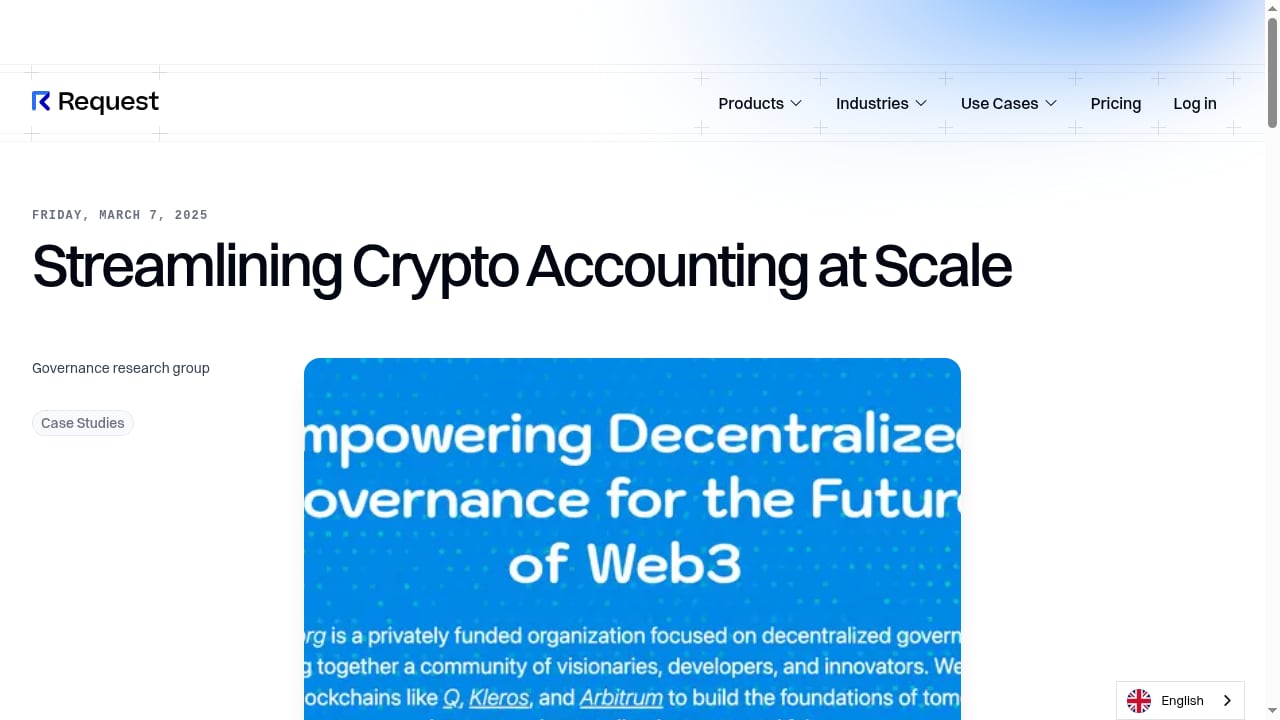
First viewport screenshot of Streamlining Crypto Accounting at Scale - Request Finance.
Request Finance is not a general-purpose banking replacement for every company. It fits a specific profile best.
Ideal Users
Crypto-native and Web3 companies are the most obvious fit. Teams that already hold stablecoins or receive revenue in USDC can pay contractors, affiliates, and suppliers without converting back to fiat first. The case studies with RealT, a tokenized real estate firm, and Polemos, a Web3 gaming company, illustrate this pattern: both needed to streamline mixed fiat and crypto payment flows while reducing reconciliation time.
Businesses with high-volume cross-border payouts also benefit. Affiliate networks, marketplaces, content platforms, and gaming companies that pay hundreds of recipients monthly can use batch payouts. Stablecoin payouts are free on every plan, which removes a meaningful cost line compared to wire fees.
Finance teams managing global suppliers can use the accounts payable module to import bills, run approval workflows, and pay via ACH, SEPA, SWIFT, or stablecoins. The accrual accounting features aim to automate reconciliation and month-end reporting, which reduces manual spreadsheet work.
Who Should Look Elsewhere
Small businesses with purely domestic, low-volume payment needs may find the $250/month starting price hard to justify. Companies that do not want to touch stablecoins at all, or that require deep ERP integrations beyond the listed accounting tools, may also need a different solution.
If your primary need is corporate card spending rather than payables, Request Finance's card product is still marked as "launching soon." In that case, a comparison like Cardfornia vs Request Finance is worth reviewing before committing.
Core Features and Use Cases
Multi-Currency Business Account
The business account is the foundation. Each entity gets its own account with budgets, spending limits, and approval rules. You can hold USDC, USDT, and 25+ fiat currencies in one place, with real-time cash position visibility across all holdings.
This matters because many finance teams currently manage stablecoins in one wallet, fiat in a bank account, and records in a spreadsheet. Request Finance collapses those silos into one ledger.
Accounts Payable Automation
The AP module supports bill import, OCR data extraction, approval workflows, and payment execution across multiple rails. The goal is to move from invoice receipt to payment without exporting data to a separate banking portal.
For teams that currently pay vendors through a mix of bank transfers and manual crypto sends, this consolidation can save hours per week. The audit trail is also cleaner, which helps during month-end close and external reviews.
Mass Payouts
Batch payments are a standout feature. You upload a recipient list, review it, and pay everyone at once. No invoices are required for mass payouts. Stablecoin payouts settle in minutes and are free on every plan; bank payouts reach 190+ countries.
This is particularly relevant for affiliate programs, creator payouts, commission distributions, and marketplace seller disbursements. If you currently process these through PayPal, Wise, or manual wire batches, the cost and speed differences can be substantial.
Accrual Accounting and Reconciliation
Request Finance includes accrual accounting features designed to automate reconciliation and month-end reporting. The platform integrates with Xero, QuickBooks, and SAP, which means payment data can flow into your existing accounting system rather than living in a separate silo.
For teams that have struggled to reconcile on-chain transactions with fiat records, this is one of the more practical reasons to consider the platform.
Upcoming Features
Corporate cards and yield rewards are listed as upcoming. Cards funded directly from the business account would close a gap for teams that want both payables and spend management in one place. Yield rewards would let idle stablecoin balances earn returns, though details are not yet public.
Pricing Signals
Request Finance publishes a starting price of $250 per month billed annually, with a 30-day free trial and no credit card required. The homepage also references pricing "from $50 a month" in one section, which suggests tiered plans or promotional pricing may exist, but the $250 figure appears to be the standard entry point for small teams.
Key pricing signals to note:
- Stablecoin payouts are free on every plan. This is a significant differentiator if you send many on-chain payments.
- No setup fees are mentioned.
- Volume-based transaction fees decrease as usage grows, which rewards higher-volume users.
- Annual billing is required for the $250/month rate, so month-to-month pricing may be higher.
For context, traditional cross-border wire fees often run 2-8% when you factor in FX markups and intermediary bank charges. If Request Finance can eliminate most of that cost for stablecoin-native counterparties, the subscription can pay for itself quickly. But if your counterparties insist on fiat rails, the savings are less dramatic.
Setup and Onboarding
The onboarding flow follows a three-step pattern:
- Create an account — a few minutes, no credit card required, with 30 days of free exploration.
- Verify your business — KYB runs when you activate the business account, typically taking a few days. Every counterparty on Request is verified, which adds a layer of trust but also adds friction.
- Pay and get paid — fiat and stablecoin rails, approvals, records, and accounting in one place.
The KYB requirement is worth highlighting. Because every counterparty must be verified, you cannot simply send funds to an unverified wallet address. This is a deliberate security choice, but it may slow down first payments to new recipients.
Strengths
Unified fiat and stablecoin rails. Few platforms combine virtual IBANs, SWIFT, and stablecoin wallets in a single account with shared controls and records. This is the core value proposition.
Free stablecoin payouts. Batch payouts to hundreds of recipients with no per-transaction fee on stablecoin rails is a genuine cost advantage for high-volume payers.
Built-in controls. Budgets, spending limits, approval workflows, and double payment detection address the compliance and fraud concerns that keep many finance teams away from crypto rails.
Accounting integrations. Xero, QuickBooks, and SAP integrations mean payment data can flow into existing close processes rather than creating a parallel ledger.
Security posture. SOC 2 Type 1 audit, OpenCover insurance partnership, scam vigilance measures, and double payment detection are meaningful signals for a platform handling business funds.
Limitations
Limited public review data. Trustpilot shows only 12 reviews at a 4-star average. That is a thin sample for evaluating long-term reliability. Prospective buyers should request references or run an extended trial.
Corporate cards not yet available. If you need card-based spend management today, Request Finance cannot yet serve that need. Competitors with live card products may be a better immediate fit.
Counterparty verification friction. The requirement that every counterparty be verified adds onboarding time. For ad hoc one-off payments to new recipients, this can feel slower than a simple wallet send.
Pricing transparency gaps. The $250/month starting price is clear, but volume-based fee tiers are not fully published. You will need a sales conversation or trial to understand your effective cost.
Fiat rail dependency. While stablecoin payouts are free, fiat payouts still rely on banking partners. Speed and cost for fiat rails will vary by corridor and currency.
Request Finance vs Alternatives

SaaS.
How does Request Finance compare to other stablecoin-enabled business platforms?
| Dimension | Request Finance | Typical Card-First Competitors |
|---|---|---|
| Primary focus | AP, payouts, multi-currency account | Corporate cards, spend limits |
| Stablecoin payouts | Free on all plans | Often fee-based |
| Cards | Launching soon | Available now |
| Accounting integrations | Xero, QuickBooks, SAP | Varies |
| Counterparty verification | Required | Varies |
| Entry price | $250/month (annual) | Often lower or usage-based |
If your priority is paying vendors and contractors at scale, Request Finance's AP and mass payout features are the draw. If your priority is employee or team card spending, a card-first platform may serve you better today. For a deeper side-by-side, see the Cardfornia vs Request Finance comparison.
For teams evaluating other unified B2B payment platforms, the ConnexPay review covers a different model built around PayIn/PayOut flows, while the Reap review examines stablecoin cards and treasury tools.
Decision Criteria: Is Request Finance Right for You?

Wholesalers.
Answer these questions before committing:
- Do you pay 20+ recipients monthly across borders? If yes, the batch payout and free stablecoin rails create measurable savings.
- Do you already hold or receive stablecoins? If yes, you avoid conversion costs and can pay crypto-native counterparties directly.
- Is your AP process manual or spreadsheet-driven? If yes, the bill import, OCR, and approval workflows can reduce operational overhead.
- Do you need corporate cards immediately? If yes, wait or choose a card-first alternative.
- Can you tolerate counterparty verification delays? If your payment flows are recurring and predictable, verification is a one-time cost. If they are ad hoc, it may frustrate.
If you answered yes to the first three questions and no to the fourth, Request Finance deserves a trial.
Related reading
- USDC Chart: How to Read USD Coin Price, Trends & Key Levels - Learn how to read the USDC chart, what drives USD Coin price moves, key support and resistance levels, and how businesses can use USDC for spending.
- Compliant Crypto Payment Cards: A 2026 Guide - Learn how compliant crypto payment cards work in 2026, what regulatory safeguards matter, and how to choose a card that fits your spending needs.
- Cardfornia vs Banqa vs OneSafe: Which Fits Your Business? - Compare Cardfornia, Banqa, and OneSafe for crypto business spending. See custody models, card features, pricing signals, and which platform fits your team.
Sources and further reading
- Read Customer Service Reviews of request.finance - Trustpilot - Do you agree with Request Finance's 4-star rating? Check out what 12 people have written so far, and share your own experience.
- Request Finance | Business Account for Currencies & Stablecoins - B2B stablecoin payments and cross-border transfers. Get paid and pay vendors, contractors and teams worldwide in local currency or stablecoin, settled in minutes.
- Financial Review Procedure and Recommendations - Toolkit - The Financial Review Checklist should be used, and each box marked in the negative should result in a financial review recommendation. Review each account separately. Check off items in red ink as they are reviewed. Do not correct errors. Ask the responsible financial officer to correct errors. After errors have been corrected, and the financial […]
Frequently Asked Questions
What does Request Finance cost?
Request Finance starts at $250 per month billed annually, with a 30-day free trial. Stablecoin payouts are free on every plan, and transaction fees decrease as volume grows. No setup fees are mentioned.
Does Request Finance support fiat payments?
Yes. The platform supports ACH, SEPA, and SWIFT payments alongside stablecoin rails. You can hold 25+ currencies and pay vendors in local currency or stablecoin.
Is Request Finance safe?
Request Finance is SOC 2 Type 1 audited, partners with OpenCover for insurance against hacks and protocol issues, and implements double payment detection and scam vigilance measures. Every counterparty is verified through KYB.
Can I pay contractors in USDC?
Yes. You can batch pay hundreds of recipients in USDC or USDT with no per-transaction fee on stablecoin rails. Payments settle in minutes.
Does Request Finance integrate with QuickBooks?
Yes. Request Finance integrates with Xero, QuickBooks, and SAP for accounting and reconciliation.
Does Request Finance offer corporate cards?
Corporate cards are listed as launching soon, funded directly from the business account. They are not yet generally available.
Conclusion
Request Finance solves a real problem: finance teams that need to manage stablecoin and fiat payments in one controlled environment. Its strengths are clear for crypto-native companies, high-volume cross-border payers, and teams drowning in manual AP processes. Free stablecoin payouts, batch disbursements, and accounting integrations are the standout features.
The limitations are equally clear. Cards are not yet live, public review data is thin, counterparty verification adds friction, and volume-based pricing requires a conversation to fully understand. The $250/month entry price is reasonable for teams with meaningful payment volume but steep for small operations.
If your payment profile matches the ideal user description, start the 30-day trial and test your actual workflows before committing. If you need cards today or have minimal cross-border volume, explore alternatives first. For stablecoin-native teams that pay many recipients regularly, Request Finance is among the strongest options available in 2026.