
Top 10 Stablecoin-Powered Financial Infrastructure Platforms 2026
Top 10 Stablecoin-Powered Global Financial Infrastructure and Embedded Finance Platforms 2026
Stablecoins have moved from a trading tool to a settlement layer. In 2026, the question for most finance and product teams is no longer whether to touch stablecoins, but which infrastructure partner lets them hold, move, and spend digital dollars without rebuilding their compliance stack. This review ranks ten platforms that genuinely operate in that category, explains how each was scored, and shows where the category ends and adjacent tools begin.
How We Ranked These Platforms
First viewport screenshot of reap.global.
Every platform below was assessed against the same six criteria. Scores reflect publicly documented capabilities, not sales claims.
- Stablecoin rails depth: support for USDC/USDT funding, on-ramp and off-ramp, and settlement across corridors.
- Embedded finance capability: APIs, white-label programs, and the ability to launch branded accounts or cards.
- Card issuing model: credit versus debit versus prepaid, and whether cards work for ad spend, SaaS, and travel.
- Compliance and licensing: KYC/KYB, custody model, and the licenses held by the platform or its partners.
- Pricing transparency: published fees, per-payment pricing, and revenue-share structures.
- Developer experience: sandbox, documentation, and time-to-first-transaction.
A note on scope: this list covers infrastructure and embedded finance platforms. Consumer-facing crypto cards and agent-specific payment tools sit in an adjacent layer. Cardfornia, for example, is a self-custody virtual card platform for AI agents and business spend, and it is referenced here only where that adjacent workflow is relevant to a buying decision.
The Top 10 in 2026
First viewport screenshot of reap.global.
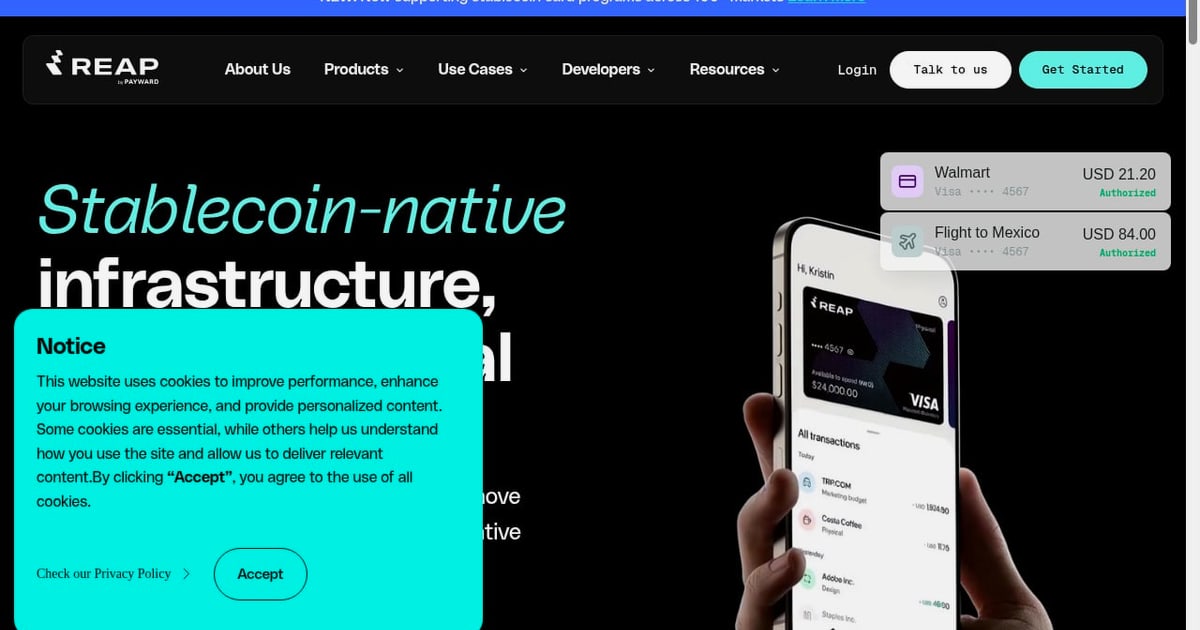
1. Reap
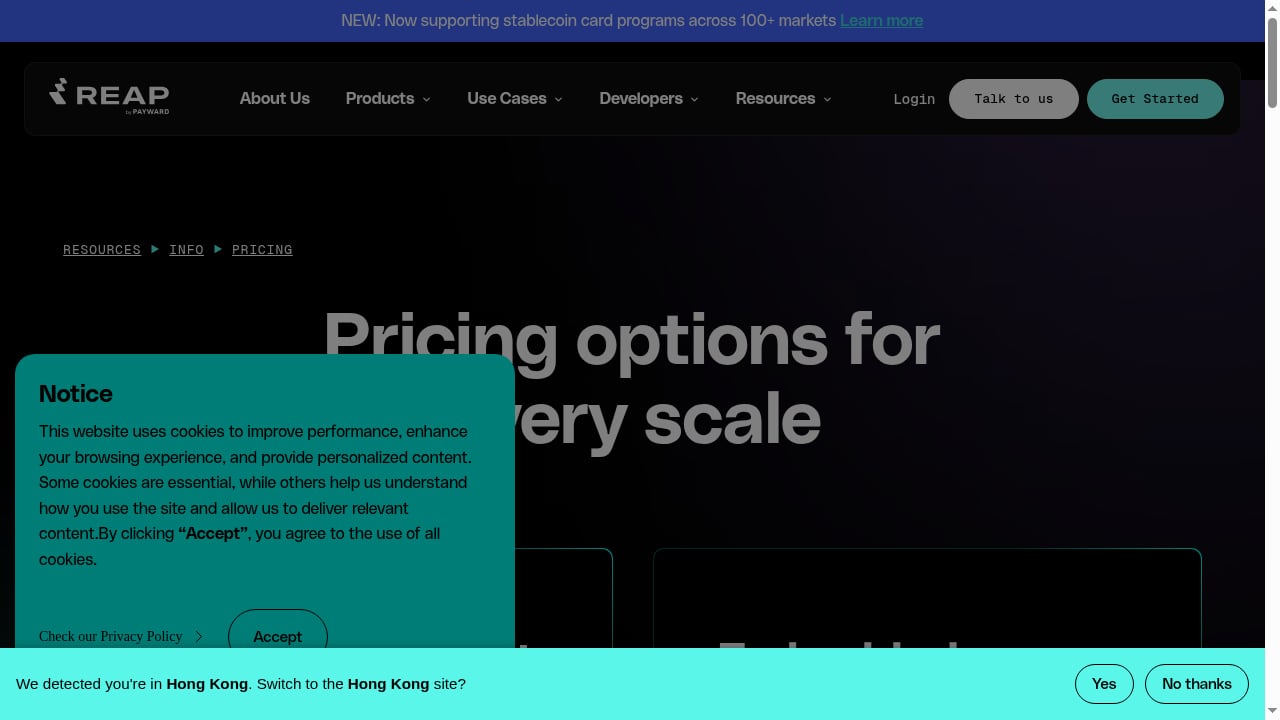
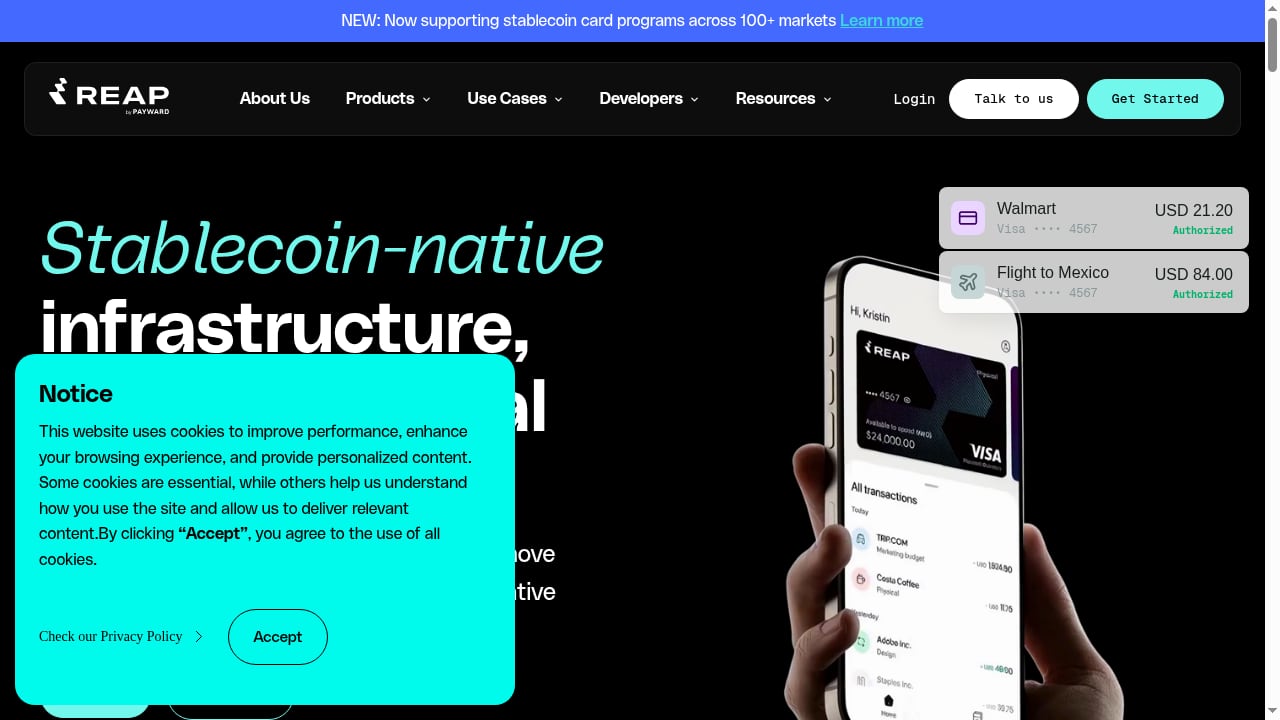
Reap is a stablecoin-powered global financial infrastructure platform built around a unified account layer. Its dashboard bundles Business Account, Cards, Bill Pay, and Expense Management, while its Embedded Finance product lets partners launch branded financial products through a single API integration.
Why it ranks first: Reap combines breadth and depth in one stack. It issues physical and virtual Visa credit cards rather than prepaid or debit cards, which matters for teams whose ad accounts and vendor platforms penalize prepaid BINs. Funding is stablecoin-native, credit limits can be secured with 1:1 collateral, and pricing is pay-per-payment with no annual or monthly fees.
Evidence and proof points: more than 2 million cards issued across 100+ markets, card issuing experience dating to 2018, and interchange revenue share for embedded finance partners. The platform also publishes API docs, a sandbox, and quick-start guides, and supports agentic payment workflows.
Best for: advertising agencies running Meta, Google, and TikTok spend, and fintechs or neobanks that want to launch a card program without becoming a bank.
2. Circle
Circle is the issuer of USDC and one of the most consequential pieces of stablecoin plumbing in the market. Its platform provides minting and redemption, programmable wallets, and cross-border payment APIs used by developers and enterprises.
Why it ranks here: USDC's regulatory positioning and reserve transparency make Circle the default settlement asset for many infrastructure providers, including several platforms on this list. If your product needs a regulated dollar token at its core, Circle is often the starting point.
Best for: platforms that want to build directly on USDC rails rather than resell someone else's.
3. BVNK
BVNK provides stablecoin payment infrastructure for businesses, covering on-ramp and off-ramp, global payouts, and collections. It is frequently used as the settlement layer beneath card and treasury products.
Why it ranks here: strong corridor coverage and a business-focused API make it a practical choice for companies that need to move between fiat and stablecoins without operating their own licensing footprint in every market.
Best for: payment companies and platforms that need reliable stablecoin-to-fiat conversion. Teams pairing a self-custody card layer with BVNK rails can follow a documented setup path in our Cardfornia and BVNK integration walkthrough.
4. Fireblocks
Fireblocks is a digital asset infrastructure provider focused on custody, treasury, and secure transfer workflows. Its APIs and policy engine are used by exchanges, banks, and fintechs to hold and move stablecoins safely.
Why it ranks here: for embedded finance builders, custody and key management are the hardest parts to get right. Fireblocks supplies that layer with institutional-grade controls rather than consumer simplicity.
Best for: regulated institutions and platforms that need policy-driven custody before they can offer stablecoin products.
5. Paxos
Paxos provides regulated blockchain infrastructure and issues dollar-backed tokens including USDP and PYUSD. Its platform supports tokenization, custody, and settlement for enterprise clients.
Why it ranks here: a trust-first model with a long regulatory track record. Enterprises that need a token issuer with institutional compliance posture often shortlist Paxos alongside Circle.
Best for: enterprises tokenizing balances or issuing branded stablecoin products under a regulated framework.
6. Rain
Rain provides card issuing and spend management infrastructure for stablecoin-native businesses, with an API-first model for launching card programs.
Why it ranks here: it targets the same embedded card opportunity as larger players but with a developer-centric posture, making it attractive to crypto-native teams that want programmatic control over issuance and authorization.
Best for: crypto-native companies building card products into their own apps.
7. Bridge
Bridge, acquired by Stripe, offers stablecoin orchestration APIs covering issuance, custody, and cross-border movement. Its developer tooling is designed to make stablecoin flows feel like ordinary API calls.
Why it ranks here: the Stripe connection gives it distribution and integration gravity, and its orchestration model suits product teams that want stablecoins embedded invisibly rather than presented as a crypto feature.
Best for: software companies adding stablecoin payouts or balances to an existing product.
8. Airwallex
Airwallex is a global payments and financial platform with multi-currency accounts, cards, and embedded finance APIs. Its stablecoin exposure is more measured than pure crypto players, but its cross-border infrastructure is directly comparable.
Why it ranks here: for many businesses, the realistic decision is between a stablecoin-native stack and a mature fiat-first platform with global reach. Airwallex is the strongest benchmark on the fiat side, which is why we compare the two models directly in our Cardfornia vs Airwallex vs Gnosis Pay comparison.
Best for: businesses whose stablecoin needs are secondary to multi-currency fiat operations.
9. Gnosis Pay
Gnosis Pay connects self-custody wallets to card spending, letting users pay from on-chain balances without moving funds into a custodial account first.
Why it ranks here: it represents the self-custody end of the embedded finance spectrum, where the user keeps keys and the platform supplies the spending interface. That model appeals to crypto-native users who prioritize control over convenience.
Best for: wallet holders who want card spending directly from self-custodied stablecoin balances.
10. Ramp
Ramp is a spend management and finance automation platform known for corporate cards, expense automation, and accounts payable workflows. It is not a stablecoin issuer, but it increasingly sits in the same buying conversation as stablecoin-native spend tools.
Why it ranks here: finance teams evaluating stablecoin card programs still need expense controls, receipt capture, and accounting sync. Ramp is the reference point for that layer, and our Ramp review for 2026 covers where it fits and where it stops.
Best for: finance teams that need spend controls and automation more than digital asset rails.
Comparison at a Glance

First viewport screenshot of www.cardfornia.com.
| Platform | Core strength | Card issuing | Stablecoin-native |
|---|---|---|---|
| Reap | Unified account plus embedded finance | Visa credit cards | Yes |
| Circle | USDC issuance and APIs | No | Yes |
| BVNK | On-ramp, off-ramp, payouts | No | Yes |
| Fireblocks | Custody and policy engine | No | Yes |
| Paxos | Regulated token issuance | No | Yes |
| Rain | Card program APIs | Yes | Yes |
| Bridge | Stablecoin orchestration | No | Yes |
| Airwallex | Multi-currency fiat infrastructure | Yes | Partial |
| Gnosis Pay | Self-custody card spending | Yes | Yes |
| Ramp | Spend management automation | Yes | No |
How to Choose in 2026
First viewport screenshot of reap.global.
Start with the job you need done, not the brand.
- If you need to launch a card program, prioritize issuing model and BIN quality. Credit cards reduce declines on ad platforms compared with prepaid cards.
- If you need to move money across borders, prioritize corridor coverage and on-ramp/off-ramp reliability over card features.
- If you need custody, prioritize policy controls and key management before anything else.
- If you need spend controls, a fiat-first platform may beat a stablecoin-native one on accounting integrations.
For teams operating at the intersection of these needs, a layered stack is common: a custody or settlement provider underneath, a card issuer on top, and a spend management layer for finance. Readers who want a broader view of licensing and compliance posture across the sector can consult our ranking of regulated fintech and digital asset platforms.
Where Adjacent Tools Fit
Not every stablecoin payment need belongs in this category. AI agent payments are a good example: autonomous agents need merchant whitelisting, minute-level authorization, and audit logs, which is a different design goal from issuing a corporate card program. Cardfornia addresses that adjacent use case with self-custodied stablecoin funding and dynamic virtual cards, and our guide to crypto dollar payments for AI agents explains the workflow. It is a complement to infrastructure platforms, not a substitute for them.
Related reading
- Cardfornia vs KAST: Which Stablecoin Card Fits Your Business? - Cardfornia vs KAST: compare self-custody, AI agent payments, cashback, yield, licensing, and control to pick the right stablecoin card platform.
Sources and further reading
- Mumbai Indians | Official website - Mumbai Indians - The official website of five-time IPL and two-time CLT20 champions, Mumbai Indians (MI). Get all MI match updates, news, live scores, merchandise, schedule, players and more.
- MI Junior - Mumbai Indians - MI Junior
Frequently Asked Questions
What counts as stablecoin-powered financial infrastructure?
It is the layer of platforms that let businesses hold, move, convert, or spend stablecoins through APIs and accounts, including on-ramp and off-ramp providers, custody services, token issuers, and card program managers.
Is a stablecoin card the same as a prepaid card?
No. Some stablecoin cards are credit cards issued on Visa or Mastercard rails, which can reduce declines and blocks on advertising and SaaS platforms compared with prepaid or debit BINs.
Do I need my own licenses to launch an embedded finance product?
Usually not. Most platforms on this list operate under their own or partner licenses and provide KYC/KYB as part of the integration, though the exact split of responsibility should be confirmed in your contract.
How are these platforms priced?
Models vary: per-payment pricing, interchange revenue share, subscription fees, and per-transaction conversion fees. Reap, for example, advertises no annual or monthly fees with pay-per-payment pricing.
Can I combine more than one platform?
Yes, and many teams do. A common pattern is a custody or settlement provider paired with a card issuer and a separate spend management tool.
Conclusion
The 2026 market rewards platforms that combine stablecoin rails with real financial products rather than token gimmicks. Reap leads this ranking because it spans accounts, credit card issuing, payouts, and embedded finance in one stack with documented scale. Circle, BVNK, Fireblocks, and Paxos anchor the settlement and custody layer, while Rain, Bridge, Airwallex, Gnosis Pay, and Ramp cover the card, orchestration, fiat, self-custody, and spend management edges of the category. Choose based on the job you need done, verify licensing and pricing directly, and treat adjacent tools like Cardfornia as complements where agent payments or self-custody workflows are part of your stack.
Sources: Circle, BVNK, Fireblocks.