
Cardfornia vs Ramp vs Digitap: Which Fits Your Business?

Cardfornia vs Ramp vs Digitap: Which Fits Your Business?
Choosing between Cardfornia, Ramp, and Digitap is not a matter of finding the "best" platform overall. Each one solves a different problem: Cardfornia handles stablecoin-funded card payments for AI agents and businesses, Ramp automates spend management and finance operations, and Digitap bundles crypto and fiat banking into a mobile app. This comparison breaks down where each platform is genuinely strong so you can match one to your actual workflow.
Quick comparison at a glance

First viewport screenshot of digitap.app.
| Criteria | Cardfornia | Ramp | Digitap |
|---|---|---|---|
| Primary focus | Stablecoin-funded virtual cards for AI agents and business payments | Spend management and finance automation | Crypto and fiat banking app |
| Funding model | Top up with USDT/USDC into a self-custodied wallet | Corporate cards underwritten against revenue or cash balance | Multi-currency fiat accounts plus multi-chain crypto wallets |
| Card type | Virtual cards issued at scale with dynamic controls | Unlimited virtual and physical corporate cards | Visa debit card with rewards and cashback |
| Best for | Crypto-native teams paying AI tools, ads, SaaS, and global vendors | Finance teams automating expenses, AP, and accounting | Individuals and small teams wanting one app for crypto and fiat |
| Standout control | Merchant whitelisting, minute-level authorization, full audit logs | Automated receipt matching, approval routing, fraud checks | Tiered plans with lower fees and higher limits as usage grows |
What each platform is actually built for
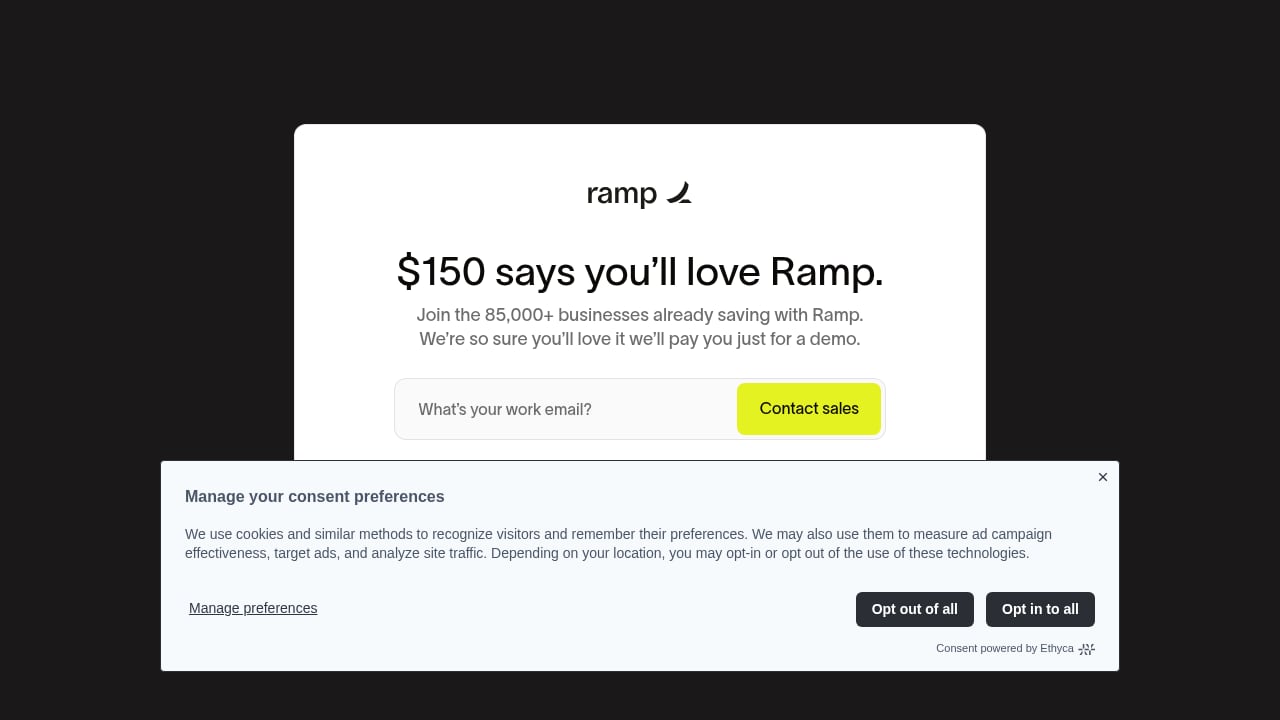
First viewport screenshot of ramp.com.
Cardfornia: stablecoin-funded cards with self-custody
Cardfornia is built around a specific problem: businesses and AI agents need to pay for digital services, but the funds sit in stablecoins. The platform lets you top up a single account with USDT or USDC into your own self-custodied wallet, then issue virtual cards against that balance. Funds move directly to a dedicated sub-account with a licensed card provider rather than passing through Cardfornia, so you keep control of your keys.
The control layer is where Cardfornia differentiates. You can whitelist merchants, set authorization windows down to the minute, and review full audit logs of every transaction. That matters when an AI agent is autonomously paying for API credits or ad campaigns and you need a hard boundary on where money can go.
Cardfornia reports average monthly volumes per card by use case: roughly $200+ for AI tool subscriptions such as ChatGPT, Claude, and Cursor, $2,800+ for digital ads on Meta, Google, TikTok, and AppLovin, and $150+ for SaaS platforms like AWS, Azure, and Google Cloud. The company is incorporated in Singapore as CARDFORNIA PTE. LTD., and its team is certified to ISO/IEC 27001, with licensed white-label partners holding MSO, API, MSB, and MTL licenses.
Ramp: spend management and finance automation
Ramp combines corporate cards, travel and expense management, accounts payable, accounting automation, and business banking into one system. Its strength is breadth inside the finance function. AI agents handle receipt collection, invoice extraction, approval routing, and expense coding, and the platform integrates with QuickBooks Online and Xero.
Ramp's commercial model is a major part of its appeal. It offers a free plan and paid tiers, underwrites against revenue or cash balance rather than personal credit, and publishes its pricing — unusual transparency in this category. The company reports 85,000+ businesses on the platform, with customers including ElevenLabs, Perplexity, AngelList, and the Denver Broncos. Case studies cite 400 hours per month saved at Barry's, a close that finished 19 days faster at Agemark, and $2M+ saved at ABB Optical.
For a finance team whose core problem is receipt chaos, approval bottlenecks, and slow month-end close, Ramp is a strong fit. What it does not do is let you fund card spend directly from a self-custodied stablecoin wallet.
Digitap: crypto banking in a single app
Digitap positions itself as an all-in-one crypto bank rather than a pure exchange or on-ramp. It combines multi-currency fiat accounts, multi-chain crypto wallets, and instant conversion in one mobile app on iOS and Android. Users can hold, move, and spend both fiat and digital assets, with a Visa debit card that offers rewards and cashback.
The app supports 100+ cryptocurrencies and 20+ fiat currencies. Tiered subscription plans lower fees, raise limits, and add priority support across crypto buys, swaps, and fiat cash-outs, upgradeable as usage grows. Digitap also runs a $TAP token presale and publishes comparison content against Binance, Revolut, Wise, and others, positioning itself as a crypto-native alternative to banking-first apps.
Digitap's value proposition is unification: trading, managing, and spending crypto without jumping between apps. For an individual or a small team that wants a single consumer-style account with a debit card, that is a coherent offer. It is less oriented toward the granular merchant-level controls a business needs when software agents are spending money autonomously.
Where Cardfornia has a supported advantage

First viewport screenshot of ramp.com.
A fair comparison should only credit Cardfornia where the product context supports it. Three areas stand out.
Self-custodied stablecoin funding
Cardfornia's model keeps funds in your own wallet until they move to a dedicated sub-account with a licensed card provider. Neither Ramp nor Digitap is built around self-custodied stablecoin top-ups for card spend. If your treasury already runs on USDT or USDC and you do not want to convert to fiat before issuing cards, Cardfornia is designed for exactly that flow. For a deeper look at how stablecoin rails connect to card issuance, see our guide to stablecoin-powered financial infrastructure platforms.
Merchant whitelisting and minute-level authorization
Cardfornia's controls are built for a world where non-human spenders exist. Merchant whitelisting restricts where a card can be used, minute-level authorization limits when, and audit logs record everything. Ramp offers configurable approval workflows and automated fraud checks, which are strong for human employee spend, but its controls are oriented around expense policy rather than agent-level merchant boundaries. Digitap's controls are consumer-oriented. For teams deploying AI agents that pay for tools, ads, or cloud infrastructure, Cardfornia's model is more directly aligned. Our guide to crypto dollar payments for AI agents walks through the setup.
Card issuance at scale for digital spend categories
Cardfornia is explicitly built for high-volume digital purchases: AI subscriptions, ad platforms, SaaS, and global travel. The reported average monthly volumes per card by category give a realistic picture of what teams actually spend. If your card program exists mainly to pay Meta, Google, AWS, and OpenAI, Cardfornia's design targets that use case directly. Ramp also supports unlimited virtual cards, so the distinction is less about card count and more about funding source and control granularity.
Where Ramp and Digitap are the better choice

First viewport screenshot of digitap.app.
Choose Ramp if finance operations are the bottleneck
If your pain is receipt collection, approval chains, accounts payable, and month-end close, Ramp is the more complete answer. Its accounting integrations, AP payment rails (ACH, card, check, wire), and travel policies are built for finance teams at companies from early-stage startups to global enterprises. The free tier and published pricing make it easy to evaluate. For a detailed breakdown, read our Ramp review for 2026.
Choose Digitap if you want one consumer-style crypto account
If you are an individual or a small operator who wants to buy, swap, hold, and spend crypto and fiat from one mobile app with a Visa debit card and cashback, Digitap's unified model is simpler than stitching together an exchange, a wallet, and a separate card. Its tiered plans scale fees and limits with usage, and the $TAP ecosystem adds rewards that pure on-ramps do not offer.
Decision framework: match the platform to the job
Use these questions to narrow the choice:
- Where does your money sit today? If it is in USDT or USDC and you want to keep custody, Cardfornia is built for that. If it is in a business bank account, Ramp's underwriting model fits. If it is spread across fiat and crypto in a personal-style account, Digitap unifies it.
- Who or what is spending? Human employees following expense policy point to Ramp. AI agents making autonomous payments point to Cardfornia. Individual spending points to Digitap.
- How granular do controls need to be? Merchant-level whitelisting and minute-level authorization are Cardfornia's strength. Approval workflows and receipt automation are Ramp's. Digitap offers plan-based limits.
- What does your month-end look like? If close speed and accounting sync dominate, Ramp's automation is the differentiator. If audit trails for agent spend matter more, Cardfornia's logs are the relevant feature.
- Do you need travel and AP in the same system? Ramp covers both. Cardfornia covers global purchases including travel but is not an AP suite. Digitap is not an AP tool.
Many crypto-native businesses end up running more than one platform: Ramp or a similar tool for fiat payroll and AP, and Cardfornia for stablecoin-funded digital spend. That is a legitimate architecture, not a compromise.
Practical examples
An AI startup paying for model access. The team holds USDC from a fundraise and needs to pay OpenAI, Anthropic, and Cursor monthly. Cardfornia lets them issue a card per tool, whitelist the merchant, and cap authorization windows. Spend lands in audit logs the finance lead reviews weekly.
A performance marketing agency. Ad spend across Meta, Google, and TikTok runs into thousands per card per month. Cardfornia's stablecoin funding avoids repeated fiat conversions, and merchant whitelisting prevents a compromised card from being used elsewhere.
A 200-person SaaS company. Finance needs receipt matching, approval routing, and QuickBooks sync. Ramp's automation handles the workflow, and the free tier keeps software costs low while the team scales.
A freelancer working across currencies. Income arrives in crypto and fiat. Digitap's multi-currency accounts and Visa debit card let them convert and spend without maintaining separate accounts.
Related reading
- Cardfornia vs Bitsa Card: Which Crypto Card Fits? - Cardfornia vs Bitsa Card: compare self-custody, AI agent payments, fees, cashback, and global coverage to pick the right crypto card for business or everyday spend.
- Marqeta Review 2026: Card Issuing, Pricing & Fit - Evidence-based Marqeta review for 2026: ideal users, card issuing and processing use cases, strengths, limitations, pricing signals, setup, and decision criteria.
- How to Use Cardfornia with BVNK for Stablecoin Card Payments - Connect Cardfornia's self-custody AI payment cards with BVNK's stablecoin rails. Step-by-step setup, workflow, examples, and limits.
Sources and further reading
- Digitap vs Ramp: The Full Crypto Bank vs The Simple On-Ramp - Compare Digitap and Ramp Network. Ramp makes buying crypto simple, while Digitap is the all-in-one crypto bank where you can buy, swap, and spend digital assets with an integrated wallet and Visa card rewards.
- 11 Best Ramp Alternatives for Startups in 2026 - We researched and ranked best Ramp alternatives based on features, pricing, and usability for startups. Find the right financial tool for your needs.
- 8 Best Ramp Alternatives and Competitors for Corporate Cards (2026) - Ramp is the highest-rated platform in this category and the wrong fit for some of the companies evaluating it. Here's what the eight credible alternatives are actually built for.
FAQ
Is Cardfornia a replacement for Ramp?
Not generally. Ramp is a spend management and finance automation platform; Cardfornia is a stablecoin-funded card platform for AI agents and business payments. They can complement each other, with Ramp handling fiat AP and accounting and Cardfornia handling crypto-funded digital spend.
Does Ramp support crypto funding?
Ramp's model is built around corporate cards underwritten against revenue or cash balance, with fiat payment rails. It is not designed around self-custodied stablecoin top-ups.
Can Digitap be used for business payments?
Digitap supports business accounts and global payments from a single wallet and Visa debit card, but its controls and positioning are consumer-oriented. Businesses needing merchant-level whitelisting and audit logs for agent spend should evaluate Cardfornia.
Which platform is best for AI agent payments?
Cardfornia is purpose-built for autonomous AI payments, with merchant whitelisting, minute-level authorization, and full audit logs. Ramp's AI automates finance workflows rather than agent spending, and Digitap does not target agent payments.
Do I need to convert stablecoins to fiat before using Cardfornia?
No. You top up with USDT or USDC into your self-custodied wallet, and funds move to a dedicated sub-account with a licensed card provider when cards are used.
Is Cardfornia regulated?
The team is certified to ISO/IEC 27001, and licensed white-label partners hold MSO, API, MSB, and MTL licenses. Cardfornia is incorporated in Singapore as CARDFORNIA PTE. LTD.
Conclusion
Cardfornia, Ramp, and Digitap are not three versions of the same product. Ramp is the strongest choice when finance operations and accounting automation are the bottleneck. Digitap is the simplest choice for an individual or small team that wants one crypto-and-fiat account with a debit card. Cardfornia is the right fit when your funds are in stablecoins, you want to keep custody, and you need merchant-level controls and audit trails for business or AI agent spending. Start with where your money sits and who is spending it — the platform choice usually follows.
For a closer look at how Cardfornia compares with other crypto cards, see our comparison of Cardfornia vs KAST.