
Cardfornia vs Airwallex vs Gnosis Pay: 2026 Comparison

Cardfornia vs Airwallex vs Gnosis Pay: Which Payment Platform Fits Your Business?
Businesses that need to move money globally now face a crowded field of payment platforms. Cardfornia, Airwallex, and Gnosis Pay all issue cards and support cross-border spending, but they solve different problems. Airwallex is built for traditional global commerce and treasury. Gnosis Pay provides white-label infrastructure for stablecoin card programs. Cardfornia focuses on self-custodied stablecoin funding and controlled card payments for AI agents and business spend.
This comparison breaks down where each platform is strong, where it falls short, and which use cases map to which tool. The goal is not to crown a single winner but to help you match the platform to your operating model.
Quick comparison at a glance
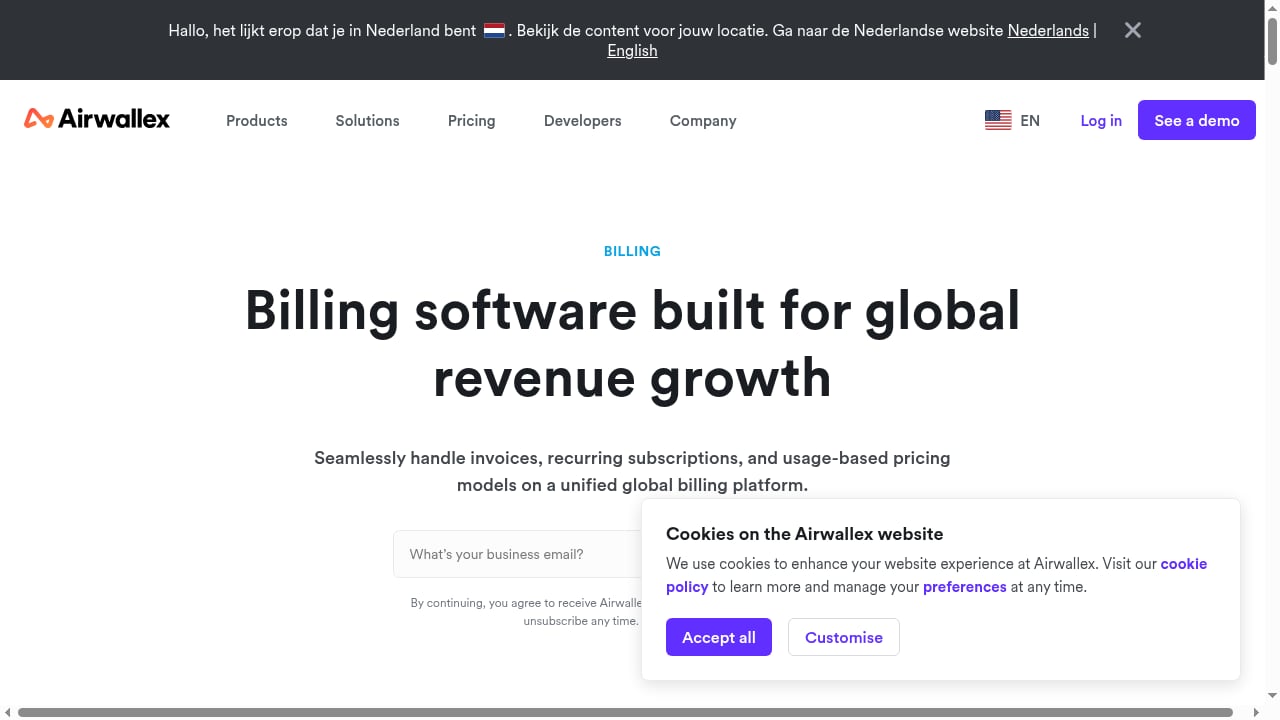
First viewport screenshot of www.airwallex.com.
| Criteria | Cardfornia | Airwallex | Gnosis Pay |
|---|---|---|---|
| Primary model | Stablecoin-funded virtual cards for AI agents and businesses | Global business accounts, payments, treasury, and spend management | White-label stablecoin card program infrastructure |
| Custody | Self-custodied funds; users hold keys | Platform-held accounts with partner banks | Self-custodial card model with enterprise program management |
| Card issuance | Dynamic issuance at scale with merchant whitelisting | Unlimited Visa corporate cards | Instant branded Visa debit card deployment |
| Best fit | Crypto-native teams paying AI tools, ads, SaaS, and travel | Businesses consolidating multi-currency operations and acquiring | Wallets and fintechs launching their own card programs |
| Notable proof points | Average monthly volumes per card by use case | 20+ currencies, 120+ payout countries, 160+ local payment methods | $209.5M volume processed, 3.9M transactions, 84.6K accounts |
What Airwallex does well
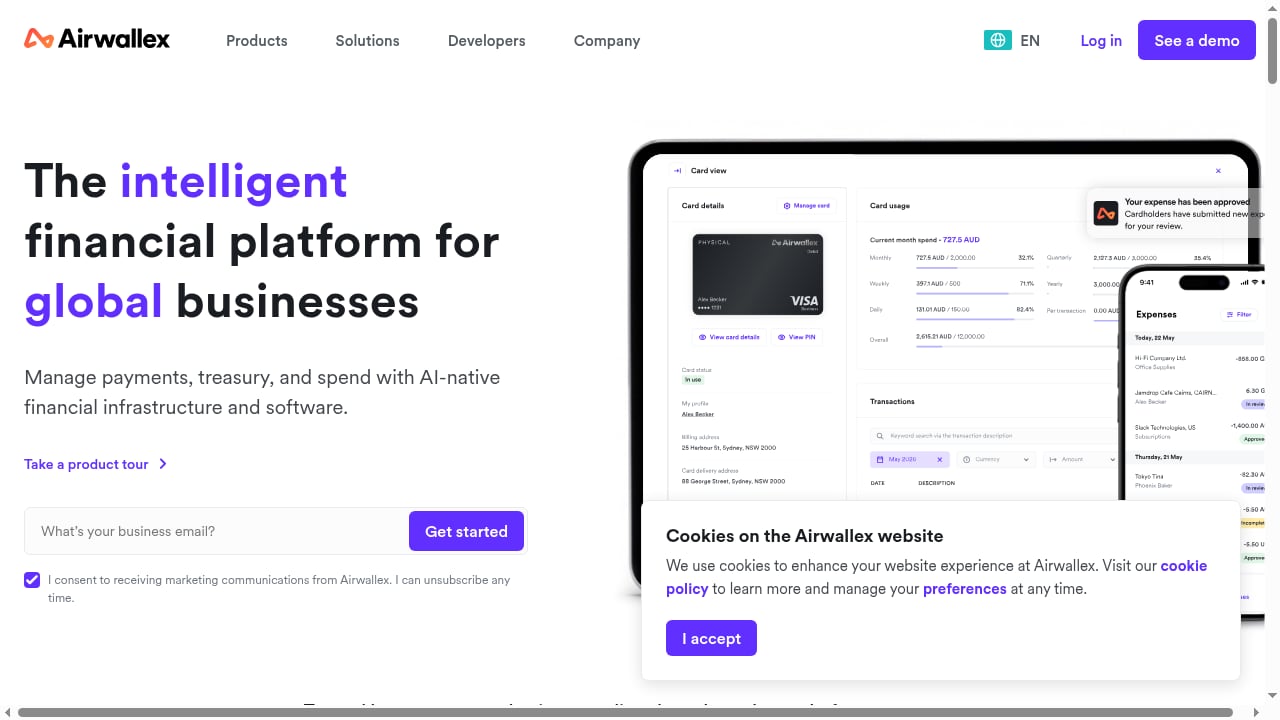
First viewport screenshot of www.airwallex.com.
Airwallex has built a broad financial operating system for global businesses. Its core strength is consolidation: a single platform for holding 20+ currencies, sending bulk transfers to 120+ countries, and accessing interbank FX rates. Businesses with entities in multiple markets can manage them from one dashboard rather than stitching together local bank accounts.
On the spend side, Airwallex offers unlimited Visa corporate cards, expense submissions, and reimbursements. Its acquiring product accepts online card payments and 160+ local payment methods, and Airwallex Billing handles invoicing, subscriptions, and usage-based billing for multi-entity companies. Pricing includes a free Explore plan and paid tiers, with custom pricing for Platform API and embedded finance.
The platform is a strong fit for e-commerce businesses selling across borders, mid-market companies that want like-for-like settlement in the original currency, and finance teams that need treasury and spend management in one place. Airwallex reports compliance with PCI DSS, SOC1, and SOC2 standards and holds customer funds with FDIC-insured partner banks in the US.
Where Airwallex is less suited: it is designed around registered businesses, not sole traders or personal accounts. Its feature depth can mean a steeper learning curve, and some capabilities are plan-dependent. For teams whose funding source is stablecoins held in self-custody, Airwallex is not built around that workflow.
What Gnosis Pay does well
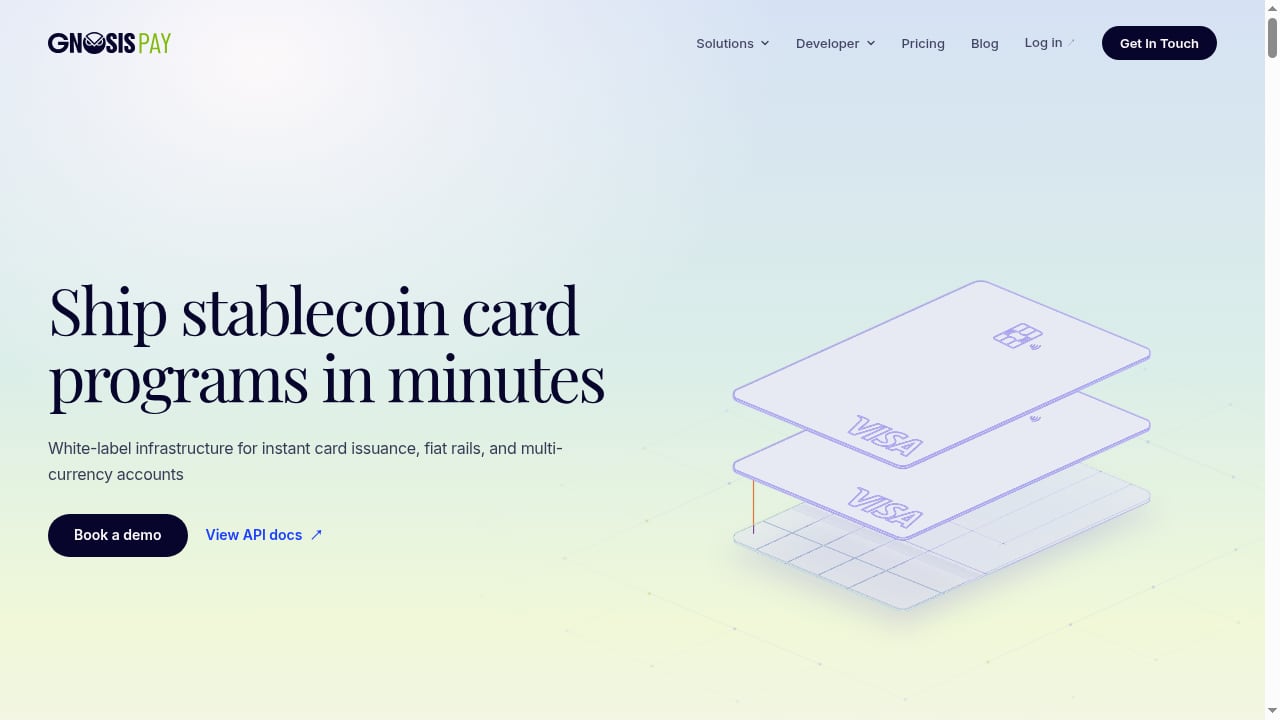
First viewport screenshot of gnosispay.com.
Gnosis Pay has evolved from a self-custodial Visa card into an enterprise-grade card program manager. Its value is infrastructure: wallets and fintechs can launch branded Visa debit cards, fiat rails, and multi-currency accounts without building the stack themselves. Integration with traditional banking rails such as IBAN, ACH, Pix, and sort codes makes it useful for companies that want to bridge on-chain balances with everyday card spending.
Gnosis Pay reports over $209.5 million in volume processed, 3.9 million transactions, 84.6 thousand accounts deployed, and acceptance at more than 115 thousand merchants. Features include instant card deployment, global coverage, card program management, and fiat on/off-ramp orchestration through Gnosis Ramp (beta). Its positioning centers on self-custody and removing barriers between traditional finance and DeFi.
This makes Gnosis Pay a strong choice for wallet providers, fintech startups, and platforms that want to offer card issuance to their own users under their own brand. The trade-off is that it is primarily a program management layer. A business that simply wants to pay its own AI subscriptions, ad accounts, and SaaS bills may find the infrastructure model heavier than necessary, and the platform assumes a certain level of technical integration.
Where Cardfornia stands apart
Cardfornia is built for a narrower but fast-growing problem: paying for digital services and autonomous AI agent activity using stablecoins, without giving up control of funds.
Self-custody without losing card functionality
Businesses top up a single account with USDT or USDC into their own self-custodied wallet. Funds move directly to a dedicated sub-account with a licensed card provider and never pass through Cardfornia. Users hold their own keys while still getting stable, high-limit card payments. This matters for crypto-native teams that want card convenience without counterparty custody risk.
Controls designed for AI agent payments
AI agents now make recurring purchases on their own: model subscriptions such as ChatGPT, Claude, and Cursor, cloud infrastructure on AWS, Azure, or Google Cloud, and digital ads on Meta, Google, TikTok, and AppLovin. Cardfornia supports dynamic card issuance, merchant whitelisting, minute-level authorization, and full audit logs, so each agent or team can be given a card with defined limits and permitted merchants. That reduces the risk of unexpected charges and account bans that can hit shared or unstable card numbers.
Practical volume benchmarks
Cardfornia publishes average monthly volumes per card by use case: $200+ for AI tools, $2,800+ for ads, and $150+ for SaaS. These figures help finance teams sanity-check limits before issuing cards at scale.
Security and licensing posture
The team is certified to ISO/IEC 27001, and licensed white-label partners hold MSO, API, MSB, and MTL licenses. Cardfornia is incorporated in Singapore as CARDFORNIA PTE. LTD. and targets crypto-native users and globally scaling businesses.
For a deeper look at how stablecoin funding works with hardware wallets, see how to use Cardfornia with Ledger. For the AI agent use case specifically, read the crypto dollar payments for AI agents guide.
Head-to-head by decision criteria

Gnosis Pay product interface.
Funding source and custody
If your capital sits in a bank account and you want multi-currency treasury, Airwallex is the natural fit. If you are building a card program for your own users, Gnosis Pay provides the rails. If your working capital is in USDT or USDC and you want to keep self-custody while issuing cards, Cardfornia is purpose-built for that model.
Card issuance and control
Airwallex offers unlimited corporate cards with expense workflows, which suits traditional team spend. Gnosis Pay enables branded card programs for platforms. Cardfornia emphasizes dynamic issuance, merchant whitelisting, and minute-level authorization, which is most valuable when cards are assigned to software agents or tightly scoped budgets rather than people.
Global payments and FX
Airwallex is the strongest of the three for multi-currency accounts, FX at interbank rates, and accepting local payment methods. Gnosis Pay supports multi-currency accounts and local rails for program partners. Cardfornia is focused on card payments and stablecoin funding rather than being a full acquiring or treasury platform.
Compliance and transparency
All three publish meaningful compliance signals. Airwallex cites PCI DSS, SOC1, and SOC2. Gnosis Pay publishes transaction and account metrics. Cardfornia cites ISO/IEC 27001 certification and licensed white-label partners with MSO, API, MSB, and MTL licenses. Buyers should verify current licensing for their jurisdiction directly with each provider.
Use case fit
- Choose Airwallex if you run a global business that needs multi-currency accounts, FX savings, acquiring, and corporate cards in one platform.
- Choose Gnosis Pay if you are a wallet or fintech launching a branded stablecoin card program and need program management plus fiat rails.
- Choose Cardfornia if you are a crypto-native business or AI agent operator that wants self-custodied stablecoin funding, scalable virtual card issuance, and granular merchant controls.
How to decide in practice
Start with where your money lives. Bank-held fiat points to Airwallex. On-chain stablecoins in self-custody point to Cardfornia or Gnosis Pay, depending on whether you are issuing cards for your own operations or for your customers. Then check the control layer: if you need per-agent limits and merchant whitelists, prioritize platforms that expose those controls. Finally, confirm licensing and compliance coverage for every jurisdiction you operate in.
For a broader view of regulated infrastructure options, see the top 10 regulated fintech and digital asset platforms for 2026. If you are also weighing traditional spend management tools, the Ramp review for 2026 offers a useful benchmark.
Related reading
- Cardfornia vs KAST: Which Stablecoin Card Fits Your Business? - Cardfornia vs KAST: compare self-custody, AI agent payments, cashback, yield, licensing, and control to pick the right stablecoin card platform.
Frequently asked questions
Is Cardfornia a bank or a card issuer?
Cardfornia is a platform that connects self-custodied stablecoin funding to cards issued through licensed white-label partners. It is incorporated in Singapore as CARDFORNIA PTE. LTD. and is not itself a bank.
Can Airwallex handle stablecoin funding?
Airwallex is built around traditional business accounts and fiat currencies. Its published capabilities focus on multi-currency accounts, FX, payouts, acquiring, and corporate cards rather than self-custodied stablecoin funding.
Who should use Gnosis Pay instead of Cardfornia?
Gnosis Pay is best for wallets and fintechs that want to launch their own branded card program with fiat rails. Cardfornia is better suited to businesses that want to pay their own AI tools, ads, and SaaS bills from self-custodied stablecoins.
Which platform is best for AI agent payments?
Cardfornia is designed around this use case, with dynamic card issuance, merchant whitelisting, minute-level authorization, and audit logs. Airwallex and Gnosis Pay are not positioned primarily around autonomous agent spending.
Do all three platforms support global card acceptance?
Each platform reports broad card acceptance through its card network partners. Exact coverage and limits depend on the issuing partner and the jurisdiction, so confirm details during onboarding.
Conclusion
Cardfornia, Airwallex, and Gnosis Pay are not direct substitutes for every buyer. Airwallex is the strongest choice for traditional global businesses that want treasury, FX, acquiring, and corporate cards in one place. Gnosis Pay is a capable infrastructure partner for companies launching stablecoin card programs. Cardfornia occupies a distinct niche: self-custodied stablecoin funding with tightly controlled virtual cards built for AI agents and business spend. Match the platform to where your funds sit and how much control you need over each transaction, and the decision becomes much clearer.
Sources: Airwallex payment processors guide, Airwallex payment processing systems, Airwallex alternatives overview.